Terrick Terrick National Park, Victoria, 22nd December 2013, VKFF – 630

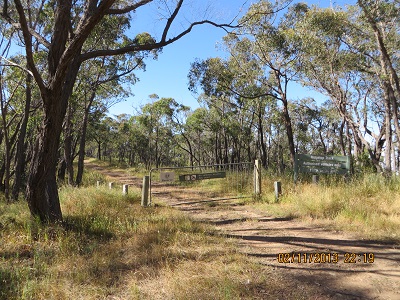
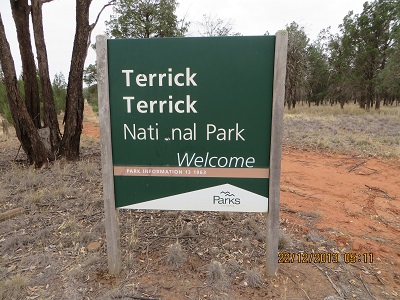
Terrick Terrick National Park entrance

Terrick Terrick National Park entrance

After enjoying a number of contacts with activators in Terrick Terrick National Park over the past year or so, today it was my turn to become an activator. I drove into the day visitor area at the base of Mount Terrick Terrick, about one and a half kilometres into the Park from the Southern access point. It is a beautiful spot in a most interesting park. Terrick Terrick National Park was created by gazettal in 1998. Its first ten years was as a State Park. I am assuming that this means it had a lesser status then. This is the first National Park in Australia’s Riverina bioregion according to the Parks Victoria brochure. What is immediately obvious to visitors is the White Cypress Pine Forest.

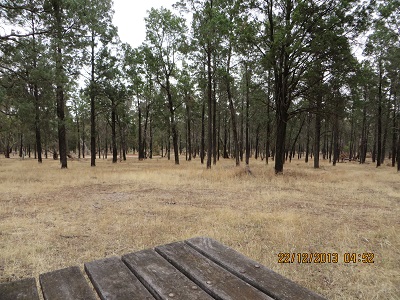
White Cyprus Pines from the operating position

White Cyprus Pines from the operating position

It was a warm day with high humidity and not unpleasant. Every now and then during my activation there was a light sprinkling of rain, but not enough to be a nuisance. I set up my station on a Park picnic table and had the whole place to myself.

My first contact was with VK2TWR/p and QRP, Rod, on Mount Townsend, VK2/SM 002. Both our signals were 5 and 7 at 0330 UTC. I was delighted to have such an enjoyable contact and earn a few more points as a chaser. Then followed VK3SE, Steve; VK5PAS, Paul who kindly alerted all and sundry, thanks Paul; VK5FMID, Brian; VK5KC, David; VK5EE, Tom; VK3XPT/p and QRP, Perrin, near but not in the Wilson’s Promontory National Park. Watch out for Perrin over the next few days as he will be in the Park and activating two summits. I enjoyed quite a chat with Perrin before more contacts: VK5LY, Larry; VK5WG, Nev; VK3JP, Ron; VK5FMID, Brian again and finally VK3FAVE, Andrew from Nyah West, making 12 contacts for the day.

I have now activated four Victorian National Parks and am aiming for ten!

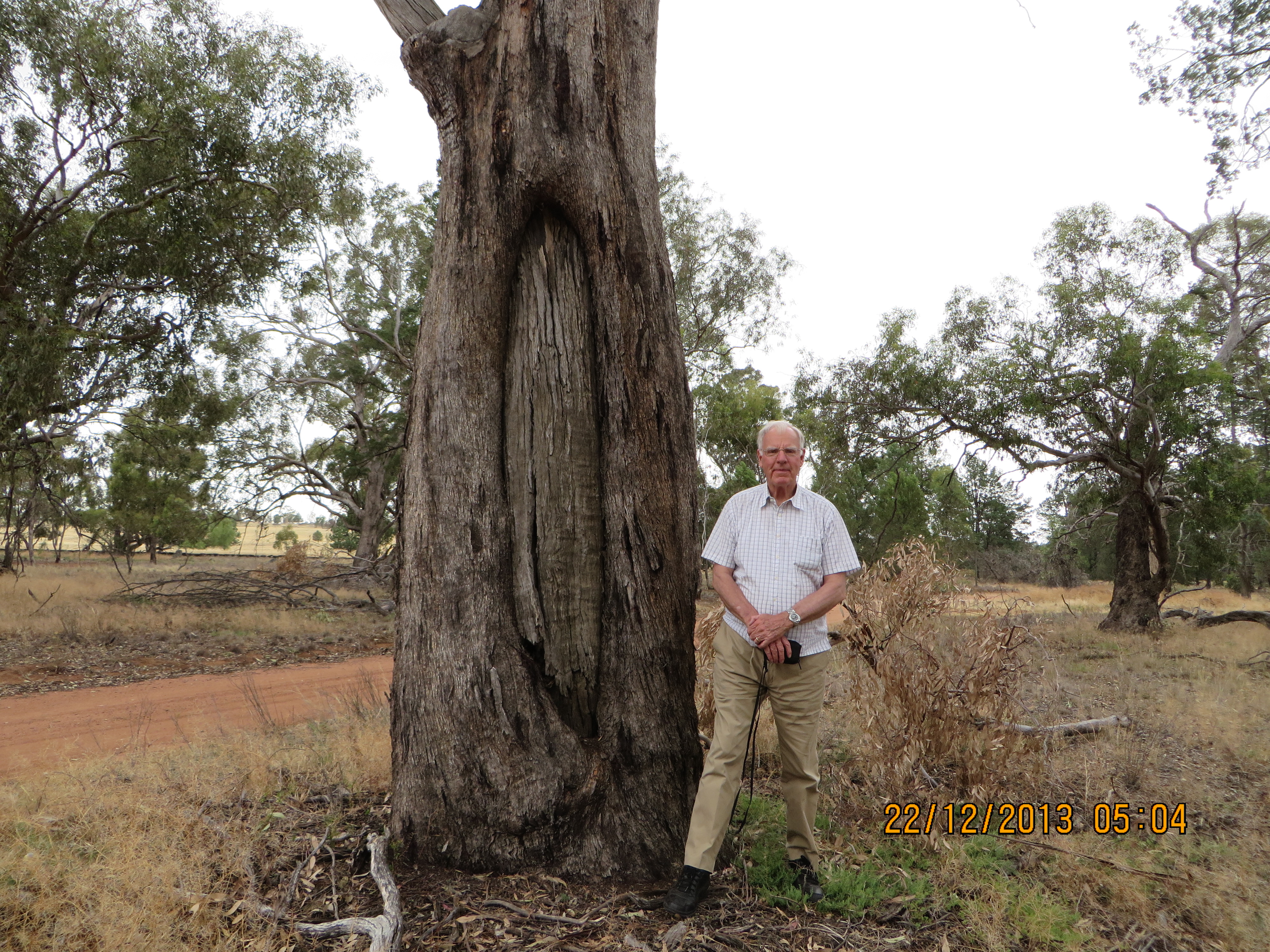
VK5BJE near canoe tree Terrick Terrick National Park

VK5BJE near canoe tree Terrick Terrick National Park

This tree has an identical scar on the opposite side from me indicating that it was perceived as valuable by the earlier inhabitants of this land and, perhaps, that such trees were not overly common in the area.

Peebinga Conservation Park, 21st December 2013

After my reasonably successful activation of Karte CP, I moved onto Peebinga Conservation Park. While I thought the band sounded in reasonable shape, there were few signals. Perhaps people were visiting their local shopping centres or engaging in sporting activities or perhaps contemplating Christmas?

Any way after tuning up and down the band and doing a fair bit of listening and then calling CQ on 7.100 I decided, out of desperation, to call into a group on 7055. There was a group at work. I apologised for calling in – but isn’t amateur radio about doing just that? Thanks to VK3OL, Jim at Bendigo, whose 5 and 9 signal was very enticing I gained a successful contact. Jim gave me a 5 and 1. I copied other members of his group, VK3YG, Pete from Lake Glenmaggie, where I have been camping in an earlier life; VK7RP/p2 5 and 7; and VK2ATY, from Albury, 5 and 7.

What is the lesson for the day? Post one’s intentions in advance  if at all possible.

Karte Conservation Park, 21st December 2013

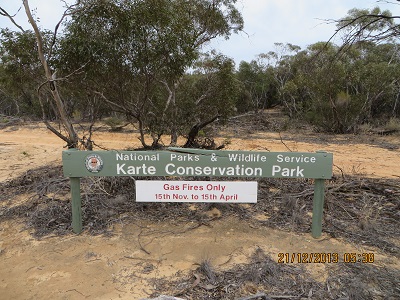
On 21 December 2013 on my way to Sydney to see my son I thought I would activate Karte Conservation Park. This park is about 30k North West of Pinnaroo. I called CQ on 7100 for a while and there were no takers. There were quite good signals up and own the band. I apologise for not posting my intentions – but I wasn’t  sure what time I would get to Pinnaroo or whether I would be able to activate these Parks with Christmas looming! I was delighted to work VK5AV, Tim from Mount Gambier , at 04:29 UTC, who kindly posted on the parks and summits site that I was in Karte CP. He also gave a call over the South East Radio Group’s repeater system and I soon had contacts with VK5HCF, Col; VK5WG, Nev; VK3GFS, Frank; VK5EE, Tom and VK5BW, Barry. The 40m band seemed pretty good and my reports were encouraging, except from Col, who gave me a 3 by 3. I was able to congratulate Nev on his elevation to Sainthood, I mean Slothdom! I am envious with a long way to go!

Karte Conservation Park

Karte Conservation Park

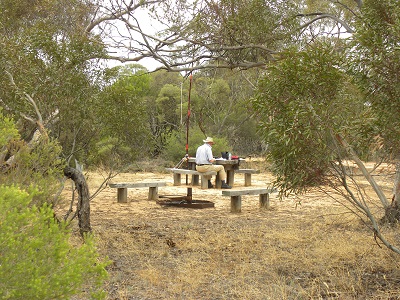
Karte Conservation Park: at work JCD picture

Karte Conservation Park: at work JCD picture

Publicising Amateur Radio

Yesterday, 11th December 2013, VK5KC, David, President of the Adelaide Hills Amateur Radio Society Inc., (AHARS) and I, attended the Blackwood High School to present two awards to students in year nine. The awards are for achievement in the areas of science and technology. You can see more details in my 2012 report below. This is the second year that our Society has made these awards available. This year two young male students, Mr X and Mr Y won the awards. The Senior Leader for the School in this area stated, ‘…these two students have demonstrated excellence in both achievement and commitment within the areas of Science & Technology. In addition to outstanding achievements in these two learning areas in terms of their grades, they have also achieved the following: (they have) participated in two science competitions (ICAS  http://www.eaa.unsw.edu.au/icas/about and Big Science) achieving High distinctions and for the ICAS they completed the Yr 10 competition and achieved High Distinctions. They are both accelerated into Yr 10 science and achieving A’s at this level. (Both) students participated in the UNSW Science and Engineering challenge (and) were selected for and attended the Siemens Science experience at Flinders university. (They) both attended the Flinders University engineering expo. (Finally, they achieved) outstanding results (high A’S) in their yr 9 electronics courses’.

I had a chance to speak with both students after assembly and Mr Y told me he likes making kits and soldering. Except for the great results and the much improved opportunities for students now, I could see something of my past!

I attended Devonport High School. I was in year nine in 1956 – the year television transmissions began in Sydney and Melbourne. I watched flickering images of the Melbourne Olympics in Devonport. I did not know about tropospheric ducting then, except that signals in Devonport were better in North Easterly weather!  I was building crystal sets and one and two valve regenerative receivers. I also did not know that I would eventually begin on a path of formal life-long learning, something that has enriched my life beyond measure. It is very difficult to imagine what the world will be like when these young men are at my age! I wonder whether they will be chasing SOTA contacts and working QRP from National Parks?

Here is my report from the Adelaide Hills Amateur Radio Society Inc March 2013  Newsletter, p. 4.

On a very hot Wednesday afternoon, December 12th, at 1.30 David Clegg (VK5KC) and I (VK5BJE) returned to school. No, it is not because we can’t spell! David originally attended High School between 1962 and 1965 and, for me, 1954 to 1957. But this time we went to Blackwood High School.  Our purpose was to represent our Society at the presentation day for year 8 and 9 students as they complete their work for the year. We were warmly greeted by the Principal of the School, Ms Marion Coady and then set off on a short walk to the Hall were the students were gathered.

The Society’s criteria for selection of students are:

In year 8 or 9 at Blackwood High School

Demonstrated interest in electronics

Commitment to their science and technology studies

Interest in pursuing science and technology as an area of interest.

The appropriate discipline teachers are responsible for making decisions about the successful students.

The formalities were quite informal but orderly. How different from my day! David was invited to present the inaugural awards to the recipients.

(Ms K) produced an excellent report on the history of radio, as part of her work in a Year 9 science class this year.

‘When I first heard we were going to be choosing a specific piece of technology and tracking its progress and evolution, the first thing that popped into my mind was the radio. I am fascinated by Nicola Tesla – one of the closest examples to pure genius this world has ever had the honour of knowing – and his struggles to be recognised as the inventor of the radio.’

The second recipient was (Mr I). ‘ (Mr I) represented the school at the Southern Science Expo during Science week  2012. He was selected to go because of his interest in electronics and commitment to studying Electro-technology and Science in the future’.

The awards are a framed certificate and a $50 voucher for use at one of three retailers including the Society’s sponsor, Aztronics, or the Wireless Institute of Australia book shop or a commercial retailer.

For these young students beginning the early adult life-long journey of learning, the Society hopes that its awards will recognise outstanding achievement among their peers as well as encourage them in their endeavours. The Society aims for its awards to highlight its work at the school, as well as bring a new awareness of our hobby as a potential learning ground for some young people aspiring for a scientific, technical or engineering career. The awards may also demonstrate that amateur radio can be a satisfying, enriching and life-long hobby pursuit for those who undertake employment in different arenas.  David and I represent both these pathways.

We enjoyed the afternoon, sharing with the students their triumphs and were proud to represent the AHARS at this important event.

John Dawes VK5BJE

13th December 2012

Mt Lofty, VK5-SE-005, a night time activation with VK5PAS/p, 6th November 2013

Paul suggested to me through the day that he was going to activate Mt Lofty at night. It was predicted to be a warm night and that is how it turned out. He invited me to come along. I could not resist. We shared his gear although I had three batteries in the car, two not used and antennas, squid pole and transceivers: all my gear from Port Gawler Conservation Park. I arrived at Mount Lofty at about 1900 hours local and Paul already had an impressive list of contacts in his log. He invited my to activate Mt Lofty, which is also in Cleland Conservation Park. I got to work and the following contacts were made on 7090 beginning at 08:52: VK3AMB, Bernard; VK5CZ, Ian; VK2JI, Ed; VK3YE/ pedestrian mobile, Peter; VK3OHM, Mark; VK3XL, Mike; VK2YK, Adam; VK3MRG/p, Marshall in his back yard; VK3FBCK, QRP, Nick; VK3ARR, Andrew; VK5MBD, Bill; VK3MRG, Marshall, QRO and VK2IWO, Romesh.  Later in the evening on the 7.130 net, I had contacts with VK5MJ, Mal; VK2HAA, Dennis; VK7DON, Don; VK4TH, Andy; ZL2ASH, Brian and VK7ROY, Roy. I did try to call FO5JV, William at Tahiti, but conditions had changed. Paul had a successful contact with William earlier in the evening: it was a highlight of a great evening. I enjoyed my 19 contacts and wish to thank all who gave me a call. I have now completed three SOTA activations.

Here is a link to Paul’s splendid video of the activation: http://youtu.be/nV6MNznDfYA

Port Gawler Conservation Park, 6th November 2013

My radio day had a second beginning on Wednesday, (the first was at 08:00 local with the 7073 net) when I received a message on my phone from VK5PAS/p, Paul. The message arrived at 10:43 am local time and indicated that Paul was activating Black Hill Conservation Park. I raced into the shack and was able to work him on 7100. This inspired me into action! I was about to leave the house anyway because of the fire danger rating in the Adelaide Hills. I thought I should also activate a park. I chose Port Gawler Conservation Park because it is on the Adelaide Plains, about 32 kilometres North West of Adelaide, near the coast and away from the hills. In the rush I forgot my camera! So I took the coordinates of my operating position: S 04 39 155 and E 108 26 786. I chose this spot away from the end of Port Gawler road to avoid parking in the turning circle.  Port Gawler can be accessed from Highway One.

Port Gawler conserves coastal mangroves which in turn provide breeding habitat for local fish species so prized in South Australia. As I drove into the park down Port Gawler Road I kept seeing signs suggesting the park is patrolled frequently. As I was researching this park prior to my activation I came across a report of vandalism and use of the park for non-approved purposes http://www.plainsproducer.com.au/?p=513  Nevertheless all was quiet during my visit. A few cars were heard on Port Gawler Road but I was off on the northern side three or four hundred metres away.

I used a fence post to secure my squid pole and it was a pretty good spot: except for the flies. I had the following contacts beginning at 03:08: VK5PAS, Paul now back at his home; VK5YX, Hans; VK3BWZ/p, Bob at Merino; VK5AV, Tim; VK5KBJ, Barry; VK5MCB, Mike from Port Pirie who I had met at the SOTA lunch at Gawler; VK5FCLK, Chubba; VK5EE, Tom; VK5FMID, Brian; VK3BWZ/p, Bob for a second contact; VK5PAS, Paul; VK5DJ, John and VK5ATQ, Trevor. Thirteen contacts in what I thought were pretty reasonable conditions on 40m, given the propagation upheavals of recent days.

An alternative to a Buy and Sell

Today in South Australia our most significant ‘ham fest’ takes place which is organised by the Adelaide Hills Amateur Radio Society Inc. Many South Australian amateurs make their way to the Goodwood Community Centre. So do some from interstate: amateur suppliers and specialists with their cars and trailers loaded up with ‘goodies’. The motivations for the pilgrimages are varied: for some it is to purchase a new transceiver or a desirable bit of extra gear for the shack. For others it is to carefully search out someone’s no longer wanted items for something that will find a new home with a new owner. For others it is to share a special interest, for example, SOTA; DStar or the VK5 National and Conservation Park award and try and win others to these special interests.  And for still others it is a social event frequently followed by lunch at a local eating house!  I normally make this pilgrimage!

This time I could not go. I was required in Clare to play with the Payneham Community Band. We all had a great time on Saturday evening with the local community band. But Sunday was free. I decided I would indulge my amateur radio interest with some visits to parks and one Sota summit. I selected two parks near Clare.

Spring Gully Conservation Park, 3rd November 2013

Spring Gully Conservation Park

Spring Gully Conservation Park

Spring Gully Conservation Park is about 12 kilometres south of Clare. It conserves a beautiful section of local bush, 96 hectares, in an area otherwise used for grazing, cropping and known for riesling and shiraz, among many varieties, the famed Clare wine region. I enjoyed seven contacts: at 22:46 I called CQ and my call was answered by VK5EE, Tom from Mount Gambier; VK5YCP, Chris; VK2AWJ/ QRP, Gol Gol using a KX3; VK3AFW, Ron; VK5FMID, Brian; VK3MRG/p QRP, Marshall on VK3 VN-009 and VK5HS, Ivan, and completing seven contacts before UTC rollover. It was a magnificent morning, sunny and warm and I listened to the WIA broadcast and the local club news and tried to join the call back on 7.135 Mhz. Although local signals were 5 and 9 from Adelaide, none of the Adelaide stations could hear me. It is really a waste of time trying to get heard operating QRP, with such high noise levels for many city stations. After a little over an hour I decided I would dismantle my station and head for Martindale Hall Conservation Park.

Martindale Hall Conservation Park, 3rd November 2013

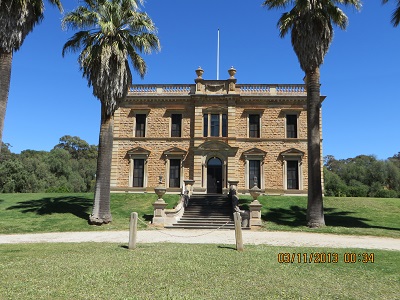
The mansion is not far from the heritage village of Mintaro in the beautiful Clare Valley. Martindale Hall became well known to film goers in 1975 when it was used in Peter Weir’s successful Australian film Picnic at Hanging Rock. There is plenty of material about Martindale Hall on the web and the mansion now functions as a boutique hotel. Opening hours on a Sunday are from 12.00 noon to 1600 hours. I arrived soon after 1100 hours, the weekday opening time. I took a few pictures and set up my station near some trees within the parking area about 150 metres from the mansion. One visitor asked my what I was fishing for: I said radio waves! However, there were not too many about on 40 metres at that time.

Propagation had changed for the worst and signals were attenuated but I still managed three contacts: at 00:54, VK2HF/3, Geoff near Swan Hill; VK5WG, Nev and VK5EE, Tom. I then packed my gear and drove to Auburn for some lunch and then down the Main North Road to Gawler before taking secondary roads to Mount Gawler.

Martindale Hall

Martindale Hall

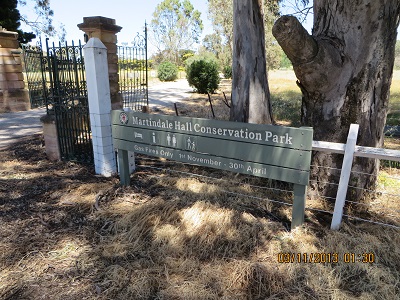
Martindale Hall - entrance and start of the Long Drive

Martindale Hall – entrance and start of the Long Drive

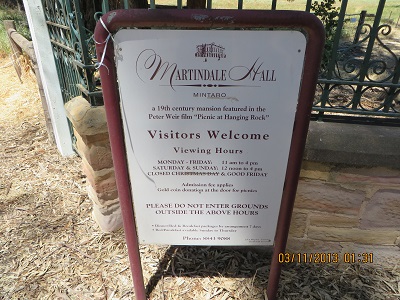
Martindale Hall opening hours

Martindale Hall opening hours

My second Sota Summit, 3rd November 2013

Mt Gawler, VK5 SE-013

I used my vehicle based GPS to navigate from the Clare Valley through the town of Gawler and on to Mount Gawler. I visited parts on SA, especially around Gawler, that I have never seen before!  I then used the Country Fire Service maps to confirm that I had indeed found Mt Gawler. These maps are 1:50 000 and show Mount Gawler being about half way between Airstrip and Richardson Roads on Mount Gawler Road. The map even shows a symbol for the trig point (located on private property just a few metres from the road). Here are the coordinates and altitude measures: 34.78054 138.81216;  DMS 34º 46′ 49.95″ S 138º 48′ 43.79″ E;  Altitude 543.48m. I did quite a bit of looking around on foot and parked my 4 x 4 in a safe place and carried my gear to the activation point.

While I had to move around the 40 metre band a little to secure contacts, I finished with 10 in the log, a reasonable effort given the buy and sell. At 05:05 my first contact was with VK5NWE, Roger; VK5FACE, Andrew; VK5FMID, Brian and then VK5TW, Trevor, making four contacts. Up until this point the going was very slow and propagation poor. I then had contacts in fairly rapid succession with VK5EE, Tom; VK5NFB, Don; VK5CZ/m, Ian driving home from the buy and sell; VK5PAS, Paul; VK3EO, Tom at Swan Hill and VK3GFS/ QRP, Frank at Mount Evelyn.

An Anniversary: six months of SANPCPA, 20th October 2013

Yesterday, while doing some other things around home and keeping a late afternoon appointment, I was able to be a chaser to help celebrate six months of the VK5 National and Conservation Park award program.

Today, I was able to activate three metropolitan conservation parks. I made a concession to the objective of responsible fuel use and, with the aim of successful navigation, I turned on the female voice in my GPS. She really sounds awful! But, I did find the Parks with a minimum of fuss.

I began early with the Hallett Cove Conservation Park. This is a small park is just 51 hectares. It conserves outstanding geological features including glacial pavements and folded rocks. It was proclaimed a conservation park in 1976. Aboriginal artefacts were discovered in the area in 1934 and more that 1700 pieces were collected. I set up my station just inside the main entrance near the information kiosk. I was able to sit near and under some melaleuca trees which provided great shade.

I had contacts with the following stations beginning before UTC rollover at 2240: VK3SAW, Ash, portable in the Grampians National Park with a scout group from Horsham. Ash called me. Then followed VK3YE, Peter as usual pedestrian mobile; VK5LY, Larry, QRP portable in Spring Gully Conservation Park. VK3GRW, Greg in North East Victoria, VK5AV, Tim; VK3BJM, Barry; VK5FAKV, Shawn from Renmark; VK3PF, Peter; VK3MMX, Darren at Harcourt; VK5KGP, Graham; VK5PAS/p, Paul at Minlacowie Conservation Park, my second Park to Park for the activation; VK5TN, Robin; VK5LY/p, Larry; VK3SAT, Lachlan in Central Victoria; VK5ATQ, Trevor and VK5AV, Tim. Sixteen contacts in just under an hour I thought was pretty good. The 40 Metre band seemed to be working well, although the noise floor was higher than I usually experience when in a rural park. All signals were either S8 or S9 with the exception of VK3YE, Peter who I received 5 and 1. I packed up and headed just a few kilometres closer to Adelaide to activate the Marino Conservation Park.
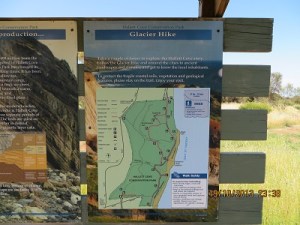
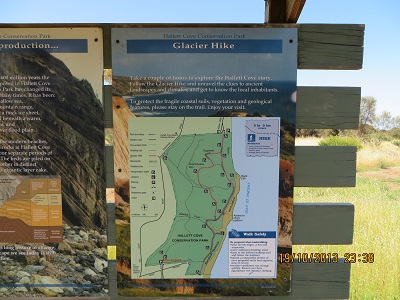
Hallett Cove Conservation Park Information Kiosk

Hallett Cove Conservation Park Information Kiosk

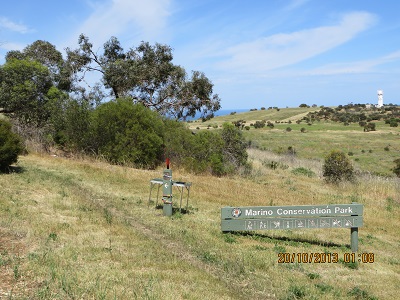
Marino Conservation Park

Marino Conservation Park was once a traditional resting and fishing place of the Kaurna Aboriginal people. However, in the early 20th century much of the area had been cleared and grazed. It also conserves coastal heath and provides a green buffer between two suburbs. I found operating from this park much more challenging than at Hallett Cove Conservation Park because of the higher noise floor. There were high tension power lines just across the road from where I set up my station.

I had contacts with the following stations beginning at 0031: VK5HCF/p, Col at Gower Conservation Park; VK5PAS/p, Paul at Barker Rocks Conservation Park; VK5AV, Tim; VK5WG, Nev, a very loud 5 and 9, best signal all day; VK5DJ, John and VK5WF, Wolfe, making  six contacts.
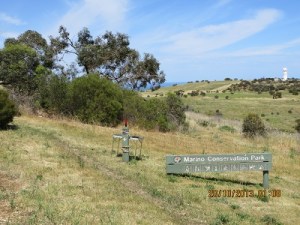
Marino Conservation Park
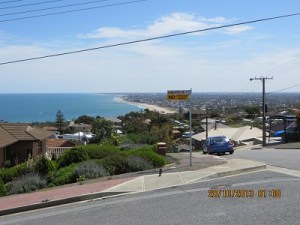
Marino Conservation Park

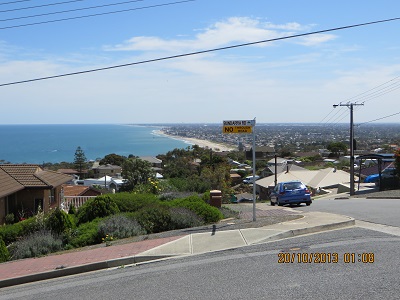
View looking North, Adelaide Coast and power lines

View looking North, Adelaide Coast and power lines, from the corner of the Park where I was set up.

Fort Glanville Conservation Park

I had the following contacts from Fort Glanville Conservation Park: VK5PAS/p, Paul at Ramsey Way Conservation Park on York Peninsular; VK3UBY, Col at Mildura and VK5ATQ, Trevor. These were all difficult contacts because of the very high noise floor.

Nevertheless, I am very pleased to have activated this park. This park conserves Fort Glanville which was constructed in 1880. It is an most complete example of a coastal artillery station built in Australia and dates from South Australia’s colonial past. The park is surrounded by a high mesh fence complete with trespassers prosecuted signs clearly displayed. I activated the Park from within the car park. The park is open on the third Sunday of the month, 20th October, and features a re-enactment of military drills, the sound of bugles, complete with the firing of the canon. I will suggest to the Adelaide Hills Amateur Radio Society (I am a member) that we should activate the park during history week during May 2014. Actually setting up a station on the lawns or further away from the main roads and the power lines might make for a more successful activation. Using a radio with better noise reduction capability compared with the FT817 would assist. I knew I should have used the Ten-Tec Argonaut VI!

At the end on the day I had activated three parks and enjoyed 25 contacts. I was pretty happy with that.
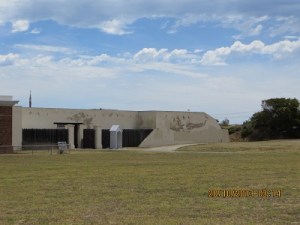
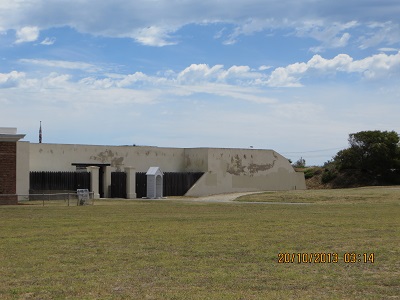
The artillery battery at Fort Glanville

The artillery battery at Fort Glanville
Cox Scrub Conservation Park 11th October 2013

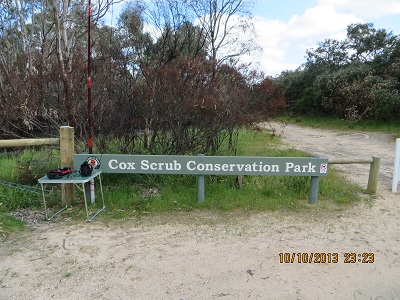
Cox Scrub Conservation Park

Cox Scrub Conservation Park

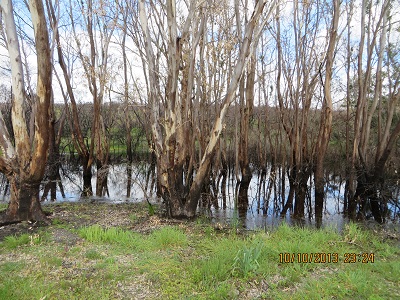
Cox Scrub CP showing burn off

Cox Scrub CP showing burn off

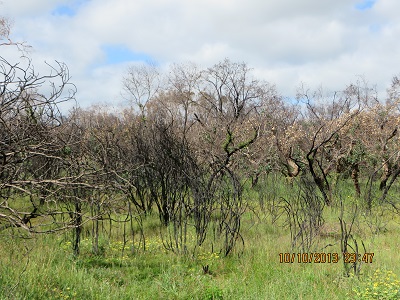
Cox Scrub CP 'green' shoots appearing

Cox Scrub CP ‘green’ shoots appearing

On Friday morning while driving to Middleton I decided I would activate Cox Scrub Conservation Park which I drive past on my journey. Last time I came back from the south coast, about three months ago after lunching with South coast amateurs, and with VK5KC, David and VKATW, Trevor on board, and on passing the park I was disappointed to see how badly burnt it was as a result of a ‘controlled’ burn that quickly got out of control! The Friends of Cox Scrub Conservation Park web page indicates that the park is 544 hectares in area and all but five hectares in the South Western corner were burnt out. The park protects the Yellow-tailed Black Cockatoo. I thought while the park was on my to do list I would not be in a hurry to visit. Any way Friday, a warm and sunny day, was the day I chose! I pulled into a parking bay within the park and set up my gear. Before UTC roll over I checked 7.100, found it was clear,  and called CQ. At 2310 in answer to my CQ call, VK5LY, Larry replied. He said my signal was 5 and 9 in Renmark and so was his at my end. I had contacts with VK5MBD, Bill; VK5HS, Ivan and VK5LI/m, Craig. All received signals were 5, 9 and my worst report was 5 and 5 from Craig. Then the band went quiet. I called CQ a few more times and checked up and down the band: nothing heard. I took three photos and packed up my gear and continued to Middleton. My photos do not adequately show the destruction.

Mount Remarkable National Park 3rd October 2013, VKFF – 360

Mount Remarkable National Park is rugged, hilly and a magnificent place. This time we approached the Park from Wilmington, that is, from the East and drove the sealed road to the Alligator Gorge car park. We have also camped at Mambray Creek where the camp ground is very popular. Mambray Creek is approached from the West and is a short drive from Highway One.

Allligator Gorge

I was starting to think that the trip during the last two days was all in vain, because of poor propagation, and this was reinforced again this afternoon. I managed to send a text to VK5PAS, Paul, advising him I was on 7.100. I heard him : 5 and 0. Obviously Paul could not hear me.  May be starting to activate the park at 06:37 was a bit late! VK2ARK, Tom at Kandos could not hear me and nor could VK1CJ. There was no propagation to Adelaide. I could barely hear VK5BW, Barry in the noise – static crashes!

My day was made when I caught up with VK3AXH, Ian, in Ballarat, with whom I have had many weak signal contacts on 144.1 + from home. Ian was 5 and 9++ and I received a 5 and 5/6. Not a satisfactory outcome from Mount Remarkable National Park, but Ian was left in no doubt about how pleased I was with the contact.