After leaving Butcher Gap Conservation Park and Kingston SE we drove to Naracoorte where we stayed overnight. The next day, Monday, we were to drive to the Grampians National Park to stay in the small resort town of Halls Creek for a few days. There we would meet our son and his family from Sydney. We had plenty of time for the journey so we had planned to re-visit Mount Arapiles, Sota peak, VK3/VW-022, worth one point to the SOTA activator. However, while I had qualified the peak on a previous visit, I could now activate the peak again in a new year for an additional SOTA point.
Also since the last activation, Mt Arapiles-Tooan State Park has now been added to the available parks for the purposes of the WWFF program as VKFF-0765. So there are now two reasons to visit this magnificent location.
While driving to the summit, accessible to two-wheeled vehicles, I noticed that the sky was threatening rain. Perhaps this was the remnant rain which passed over the CoorongNational Park as we drove from Adelaide. At Mount Arapiles the wind was blowing but not quite at gale force. On my previous activation I did not set up at the summit – there were simply too many rock climbers and visitors around. This time I decided to seek a more sheltered spot.
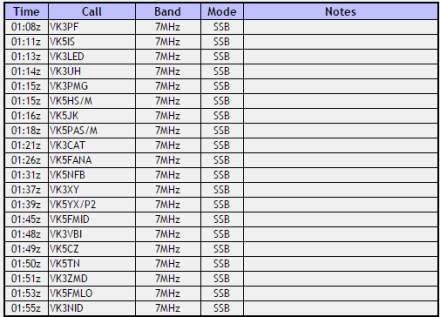
We spent just over an hour at Mt Arapiles and I qualified the summit with 20 contacts and made a reasonable start towards WWFF qualification.
Here is my SOTA log for the activation.
JCD photo
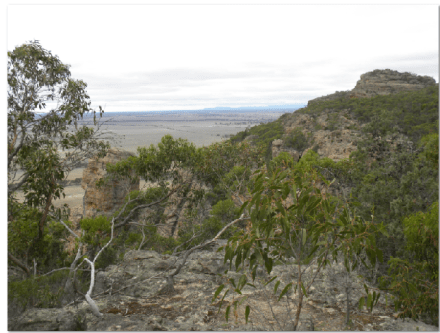
This photo shows a view looking towards the summit of Mount Arapiles showing the grain cropping land of the Wimmera in the background. The views from Mount Arapilies are spectacular. The Northern end of the Grampians is just visible in the photo. The distance between Mount Arapiles and the Grampians is stated on a plaque at Reeds Lookout in the Grampians as 45 kilometres.
Once again thank you to all of the chasers. It was great fun.
South Australia has two towns with the name of Kingston. There is Kingston on Murray and Kingston SE. Both are named after a late Victorian politician who became a Founding Father of Federation. Sir Charles Kingston was that man, a prominent South Australian politician of liberal persuasion with a commitment to protectionism.
Why is this relevant to this activation? Well the Butcher Gap Conservation Park is located in Kingston SE, a small, but very attractive town on the South East Coast of South Australia. Kingston SE is about two thirds of the way between Adelaide and Mount Gambier. It relies on the fishing industry and tourism. One land mark, in need of repair, is the large red cray fish on the outskirts on the town. It is surrounded by a safety fence and appears in a sorry state. The lobster dates from the days when small country towns had to have a large structure to differentiate them and highlight local attractions: so we have the big orange, big banana and big ram. I am sure there many are more!
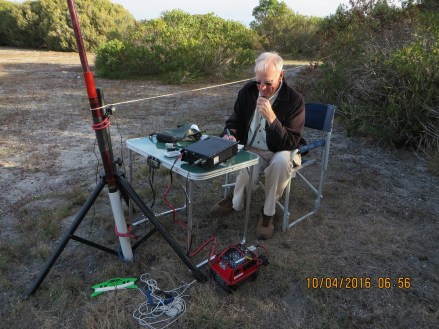
The photo shows me tucked away out of the wind in the typically coastal landscape preserved in this park.
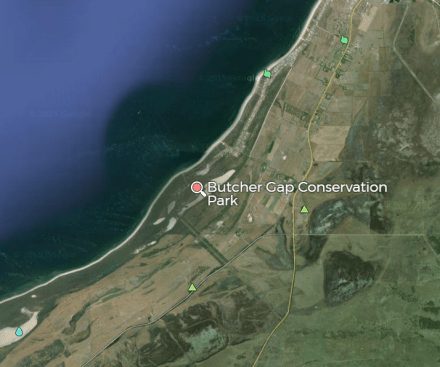
Map: Courtesy of Mapcarta
Here is a photo/map showing Butcher Gap conservation Park. I accessed the Park north of the lake and behind the houses. I carried my gear into the Park for about 100 metres to avoid the wind. The photo of my operating position shows that I had to guy the squid pole against the wind from the sea.
I have previously activated this Park for the South Australian National Parks and Conservation Parks award. Here is a link to that activation:
But this activation was for the VKFF program. It was my intention to activate the Coorong National Park on the way to Naracoorte but when we arrived at the park it was raining. Heavy showers were passing through the area. When we arrived at Kingston SE, the sun was shining, just a light breeze was blowing and it was quite warm: shirt weather and no jacket!
Contacts
I was on the air at 04:55 and completed my activation at 06:46, just under two hours. I was able to gain 47 contacts and thus succeed in activating this Park for the WWFF program.
I decided to check around the band and to try and have contacts with the current activators before settling down on one frequency. My first contact was with Rob, VK4AAC/P3 (7.144) who was activating Wodonga Regional Park, VKFF-0980. Signals were 5 and 9 both ways.
Then on 7.130 I found VK5FMAZ, Marija, who was activating Kenneth Stirling Conservation Park with her husband Paul, (VK5PAS). I was delighted to have this contact with Marija and signals were 5 and 9 both ways. I listened a bit more and checked from about 7.085 up to 7.150 and I believed I had worked all the portable stations on the air at that time. I then checked 7.120 and set up on this frequency as it was clear at that time.
I called on 7.120 and worked the following stations: VK5PMG, Mick; VK5FANA, Adrian; VK5KC, David; VK4RF and VK4HA, Rick s5 6 and r5 3; VK3BBB, Brian; VK3DAC, Fred; VK5ANL/P3, Nick on VK3/VC-019, Mount Warrenheip; VK3UCD, David; VK2KF, Tom; VK3AWG, Chris; VK7NWT, Scott; VK3ZMD, Mike; VK5FAKV, Shawn; VK6MB, Mike, s5 3 r3 5; VK7LTD, Tony; VK5LSB, David; VK3NCR, Craig; VK3TKK, Peter at the Organ Pipes National Park, VKFF-0627; VK5JK, Jeff; VK5AV, Tim; VK3LIP, Edward; VK5KBJ, Barry; VK5WG, Nev; VK1DI, Ian; VK2NP, Cliff and VK5FMLO, Michael. Due to changing conditions it became apparent that interstate stations (VK4) were not hearing me and the QRM became too distracting! I decided to QSY to another frequency and found 7.144 to be vacant. I then had contacts with Glenn, VK2FGOE/QRP at Bathurst; VK3YSP, Joe; VK5ZEA, Michael at Port Lincoln; VK3FAPH, Aaron; VK2YW, John; VK5SFA, Steve; VK3FOWL, Julie; VK5ZGG, Ian; VK4FW, Bill at Toowoomba 5 and 8 both ways; VK3MC, Murray; VK3DBP, Paul; VK3PAT, Chris; VK2HOC/M, Paul, VK2LEE, Lee, VK3FTAD, Fred and finally, at 06:46, VK3MCK, Don. It was time to pack up and head for Naracoorte where we had arranged accommodation overnight before travelling to the Grampians National Park in Victoria.
I was very pleased with the activation, signals generally were excellent. I used my Yaesu 897 set for 10 watts, a linked dipole for 20 and 40 metres and, to cap it off, I had contacts with some amateurs who were new to me. Thanks to all who gave me a call.
An Activation to commemorate the third anniversary of the South Australian National and Conservation Parks award program for radio amateurs.
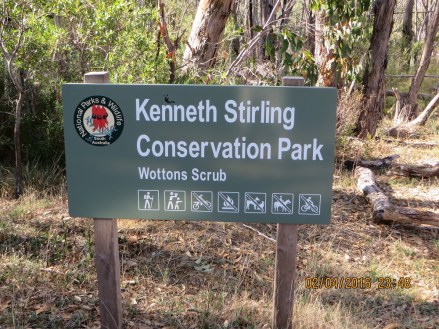
I chose to activate the Kenneth Stirling Conservation Park in the Wottons Scrub section. The Park is in four sections: Filsell Hill, Wottons Scrub, White Scrub and Burdett Scrub. Filsell Hill is the largest of the four sections and some time ago I set to activate this section. The Park is only accessible though private property and as I had made no arrangements I abandoned my plans. However, Wottons Scrub is easy to find and is well sign-posted. My wife and I checked out access about a week ago and have resolved to return to Wottons Scrub for a walk. Much of the land for this Park has been acquired for the people of South Australia and the nation by the generosity of benefactors. The park is named in memory of Kenneth Stirling, one such benefactor and so was Wottons Scrub (a Mr Wotton).
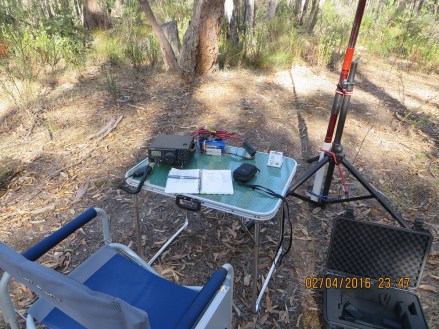
I chose to set up in the park on the track which leaves the gate where I parked. I took my gear about 100 metres into the park within a small cleared area and set up my station there. I was probably invisible to motorists driving the road, but I could see back to the car park from my spot and I made sure I did not impede bushwalkers. However, there were no walkers: I had the Park to myself.
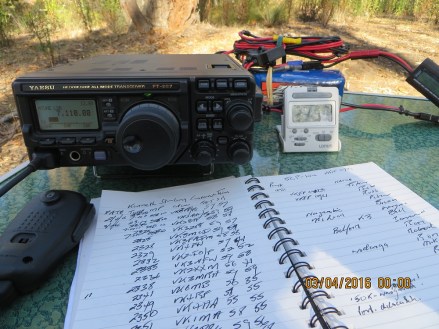
The photo shows the Yaesu 897, my LiFePo4 battery (8.4 amp hours), clock in UTC, and my log (with writing showing the end result of being a note taker for too long!).
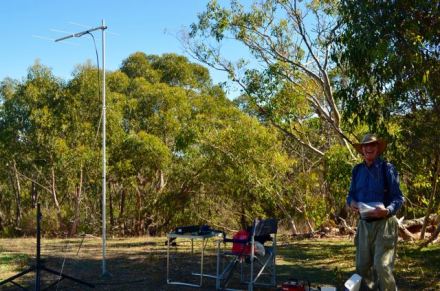
This photo shows another view of my station. The ten metre squid pole is mounted on my tripod and the ends of the linked dipole are in trees at about two metres from the ground. It is a splendid location.
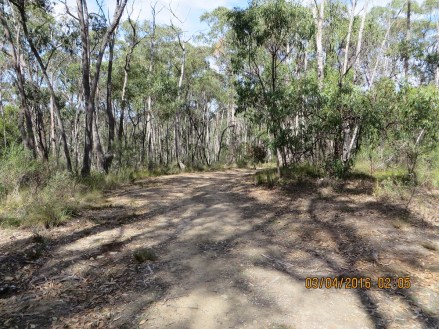
This photo shows the view looking down the track away from the gate.
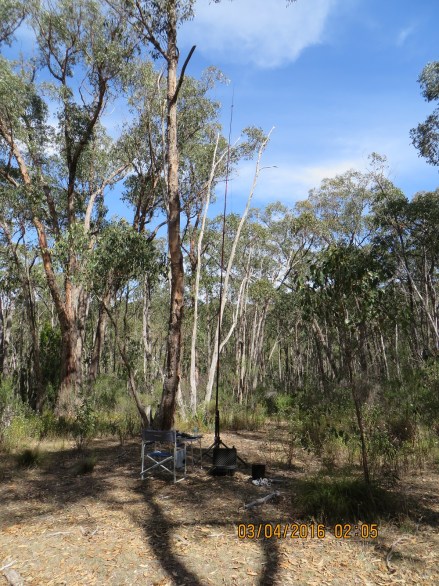
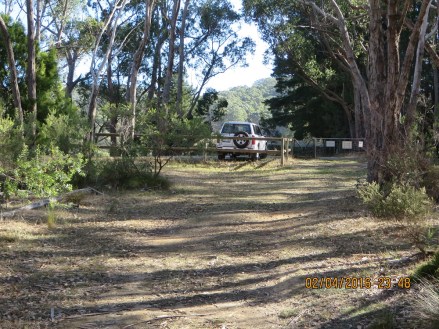
This photo is taken from the track looking back to the Gate. My operating position was on the right hand side of the track heading away from the gate.
My contacts
I was on the air at 23:45 UTC (2nd April 2016) and my first contact was with Peter, VK3PF/P in VKFF-0113, Coopracambra National Park, in East Gippsland. Signals were 5 and 7 both ways. A Park to Park contact over such a distance with two low power stations was a good omen. Thanks Peter for the excursion to East Gippsland.
23:17 VK4AAC/P3 Rob was in VKFF-0961 Cobram Regional Park. Signals were 5 and 9 both ways. A second Park to Park contact sequentially – this is really great. Thanks Rob, we appreciate your mammoth excursion. Then in succession I had contacts with: VK2BJP, VK3ZPF, VK3MCD, VK3FADM, VK4FW, VK2IO/p at 23:32. Gerard was in Belford National Park, VKFF-0023, 5 and 2 both ways. I had already worked Gerard in this park from home but it was great to have a Park to Park contact. Then followed VK3AFW, VK2XXM, VK3MRH and then VK6MB. I gave Mike 5 and 6 but he had noise and he gave me 3 and 2 However, it was great to have the contact on 40 metres. VK4RF and VK4HA were both 5 and 8 and I received 5 and 5. It was good to get Rick at such a good level. Then followed VK1MA, VK3DPG, VK3VWS/P, VK2NP and on the 3rd of April just after UTC rollover, Peter, VK3TKK and Tony, VK3AN, about to do a Foundation assessment for an aspiring amateur, Barry, with whom I had a discussion and wished him well and then VK7MBP near New Norfolk in Tasmania s5 and 8 and 4 and 5 received. At 02:22 Mick, VK3PMG, 5 and 7 and 5 and 5. There were no South Australians in the log at this stage. Perhaps they were all worn out and were sleeping in? I knew they were out and about and had received reports from other stations commenting on the number of VK5s in the field. There was no short skip. I saw the contact with Mick, VK3PMG as a sign conditions were beginning to change. The came VK3MCK, VK3ZMD, VK3FQSO, VK3AWG, VK3FAHP/P and VK3AN a second time.
At 00:40 I had a slightly longer contact with Tony, VK5ZAI/P3 who was camped at Laanecoorie Weir, about 30 kilometres from Bendigo, Signals were 5 and 8 and 5 and 9 received. At 00:50, VK3DBP, VK1AT/P3 at Raymond Island in Gippsland, VK5PAS/P, Paul, a Park to Park contact who was operating from VKFF-0940, Waitpinga Conservation Park. While we made a successful contact it was hard work for Paul, 5 and 7 and 5 and 1 received.
At 01:18 I had contacts with VK5GJ/P, Greg and VK5GI/P, Norm, who were operating from VKFF-0999, Bandon Conservation Park. At last a sure sign that propagation was beginning to open up locally. I then worked John, VK2YW, 5 and 9 both ways, VK3VTH/P5, Tony at VKFF-0792, Big Heath Conservation Park in the South East of South Australia and VK5ZGY/P, Greg in Billiatt Conservation Park, VKFF-0821. Then followed VK3EJS and VK5PL, David in the Marne Valley Conservation Park, VKFF-0906. Adrian, VK5FANA was in VKFF-0876, Carribie Conservation Park. I then worked Peter, VK3PF/P at Mount Raymond, in Mount Raymond Regional Park, VKFF-0975.
Then followed VK3AIG, VK5HSX/P, Stef in Beachport Conservation Park, VKFF-0791, VK5TN, VK3SIM, VK5AAH, David in the Fort Glanville Conservation Park, VKFF-1031, VK5PAS/P, Paul in Waitpinga Conservation Park, VKFF-0940, VK7CW, Steve in Tasmania, VK3MEG, VK5AV and finally, VK1AD, Andrew. This was a rare contact for Andrew and I. He is either QRP and propagation is not working in our favour or noise is an issue at his end.
In summary, I enjoyed 51 contacts and thus qualified the Park, with contacts from VKs 1 through to 7. The highlight for me was working 14 other Park operators, or Park to Park contacts. Thanks to all of the operators: at home or in the field who helped make this morning activation so successful.
On Friday afternoon, Good Friday, VK5PAS, and I, visited Scott Creek Conservation Park for a joint activation. In addition to the usual HF station we wished to add to the number of bands used by adding some VHF and UHF capability. But more on that later.
I have activated this park many times and have qualified the park for the WWFF program. Here is a link to my last activation:
First, to field test a Spiderbeam asymmetrical dipole designed to work on five HF bands. This antenna is quite impressive and well-made, but like most, if not all, Off Centre Fed (OCF) antennas, presents a higher than desirable VSWR on some of the bands. Paul, who is the reviewer, will say more about this. If you use 100 watts and want an excellent antenna for camping, are prepared to use a coupler (antenna tuner) on occasions, this antenna is worthy of consideration.
Second, to conduct an HF activation. This task mainly fell to Paul (VK5PAS), who operated on the 40, 20 and 15 metre bands.
Finally, to try and sample antennas for six metres (a dipole), two metres, a Cushcraft three element beam and a six element log periodic style antenna (made by ATN antennas) for 70 centimetres. I did not bring any 23 cm gear and nor did I operate on six metres and 70 centimetres. I will in the future. The beam antennas are supported by a three piece aluminium mast which is guyed. This mast can be erected by one person but it easier with two! Thanks to Paul for driving the tent pegs into the ground while I held the mast. I use good quality semi-rigid coax fitted with N connectors for VHF and UHF. The antenna is rotated by the armstong method and an orienteering compass provides the bearings. My radio for this activation was a Yaesu 897 operating at 20 watts. Two LiFePO4 batteries were used: of 4.200 and 8.400 amp hours capacity.
This photo, courtesy of Paul, VK5PAS, shows my operating position, about 20 metres from where Paul’s station was located.
The weather was good, warm with the temperature in the low twenties, sunny and with just a gentle breeze.
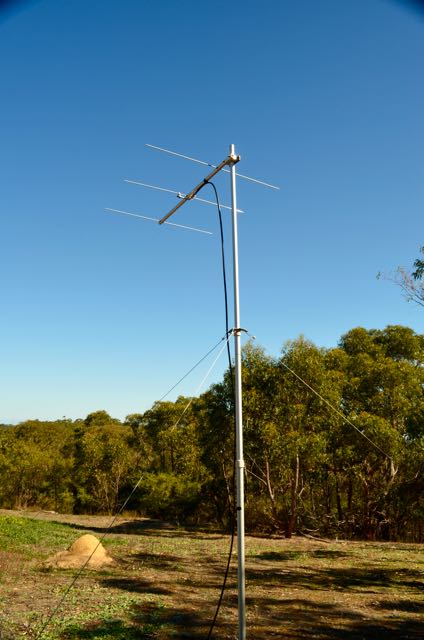
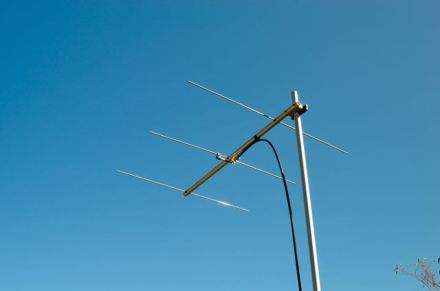
This photo, also from Paul, VK5PAS, shows my two metre antenna, a simple three element beam fed with quality semi-rigid coaxial cable (unfortunately the identification markings have rubbed off with lots of use).
The final picture, also courtesy of Paul, is a close up of the beam showing the gamma match.
Contacts
After field testing the OCF dipole I set up my two-metre station at 05:25z. I checked the Mount Gambier beacon, VK5RSE, on 144.550, at Mount Graham. This beacon is listed in the Wireless Institute of Australia call-book as having 25 watts transmit output. The beacon was showing 5 and 2 on my FT897 and climbed to 5 and 5 on the peak of the QSB cycle. The QSB cycles were even and thus predictable. At this point my confidence soared. The Mount Lofty beacon, VK5VF, 144.450, about ten kilometres from our operating location (as the wedge-tailed eagle flies) was really loud! I placed a post on Parksnpeaks and hoped for the best. I called on 144.110 for a few times without success, so I soon moved to the calling frequency of 144.100.
05:42 VK5KC, David, 5 and 9, both ways
05:44 VK5AKK, Phil, 5 and 9, both ways
05:54 VK5MC, Chris at Millicent in South Eastern South Australia 5 and 4 and 5 and 5
05:57 VK5GY, Gordon, operating at Bullock Hill Conservation Park, 5 and 5 both ways. Gordon was holding his beam in one hand! Gordon told me he is celebrating 40 years of being an amateur (in the UK and Australia) so I shared my 40 year story with Gordon and gave him a second call (06:01) as VK5PF, 5 and 5 both ways.
Paul told me there were operators on 40 metres who wished to contact me – so we swapped stations.
So on 7.150 I had the following contacts:
06:06 VK5FMID, Brian, 5 and 9 both ways
06:08 VK2IO, Gerard 5 and 7, 5 and 4
06:08 VK4AAC/P3, Rob 5 and 9 and 4 and 7. Rob was in a noisy caravan park.
06:11 VK5KHZ, Hans, 5 and 9 both ways
06:13 VK3ZMD, Mike 5 and 8, 5 and 7
06:17 VK5FANA, Adrian 5 and 9 both ways
06:18 VK4FW, Bill near Kingaroy, 5 and 9, 5 and 4
06:19 VK3CDR, Chris 5 and 9 both ways
06:22 VK4GSF, George, Toowoomba, 5 and 9 both ways
06:23 VK3GWS/P, Grant at Beechworth 5 and 9 both ways
While I was working away on 40 metres I could hear Paul on two metres. We decided to swap radios when it went a bit quiet on 40 metres. I called CQ on 144.100.
06:36 VK5DK, 144.100, Col at Mount Gambier, 5 and 9, 5 and 8. I was delighted: a good haul on two metres with a modest station – 20 watts and a three element beam! Col, of course, has a great set up on two metres and most other higher bands.
06:40 VK5NC, Trevor at Mount Gambier, 5 and 3, 5 and 4
06:46 VK3LY, Bill from Nhill, 5 and 3, 5 and 1
I called a few more times and then decided I should set up on 146.500 FM. VK5FANA, Adrian, advised he would travel to the top of a nearby hill and give me a call. Unfortunately we did not make a contact. I suspect we could have made it but our efforts did not correspond in time.
Later using Paul’s hand-held radio I had contacts with:
07:20 VK5PET, Peter, Mark Oliphant Conservation Park, 5 and 9 both ways
07:21 Rick, VK5FGFK (and a second contact from me, VK5PF), Mark Oliphant Conservation Park, 5 and 9 both ways
and later, 07:40, with David, VK5KC on 52.200 ssb, 5 and 3 both ways. Twenty two contacts on three bands: 10 on 40m; 11 on two metres and one on six metres was my total for the day and 11 contacts on two metres were very satisfying.
Here is a link to Paul’s, VK5PAS, YouTube channel which captures some of the fun and excitement of this style of portable activation. Thanks to all of the operators who gave us a call.
In November 2016 I will celebrate 40 years as an active radio amateur. I decided at the end of last year, as a birthday present, to apply to the Australian Media and Communication Authority (ACMA) for a two-letter advanced call sign. In case you think I am being ‘greedy’, in our small state of South Australia, there are about 200 hundred two letter call-signs remaining, including some highly desirable ones for CW (morse code use).
The Wireless Institute of Australia (WIA), the peak body for radio amateurs, and the agency under contract from the ACMA to administer call-signs, requires an amateur to choose two preferences, in case the first one has already been applied for. I made two call-sign choices and sent off my application to the WIA for processing and forwarding on to the ACMA. I enclosed the fee. And then I got on with other things.
There were, when I first considered this application, about three call-signs of deceased amateur friends of mine available, all amateurs I held in high regard. Indeed one was an employee in my Department. I always thought he had a desirable call-sign, was very technically proficient and a great home constructor of microwave transmitting and receiving equipment, but I didn’t think I could walk in his footsteps as an amateur. The second call-sign was that of an amateur I mention in my blog. He was a 160 metre ‘home-brew’ man! (see About) The third call-sign of an Amateur Television (ATV) colleague of mine was snapped up while I was debating whether to proceed down this path. I purchased crystals from him.
After much thinking I decided to apply for a call-sign with which I had no association and did not know any of the previous owners.
Now VK5PF will present no great challenge to that other well-known ‘Papa-Fox(trot) active in South East Australia! I intend to use this call-sign both from home and from Parks and Sota Peaks for CW (morse code) low power transmissions only. I think VK5PF is a pretty good CW call-sign! And there is no ‘e’ in this call-sign, in CW a dit!
I would like to express my appreciation to our regulator, the ACMA, and, of course, to the WIA.
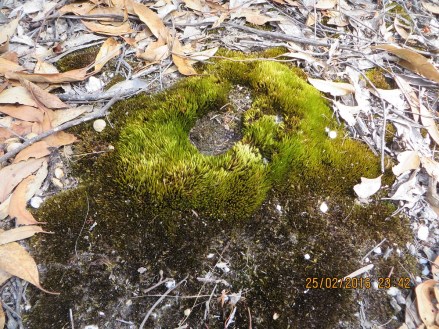
Moss glistening in the sun: Mylor Conservation Park
On Friday morning we, myself and xyl, Jenny, decided to go for a walk in the MylorConservation Park, VKFF-0785 and 5CP-156. Mylor Conservation Park is 49 hectares and preserves remnant bushland in the Adelaide Hills. The walk though the Park is not strenuous and the bush is magnificent. The Park is near Mylor and is just over seven kilometres from my house. I previously activated this Park for the WWFF program two Friday afternoons previously, that is on the 12th February. On that occasion I brought the activation to an end as a result of being bitten by ants. I was aiming for 44 contacts. I did not reach that goal.
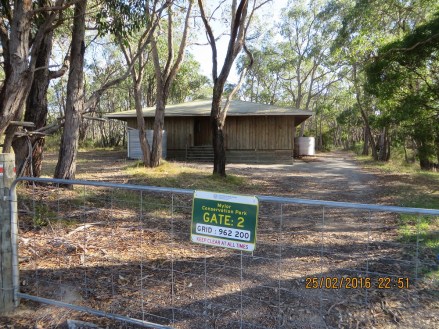
So we thought we would explore the Park thoroughly and we did. I was hoping to find an activation spot away from power lines, nearby houses and on gravel or some other hard surface to minimise the risk of ants. We entered the Park at the main gate and followed the sealed track to the end of the Park. Here we saw a wooden building which can be hired for camping.
There were also open areas nearby, which, if not for the high tension lines on Whitehead Road, would provide great activation spots. The Park is on the left hand side of the picture opposite Gate 2.
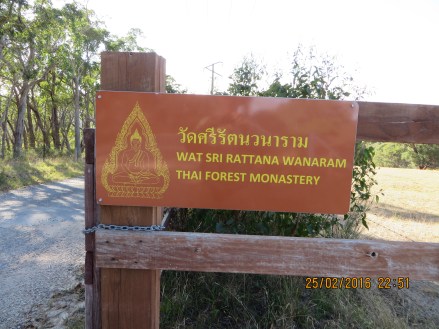
Private Road to Thai Monastery.
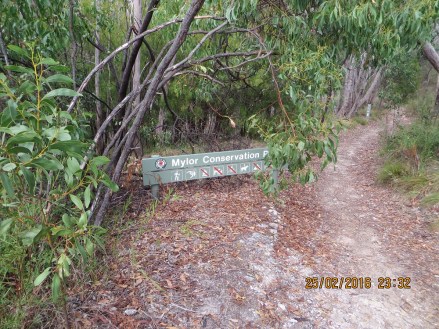
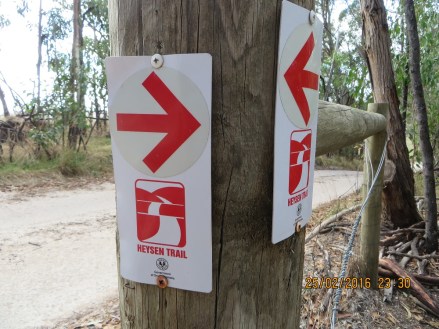
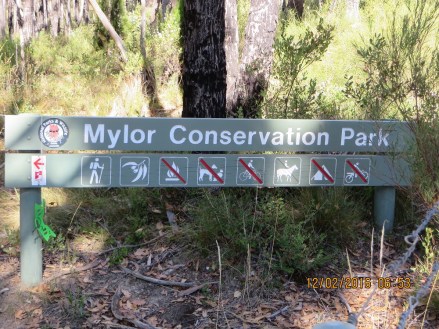
I explored another side track which took me to Gate 5 and we returned to the car park on the track which is also part of the famous Heysen Trail. The picture below shows that the unnumbered Gate was on the Hooper Road boundary. I did consider this previously (12th February) as an activation spot but thought the bundled power lines overhead would cause too much noise.
Entry point for Heysen Trail
Heysen Trail Marker
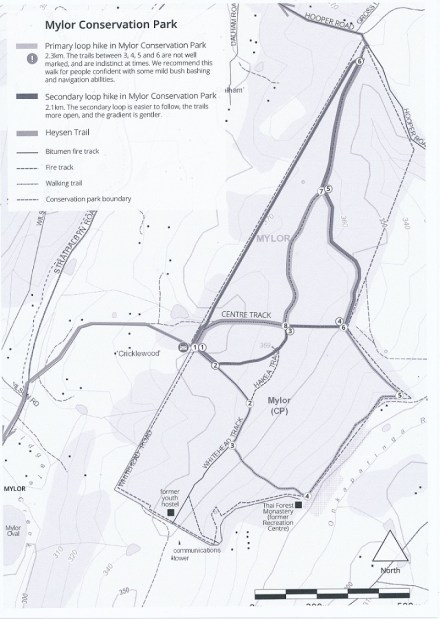
We also took coordinates where we found a very small patch of couch grass on the track in a low spot which was still damp. These coordinates will be sent to the Friends of Mylor Conservation Park. About half way along the sealed track (an old road) there is a cross road: this is roughly in the centre of the Park and there are posts in place for mounting squid poles. This would make a great QRP location away from the noise, reasonable elevation, probably 330 metres above sea level, but the only access is by hiking. You would have to be prepared to take a ground sheet and sit on the ground. This is not much fun for a Park activation!
My operating point was half way between 1 and 8 on the Centre Track.
I decided to compromise. I would walk into the Park carrying my gear. In preparation for the late afternoon activation, I loaded the large ruck sack with my Ipad and modem, three LiFePO4 batteries, two antennas, log book, water and jacket. The exercise required two trips to carry my gear. On the first I carried my tripod, squid pole, table and chair. The walk was about 300 metres uphill. On the second trip I carried the back pack and my FT897 in its black plastic case. I have learned the hard way: the gear is heavy but I have an FT857D on order which will help! All together with the walk in the morning and the afternoon return visit my pedometer reported I had walked 15,146 steps (my goal is 10,000 per day) or 12.25 kilometres and that I had burned 2990 calories. I have to report that on Thursday afternoon, VK5PAS, Paul, VK5KC, David and I had indulged in coffee, cake and cream! So I had extra motivation for the walk!
Contacts
I set up my gear and was on the air at 05:52. I found 7.120 to be clear and called CQ. I was answered by VK5HDW, David in Ferner Conservation Park. I gave David 5 and 8 and received 5 and 9. I thought that 40 metres looked pretty good for a change! I saw that Rob, VK4AAC/P5 was operating on 7.100 from Danggali Conservation Park and secured a contact before going back to 7.120: 5 and 9 each way. VK3PMG/M, Mick, was driving west near Ararat and we had a contact 5 and 6 each way. Then I was called by VK3PF, Peter who gave me 5 and 8 and I gave him 5 and 6. Then Brian, VK5FMID, from Mount Gambier called: he was 5 and 8 and he gave me 5 and 7. At 06:03 Rick, VK4RF/VK4HA called: signals were 5 and 6 each way. Thus with six contacts around South Eastern Australia, I was able to determine that propagation on the 40 metre band was really quite good and it should be a fun activation.
Then in quick succession followed VK5NRG, Roy; VK5FANA, Adrian on Yorke Penninsular; VK5PAS/M, Paul on his way to Kaiser Stuhl Conservation Park; VK5GJ, Greg; VK5YX, Hans; VK3TKK/M3, Peter 5 and 9 both ways; VK3DBP, Paul; VK5NFT/M, Tom; VK3FJBA, Joe near Melbourne; VK5PL, David; VK5AV, Tim; VK2HHA, Dennis from Albury 5 and 8 both ways; VK3FIRM, Mike; VK5EE, Tom; VK5ZGY, Greg from Mount Gambier. I them moved to 7.144 and listened before callling VK5HSX/P, Stef in Deep Creek Conservation Park. I decided to chase Stef, VK5HSX/ because DX stations, although weak, were on 7.110 and making the going a bit hard. I decided to stay on 7.110 for just a little longer to and worked VK5KLV/P, Les in Winninowie Conservation Park. At 06:45 I worked a succession of stations: VK5FPAC, Bob; VK3JK, Craig; VK5KKS, Kevin; VK3BNC, Bob; VK5KPR, Peter; and at 07:08, VK5PAS/P, Paul, at Kaiser Stuhl Conservation Park, and on 7.085, VK1DI/P1, Ian in Pinnacle Nature Reserve, VKFF-0862, 5 and 7 and 5 and 8.
I thought I would try for some VK6s. I posted my intention to migrate to 14.312 which I found clear. I called CQ a few times to allow chasers to see my post on Parks and Peaks and was soon answered at 07:33 by VK4RF/VK4HA, Rick 5 and 9 each way: F1BBL, 5 and 5 and 5 and 3 received and finally, JA1QVR, Sam 5 and 8 both ways. I was using 40 watts and a linked dipole and Sam was transmitting with a kilowatt and a four element beam. He was chuffed and so was I.
I enjoyed myself making 36 contacts with one duplicate. Thanks to all of the chasers and, of course, the activators. I made five park to park contacts.
Today was a Parks and radio day. In the morning my wife Jenny and I went for a walk in the Scott Creek Conservation Park. This was my first walk in the Park for some months due to health issues. It was great. The day was warm and sunny, the kangaroos were out and about watching us and the birds were singing. I was living for the day! Jenny was identifying a weed for the authorities: an Ivy plant that grows on the indigenous eucalypts, the brown stringy bark trees. She found at least three examples. We also saw a mob of dorper sheep. When they spotted us they ran towards SA water land which adjoins the conservation park. They owe their freedom to private gates nearby which were left undone during the motor car rally held in November. The Ranger will be advised.
When we concluded our activities at Scott Creek Conservation Park we drove to Mylor Conservation Park which is also nearby in the Adelaide Hills. (I measured the distance in the car last evening when leaving Mylor Conservation Park and driving home the most direct way at 7.1 kilometres: thus I am in the fortunate position of having three parks within ten kilometres of my house). The purpose of the visit to Mylor was to check out possible operating locations. In the end I finished up going to the main gate off Whithead Road. This is not far from houses and a Buddhist Monastery and the noise was about S7. It was hard to tell how much of the background noise was simply that and how much was power-line noise. But at the end of the activation the noise had dropped to about S3. We also explored Hooper Road which runs along the Park boundary. We drove to the end of the road and the beginning of the fire trail. At this point the road branches into two private driveways. There is a Park gate about half way along this road but a glance over head showed bundled power lines. I did not even bother to try from that location! I decided I would return to the location of my first activation near the main gate off Whitehead Road.
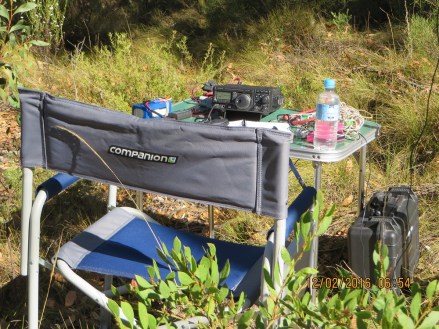
This photo shows my operating position with the FT897 on the left hand side of the table and 8.4 amp hour LiFePO4 battery. Even after 30 contacts the battery voltage was 12.9 volts.
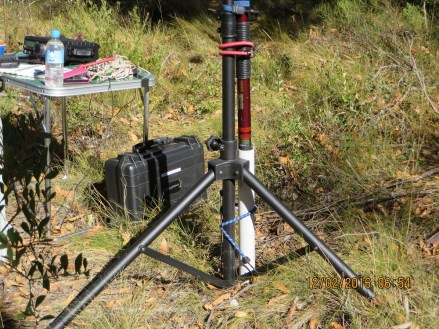
This photo shows a ten metre squid pole attached to my tripod. For this activation I did not guy the squid pole or use ten pegs to hold the tripod legs in place on the ground. There was only a light breeze.
The Park
Mylor Conservation Park is a small park in the Adelaide Hills. It conserves remnant bushland in an area largely cleared for agriculture and residential development on small holdings (four hectares mostly) except in townships. There is a Friends Group and flora and fauna lists are available on the State Government parks web site.
Contacts
I began on 40 metres and after 17 contacts I decided to try 20 metres. I made five contacts on 20 including three DX qsos before moving back to 40 metres where a further ten contacts were made. Thanks to all who gave me a call, who posted my activation on Parks and Peaks as well as the DX cluster. I decided to end the activation because of the impact of my trespassing. While I gave my operating position a pretty good check for local inhabitants I decided to end the affair when I was bitten twice, simultaneously on the right hand pointer finger and left arm just above the wrist. The attackers were ants. I am not sure what species they were but they surely packed a punch. My arm is still swollen as I write this blog entry on Saturday morning. While ants have been attackers in the past on many occasions, these guys had the most impact on me. When I return to the park to try and secure 44 contacts I will set up in another location. The ants that can cause the most problems are hopper ants.
THIS is the angry little ant that’s putting up to two South Australians a week into hospital emergency rooms, some with potentially fatal anaphylactic shock.
The native hopper ant (Myrmecia pilosula), also known as the jack jumper, packs a painful sting from its tail — but for a significant proportion of people the consequences can be much greater.
Last Sunday a 71-year-old Stirling man was taken to hospital by ambulance after being stung, a situation that has become common during summer, according to Professor Bob Heddle, SA Pathology’s chief pathologist and head of Clinical Immunology at the Royal Adelaide Hospital.
Prof Heddle said the aggressive ant, which moves with a distinctive hopping motion, has been responsible — along with its cousin, the inch ant — for a least six deaths in Tasmania and Victoria in recent years, although he believes deaths caused by the insects are probably under-reported.
Sunday Mail, January 14th 2015
So I cannot tell what bit me, except that the impact of bites from hopper ants are cumulative. So I will be careful in the future.
I was on the air at 0552 after checking that 7.105 was clear:
VK5PAS 58 58 Paul
VK3FORD 55 55 Matt
VK3PF 58 55 Peter
VK3PMG 58 44 Mick
VK2HAJ 59 57 Dennis
VK3FLCS 56 57 Brett
VK3DBP 57 57 Paul
VK3FQSO 57 56 Amanda
VK3MCK 59 55 Don
VK3NBL/P 57 55 Ray
VK3TKK/M 57 55 Peter
VK2YK 57 56 Adam
VK3PAT 59 59 Cliff
VK5FRCP 58 59 Rex at Piccadilly. There had been no propagation locally through the afternoon until VK5FRCP called. Rex is located in the Adelaide Hills, a kilometre or two from Mylor Conservation Park.
VK3EMI/P 56 55 Gerry
VK3ZPF 59 55 Peter
VK2NEO 59 59 Peter
I decided to try 20 metres, but not before trying to contact VK5FANA, Adrian on the Yorke Peninsular. I called VK5PAS after he worked VK5FANA at 0552. I also listened for VK5FANA, operating just higher in frequency that me a few times while I was having a quiet moment between calls. I could not contact him.
At 0700 I checked 14.310. It was clear and I spotted myself.
9A3NM 57 55 Sasa in Croatia
VK4RF 59 59 Rick
VK4HA 59 59 Rick
I5FLN 57 55 Luciano
IW2NXI 57 58
Twenty metres then went quiet so I migrated back to 40 metres:
VK5PAS/P 56 55 Paul at VKFF-077
VK4RF 59 59 Rick
VK4HA 59 59 Rick
VK4GFS 59 57 George
VK3KRH 59 59 Roscoe
VK5NRG 55 43 Roy
VK5KC 56 45 David
VK2NP Cliff 57 53
I then listened for VK5FANA, who briefly popped up out of the noise and was not heard again by me. I could hear stations contacting Adrian and giving him great reports. Sorry Adrian, may be next time!
Over the last two years VK5PAS, Paul, the originator of the SANCPA award program, has established a tradition of Friday late afternoon or early evening activations of South Australian National and Conservation Parks for the award. This award encourages portable amateur radio operations from South Australian Parks. It has become quite popular and a number of portable operators in the state make the effort to set up in a Park and lots of South Australian chasers and even more from interstate reward the activators with contacts. From the point of view of the portable operators, the activity develops planning skills, navigation techniques, introduces them to SA’s great parks as well as developing amateur radio skills associated with setting up a satisfactory low-power station and using battery power. Of course the activity develops operating skills, on-going learning of communication techniques, which not only benefit the individual, but perhaps may be useful to community organisations or help with developing a career.
For me, it is just fun. I have always enjoyed portable operations. So I decided to return to the Mark Oliphant Conservation Park, VKFF-0782, for the fifth time. I was keen not only to assist chasers obtain this park but also to gain a score of 44 contacts to qualify this Park for the WWFF award. I always enjoy hearing from the operator at the other end say ‘this is a new Park for me’. On Friday evening I secured 38 contacts, including three duplicates, my overall cumulative score more than reaching the required 44. Here is a link to my previous activation:
I was pleased to be able to briefly discuss the symbolism of operating from this Park, with one of my contacts. The Park is named after a very prominent Australian scientist, who was also a conservationist and a past Governor of South Australia. Of course Sir Mark was interested in radiation, from nuclear energy, slightly different to the electro-magnetic radiation we play with! He also invented the Magnetron.
In my post of 11th December 2015 I included a photo of the plaque with the citation to Sir Mark. The operator told me he had read my earlier post and had noted the detail about Sir Mark.
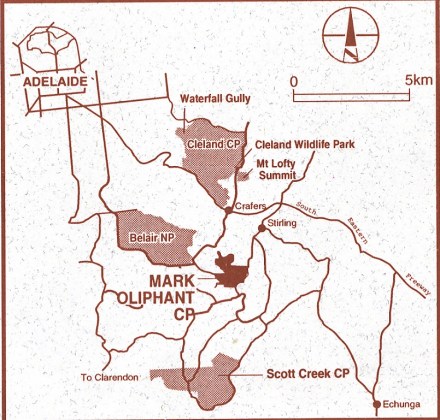
This map, taken from a Park Guide shows the location of the Park in relation to Belair National Park, Cleland Conservation Park and Scott Creek Conservation Park. The brochure indicates that the ‘main function is to conserve an important example of the Adelaide Hills Forest Environment’. Messmate and Brown Stingybark trees dominate the forest canopy.
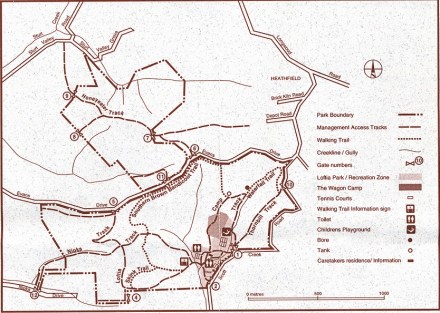
On this occasion I chose as my operating location an area just inside the Park near the point marked 6 on the map. Travel down Evans Drive (from the Heathfield end), a gravel track, until you reach the park boundary on your right hand side and you will come to a gate. When turning from Scott Creek Road into Evans Drive the Park begins on the corner and is thus on your left hand side at the turn. Near point 6 is a better location for the amateur radio operator than just inside the main gate (where the dedication plaque can be found). Maps courtesy of the SA Government.
Contacts
I operated on 40 metres. I did briefly listen on 20m and decided not to stay! I was on the air at 05:25 and enjoyed the following contacts:
05:31 VK2GAZ/P, Garry in VKFF-0544 (Park to Park contact) Woolemi National Park
05:35 VK3FLCS
05:43 VK5PET/P Peter in VKFF-0784 Mount George Conservation Park
05:47 VK3NBL
05:50 VK2VW
05:52 VK3AWG
05:53 VK3DQW
05:57 VK3EMI
05:57 VK5GJ/QRP
05:59 VK3PMG
06:00 VK3TKK/M
06:02 VK5FLEX
06:04 VK5PET/P Peter in VKFF-0784 (P2P) Mount George Conservation Park
06:07 VK5NRG
06:10 VK3YAR
06:14 VK5FANA
06:18 VK5GY/M
06:19 VK4RF
06:21 VK4HA
06:25 VK5AKK
06:30 VK3PF
06:31 VK3FPBI
06:38 VK7NWT
06:41 VK2FROD
06:44 VK3MCK
06:46 VK3YB
06:50 VK5PET/P5
06:57 VK2IO
07:00 VK3HRA
07:02 VK5YX
07:10 VK5KLV
07:12 VK5EE
07:13 VK5KPR
07:25 VK2FROD
07:16 VK5AW/P5 Adrian in VKFF-0372 Murray River National Park
07:19 VK3JK
VK5PAS/P5 Paul in VKFF-1029, Ettrick Conservation Park
Thanks to the operators in VK2, 3, 4, 5 and 7 who gave me a call. And a special thanks to those who spotted me: it makes a great difference to the activity!
After discussions with Andrew, VK1AD, I decided to activate Mount Ainslie, VK1/AC-040 (also VKFF-0850), on the 24th December 2015. I had previously activated this summit courtesy of Andrew, then VK1NAM, in May 2015. Here is a link to that activation:
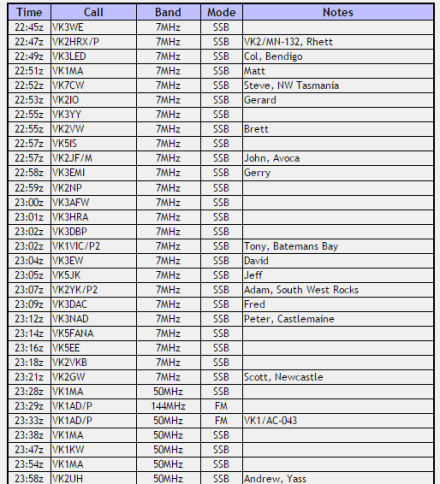
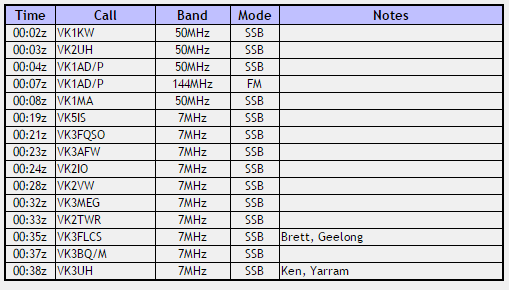
Andrew planned to visit Mount Stromlo, VK1/AC-043, hoping to work six and ten metre contacts via sporadic E propagation. Six metre contacts to VK5 have been achieved and early morning 10m contacts into the USA also have also been fairly regular occurrences. I was keeping my fingers crossed in relation to six metres. After my experiences of six metres in Canberra in May 2015 during the Wireless Institute of Australia (WIA) Annual General Meeting, I decided to make a six metre dipole. It was that antenna I planned to use from Mount Ainslie on this occasion. However, I began my activation on 40 metres and my log is reproduced below. I had an hour and a quarter playing on 40 metres before the six and ten metre activity began. I had a great time.
Mount Ainslie Log 23/12/2015
Mount Ainslie Log 24/12/2015
As can be seen from the log I had a number of contacts on 6 metres: all were with Canberra stations except one, VK2UH, Andrew at Yass. My radio was set for ten watts and I was using a half wave dipole. I was delighted with all of the six metre contacts, but especially the contacts with VK2UH. I also had a contact with Andrew, VK1AD, on two metres FM on 146.500. This was a first for me in the SOTA program. I used an ICOM 80AD set for 500 milliwatts. Signals were 5 and 9 both ways both before and after UTC roll-over. All contacts with VK1AD were, of course, summit to summit (s2s). I have resolved when I return home to add ten metres to my six metre dipole by turning it into a two band linked dipole. While there was no sporadic E on this occasion I had a great time and wish to thank Andrew, VK1AD, for being on Mount Stromlo and making the VHF s2s contacts possible. I also wish to acknowledge VK2HRX/P, Compton, who called me on 7.090 Mhz from VK2/MN-132 also a s2s contact.
The Park
Mount Ainslie rises 843 metres above sea level (or 2,766 feet). It is a hill in the City of Canberra and is visible behind the Australian War Memorial. The views from the top are great. There is a photo in my account of the previous activation in the archives for May 2015. Mount Ainslie is a summit in the Mount Ainslie Nature Reserve which now counts for the World Wide Flora and Fauna Award and has the VKFF-0850 number.
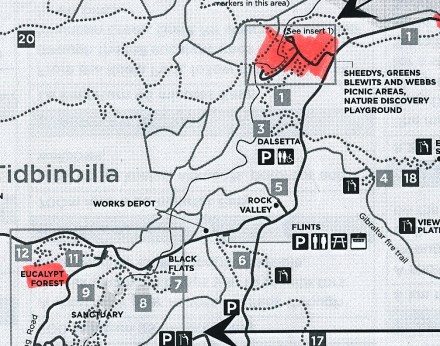
I planned three radio excursions while we stayed in Canberra. In the end I achieved two. My attempt to activate Mount Stromlo, VK1/AC-043 was abandoned. While I did read a number of blogs about this SOTA summit which suggested that the second hump, about 500 metres away from the Australian National University’s new building and the telescopes was suitable, on the day I decided it was too warm and too humid for the walk. I tried two locations and the noise level was about S8. I wanted to activate this summit because it was one I was not able to visit during May when I attended the Wireless Institute of Australia (WIA) Annual General Meeting. So I then decided to travel to Tidbinbilla Nature Reserve, VKFF-0989, about 37 kilometres from Canberra. This is a gated Park. On arrival I purchased an entry ticket ($7.50). This was a concession for Seniors. I didn’t ask for the concession. My hair colour probably did the trick! I didn’t regard this as ageist or reverse discrimination and I told the Rangers why I was visiting the Park and asked could they suggest any good locations. They were very interested in my radio activities. I took the liberty of giving them Andrew’s (VK1AD) blog URL and also mine. They produced a map, marked two spots, and suggested that I have a look. I checked out both locations and settled on the second away from any visitors. I had the area to myself for the whole time. I was impressed!
My spot at Tidbinbilla Nature Reserve
I enjoyed 22 contacts beginning at 01:25z on 7.095 Mhz and concluding on 14.310 Mhz.
01:25 VK2HPN 57s 51r, Phil
01:37 VK2FDAV 57s 55r, David Grafton
01:39 VK2IO 59s 46r
01:50 VK4RF 55s 55r
01:53 VK4HA 55s 55r
0152 VK3FQSO 53s 52r
01:54 VK2VW 59s 55r Brett
01:57 VK5FANA 54s 33r Adrian
02:02 VK3PMG 59s 43r
02:09 VK2NNN 59s 55r
02:07 VK1AD 52s 52r Andrew
02:08 VK2IO 59s 56r
02:10 VK2ZPF 59s 54r Peter
02:11 VK2YK/P 59s 55r Adam South West Rocks
02:17 VK3FLCS 52s 55r Brett Macedon Ranges
02:20 VK2EIR 59s 59r Joe Castle Hill
02:24 VK2VKB 57s 57r Kevin
02:26 VK3UH 55s 55r
02:28 VK6HSB/P2 59s 57r Steve at the Mystery Bay Caravan Park
02:32 VK2LKW 59s 59r Wolfgang Blue Mountains
02:47 VK2NBL 59s 58r Ray Melton
02:55 14.310 VK4ABJ 59s 58r Jeff Rockhampton
Operating conditions at Tinbinbilla Nature Reserve
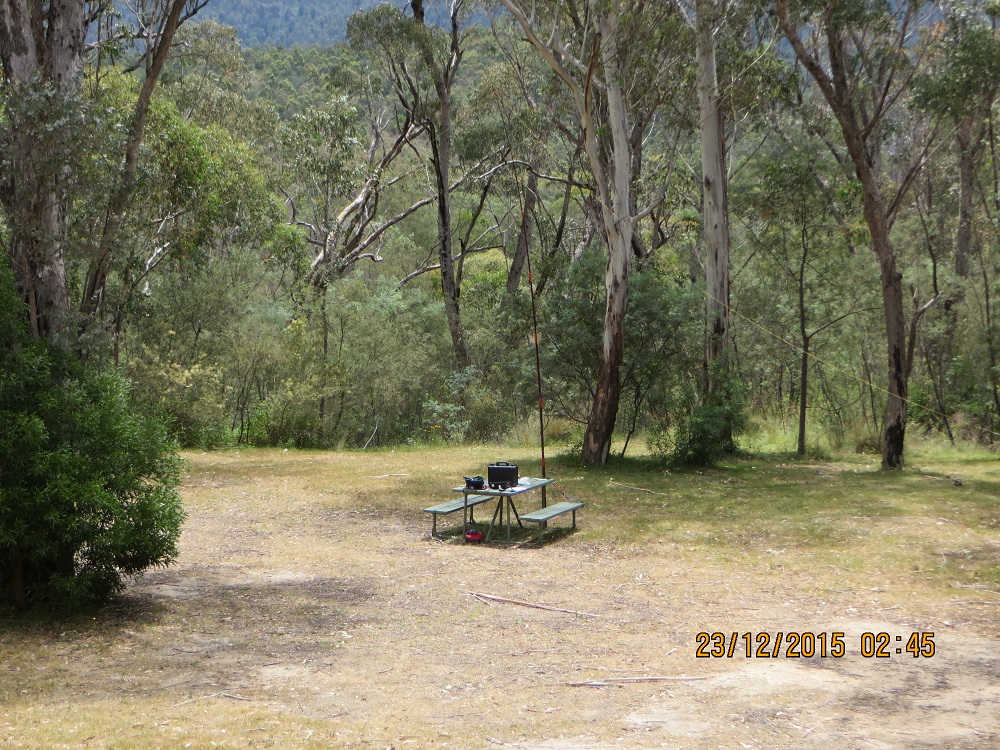
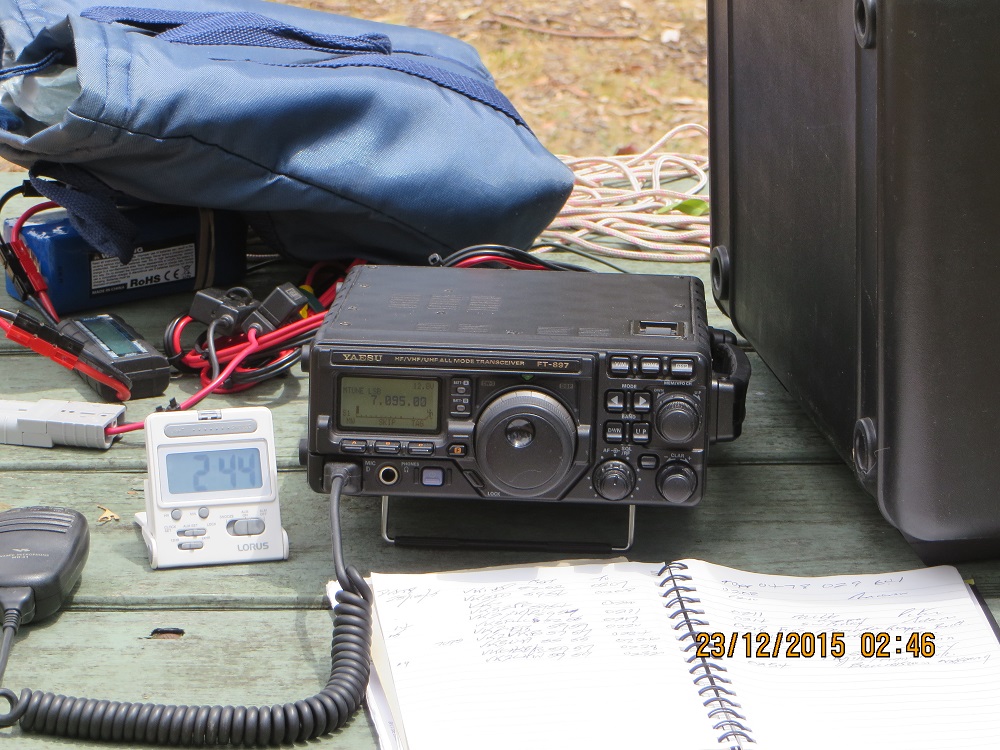
On this activation I used the FT897 set for ten watts and LiFePO4 batteries. The battery just visible under my lunch bag (insulated), which was used to keep the direct sunlight off the battery. This photo was taken in a quiet spot between my contacts with VK2LKW at 02:32 and VK3NBL 02:47. The FT 897 travels in the black plastic case protected by an foam inner lining. The picnic table was about 75 metres from the car park. The drive from Canberra to the Park is well sign-posted and I recommend this Park to any visitors to the ACT.
Again I would like to thank all of the chasers who helped make this activation so enjoyable.
The map shows a portion of the Tidbinbilla Nature Reserve (Map courtesy of the ACT Government). The two areas coloured in red are the suggestions made to me by the staff. I chose Webbs which is near the turning circle in the top shaded area.


 vk5bje