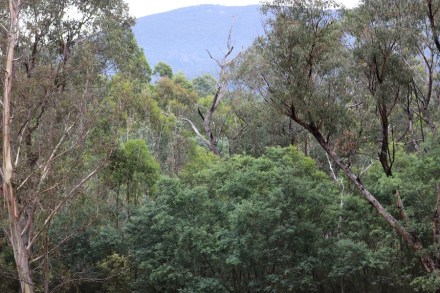
Murrumbidgee Valley National Park, VKFF-0554, 3rd January 2017

Our four day stay in Canberra came to an end on Tuesday morning 3rd January when we left to travel to Narrandera in New South Wales. Narrandera is one gateway into the Riverina area of NSW. We have stayed at Narrandera before and, on one occasion, spent time at the local cemetery looking for a memorial for one of Jenny’s ancestors. This time we were planning to visit the Murrumbidgee Valley National Park. This was a new park for me.

But more on the park in a moment. We planned to have lunch at Wagga Wagga and it was suggested by a volunteer at the local Information Centre that the Cafe at the Art Gallery would be a good choice. We were also told that the Archibald Portrait Finalists were on display at the Wagga Wagga Art Gallery. Here is a link to the portraits:

https://www.artgallery.nsw.gov.au/prizes/archibald/2016/

I made two choices, first, the portrait of actor Gary McDonald and second, the portrait of retired Victorian Supreme Court Justice Bernard Teague. Neither of my choices were successful but it will be interesting to see which portrait wins the People’s Choice Award.

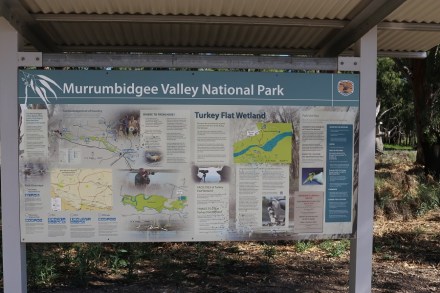
After arriving in Narrandera we set out for the Murrumbidgee Valley National Park for some bird watching and radio. We took the Irrigation Way from Narrandera to Yanco and then took Euroley Road before taking the marked track to Turkey Flat. The first few hundred metres of the track into Turkey flat is quite badly rutted and, if wet, would be impassable. It presented no difficulty to our Patrol but a small car would bottom out. I would recommend seeking advice if using a two-wheeled drive vehicle. Turkey Flat was the third marked entry to the Park along Irrigation Way.

murrumbidgee-national-park

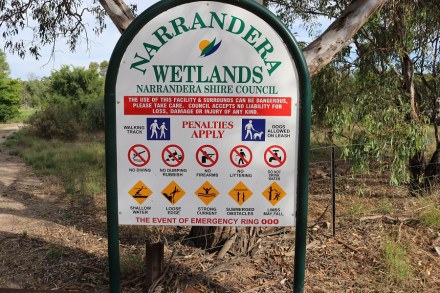
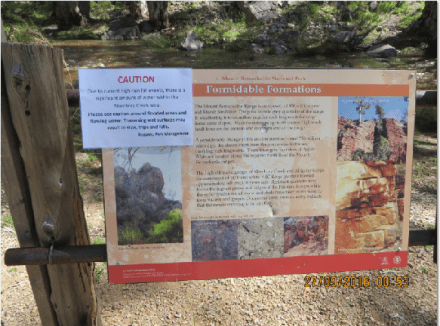
The notice board at Turkey Flat Wetland

murrumbidgee-np-my-operating-spot-new-growth

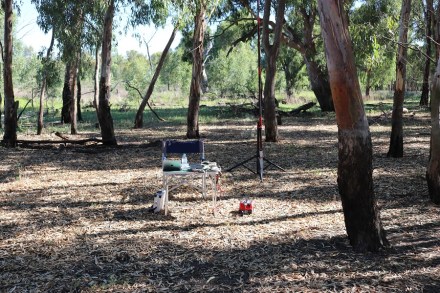
My operating position

new-growth-murrumbidgee-np

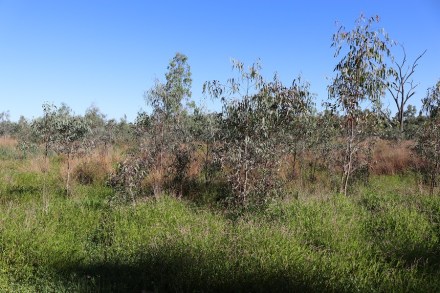
New growth along the river

birdhide-at-murrumbidgee-np

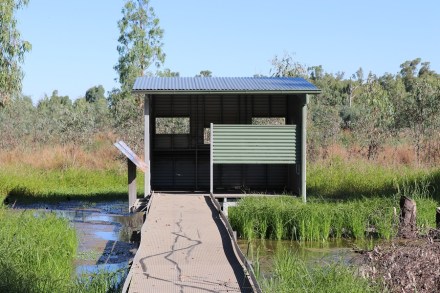
This photo shows the bird hide at Turkey Flat.

Despite the water on the ground and a wet year our visit was entirely mosquito free!

I checked 7.144 at 05:00 UTC and found it free.I gained 17 contacts which I was pretty pleased about given it was holiday time.

05:04 VK4FRAL

05:14 VK4XI

05:21 VK2YK

05:38 VK5KLV

05:40 VK5PAS

05:43 VK2FSAV

05:53 VK4FFAB

05:56 VK4HNS/4

05:58 VK4NH

06:01 VK4RF

06:01 VK4HA

06:04 VK7LTD

06:07 VK7FAMP

06:09 VK5KGP

06:12 VK5TW

06:13 VK5KPR

06:18 VK5MJ

I enjoyed this unplanned activation. Signals were good and it was a pleasant way to spend a late afternoon. I appreciated all of the stations who gave me a call.

Next morning we set out from Narrandera to Moama. But before leaving Narrandera we decided to visit the Narrandera Wet Lands within the town and near the road bridge. The aim was to see some birds and take some photos.

narrandera-wet-lands

narrander-stump-2

narrandera-stump

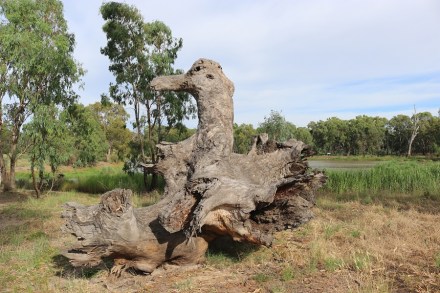
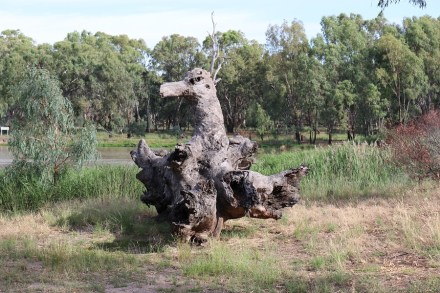
Stumps are popular photographic subjects but how much better when the stump is a dragon!

Tidbinbilla Nature Reserve, VKFF-0989, 1st January 2017

I visited Tidbinbilla Nature Reserve on the 23rd of December 2016 and managed 22 contacts. One of the challenges at Tidbinbilla is that there is no mobile phone coverage and you call CQ and hope someone hears you. Nearly always that happens but you might have to wait a bit or change bands. Here is a link to that activation:

https://vk5bje.com/category/tidbinbilla-nature-reserve/

We were making our way home from Sydney back to Adelaide and we decided to return to Canberra to see the Versailles: Treasures from the Palace exhibition at the National Gallery of Australia on Saturday 31st of December. It was stunning and well worth the visit. We spent over four hours at the Gallery. France was bankrupt by 1788 and, if you are fortunate enough to visit the Palace of Verailles, you will probably understand why there was a revolution. The wealth and grandeur on display there was won at the expense of the people of France. The exhibition in Canberra displays some of the wealth in paintings, carpets, statues and other artifacts.  I have wondered in the past about how out of touch with the people were the absolute monarchies, the Sun King and his two successors in France and Ludwig in Bavaria and the splendid castles he left. These wonders are now of course held in the name of the people and attract tourist dollars. Of course I have visited Ludwig’s castles as a Wagnerian and simply marvelled at the scenes from his operas which adorn the walls.

So after Saturday I thought I should spend some of Sunday, New Year’s Day, in a Park. I decided to return to Tidbinbilla and complete the activation and gain enough contacts to give me the 44 required. I arrived at the Park and drove straight in: there was no way to pay the fee as the office was closed and there were no envelopes or card facilities! If you look at a map of the park you will see there is a loop road beginning about four kilometres past the Tidbinbilla Visitor Centre. I drove the loop to see whether there were other good activation spots and there were (perhaps the most interesting area is where the road crossed the Tidbinbilla River) but I decided to return to Webbs where I activated on my last visit. It is a great spot and I once again had it to myself.

webbs-at-tidbinbilla-nr

The photo shows Webbs at Tidbinbilla Nature Reserve: there is plenty of room for a half wave dipole on 80 metres!

I checked 80 metres first of all and there were a few contacts underway up and down the band with good strong signals. I could even hear the South Australians on 3.594 Mhz, weak but perfectly readable. I give a few calls but they could not hear me. I was using my 857D set for 15 watts and they are all 100 watt stations. I called CQ on 3.612 Mhz for a few minutes hoping I would gain a contact or two but it was all in vain. I decided to move to 40 metres and checked 7.115 Mhz. It was clear and I called CQ at 21:57z. There were no responses. I decided to have a look around the band and heard VK1AD/P.

My first contact at 22:02 on 7.095 Mhz was with Andrew at, VK1AD/P, who was activating SOTA summit VK1/AC-023. We were both 5 and 5. Andrew kindly spotted me. There is no mobile phone coverage at Tidbinbilla.

22:04 VK1VIC/2, 51 43, Tony, VK2/ST-001. I thought I should quickly move back to 7.115 and checked the frequency once again and at 22:07 was called by Mick, VK3GGG/VK3PMG. His signal was 5 and 6 and I received a 5 and 3.

22:12 VK2FENG, Helen, 51 53

22:12 VK5IS, Ian, 59 57

22:13 VK1MA, Matt, 59 55, VK1/AC-008 and VKFF-0377

22:16 VK5KLV, Less at Port Augusta, 58 57

22:18 VK2IG, Mike, 55 51

22:22 VK5WG, Nev, 59 57

22:23 VK2HFA/P 57 53 near Port Macquarie

22:28 VK4AAC/5, Rob at Hahndorf 59 37. Rob was at Hahndorf (Australia’s oldest German town) where the WIA AGM for 2017 will be held.

22:30 VK5HYZ 57 53 David

22:32 VK7FAMP 53 43 Angela

22:35 VK2YES/P 52 57 Mario

22:37 VK7LTD 56 43

22:54 VK3ANL/P 55 45 VKFF-0750 & VK3/VC-031

22:57 VK3XV/P 59 57 Tony at Ham Hill

22:57 VK5RV 59 59 Ron

23:03 VK3FPSR 59 54 Peter

23:07 VK5PAS/M 59 58 Paul near Mount Bryan

23:09 VK7FRJG 55 55 Rod at New Norfolk

23:12 VK3SQ 59 58 Geoff

23:14 VK5ZAT/P 52 54 Nick

23:19 VK2YW 59 59 John

23:21 VK2IO/P 57 58 Gerard

23:24 VK3YSA/M 58 44 Anthony Melbourne

23:28 VK3XDM/3 53 52 Mitch VK3/VC-003

23:29 VK3EQ/3 53 57 with Mitch

23:38 VK1MA/1 53 53 Matt VK1/AC-008

23:45 VK5CZ/5 51 51 Ian VK5/NE-035 Ian

23:46 VK5NHG 51 51 Hugh with Ian

23:50 VK3ZPF, 57 57 Peter VK3/VC-005 in Yarra Ranges National Park

Thanks to all who gave me a call at Tidbinbilla Nature Reserve. Thirty three contacts , together with those from my previous activation, means I have more than the 44 contacts required to qualify the park.

brindabella-range-from-tidbinbilla

VK1MA/1, Matt was in the Brindabella Ranges (see photo above) at Mount Ginini and had a very strong signal, 5 & 9 but he was running more power than me and was elevated. I was operating at 15 watts and received 5 and 5.

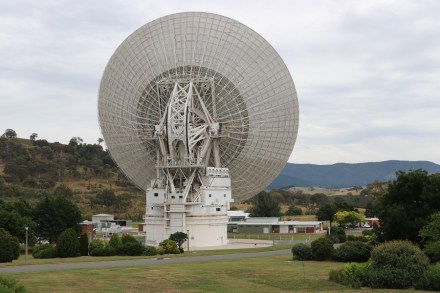
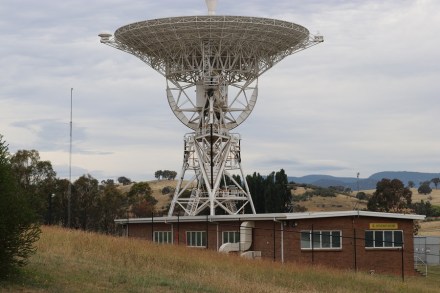
On the way back to Canberra I decided a coffee at the Cafe at the Space Tracking Station would be in order. I also wanted to see some dishes that the microwave enthusiasts would love!

tidbinbilla-space-tracking-station

rover-vehicle-at-museum

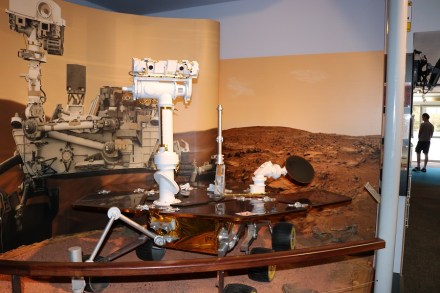
This photo shows a lunar rover in the Tidbinbilla Museum at the Space Tracking Centre. I recommend this as a splendid place to visit and the volunteer guide was very helpful and knowledgeable. another-dish

Finally, I would like to say how much I enjoy visiting the ACT. It is a beautiful place.

Scheyville National Park, VKFF-0444, 27th December 2016

Scheyville National Park is only a 20 minute drive from our son’s home at The Ponds. It is the closest national park to this area and Cattai National Park is not that much further to go. Here is a link to an earlier activation which includes some photos:

https://vk5bje.com/category/scheyville-national-park/

The land contains the remnants of a built environment. More details are provided in my earlier post. I did drive right through the park on this occasion looking for activation spots and chose to return to my first location used last time.

I thought I would make an early start at the Park and there was no one else there that I could see. I did have a break when a Ranger spotted me and drove down to my location from Memorial drive. He had never heard of amateur radio. He was quite interested in my set up and was fascinated by HF communications. Of course he knew about radio communications and pointed out the radio in his Departmental vehicle.  I showed him my log and at 22:42 UTC I had a contact with Ian, VK1DI/p, who was at Yurammie State Conservation Area, VKFF-1403 and my only park to park contact. He was impressed. I also showed him my post for my last visit to Scheyville, two years ago to the day. He pointed this out. He also told me that the ants that were attacking us were meat ants. They track down their prey – in this case humans and even if you move to a new location they soon find you! This is the first time I have spoken to a NSW Government Ranger.

I thought I would begin my activation on 3.610 Mhz at 22:02 UTC hoping to attract some nearby NSW amateurs and posted to this effect on Parks and Peaks. I did not get a contact on 80 metres which was a bit disappointing as I and others, especially Paul, VK5PAS, make good use of this band for portable activity at home and I had some success on 80 metres at the Greater Bendigo National Park.

I moved to 7.144 Mhz and called CQ at 22:09. Peter, VK3ZPF answered my call with s53 r52. A promising start was made on 40m and I had high expectations of a good morning, even though it is a public holiday here in NSW (and may be elsewhere).

Quite a few CQs later I worked Tom, VK5EE, at Mount Gambier 57 54

22:19 VK3FORD 55 55 Matt at Swan Hill

22:25 VK4HNS/P Neil 58 55

22:28 VK3PMG Mick at Stawell 59 57

22:29 VK3GGG 59 57

22:30 VK7AN Al on the North East Coast of Tasmania 59 57

22:33 VK5HCF Tom at Mount Gambier 59 54

22:35 VK5PAS 59 57

22:38 VK3SQ Geoff 59 54

22:42 VK1DI/2 Ian at VKFF-1403

22:45 VK2KYO Ken 59 55

22:48 VK2HHA 59 59 Denis Albury

22:51 VK5FMWW Mike 55 45

22:52 VK5FVSV 55 45

22:54 VK5ZGY Greg 51 51

22:57 VK7CW Steve 59 57

22:59 VK2MTC 59 59 Greg at Cooma

23:00 VK2XXM 59 58 Robert

23:03 VK3MRG 51 51 Marshall

23:07 VK3RV Peter 59 55

23:15 VK3WQ Jenny 59 56

23:19 VK4RF Rick 59 57

23:10 VK4HA 59 57

This is the point where the Ranger visited and at 23:43 I called CQ on 14.310 for quite a few minutes before returning to 7.144. I made no more contacts but it was a most enjoyable activation and thanks to all who gave me a call.

Mount Ainslie, VK1/AC-040 & VKFF-0850, 20th December 2016

I had been in contact with Andrew, VK1AD, about activating Mount Ainslie, VK1/AC-040, while in Canberra on our way to Sydney. This discussion followed an earlier one based on his blog and description of Digital Mobile Radio (DMR) and the new 70cm repeater for that mode commissioned in Canberra.  I noted from Andrew’s blog that he had used DMR on UHF for SOTA activations. But the story begins earlier than that.

In October I chaired a general meeting of the Adelaide Hills Amateur Radio Society, where two Adelaide amateurs presented an introduction to and demonstration of DMR. The Club President, Barry Williams, VK5BW, was ill with a late winter bug that had been doing the rounds in Adelaide.  Barry asked me to step up as Chair which I gladly did. Later I decided to purchase a radio for DMR: a Tytera MD-380 which I imported from China. I spent a week or more reading the reviews of non Motorola radios designed for DMR (which Motorola developed) but which is open to any manufacturer to use.  One of the Adelaide presenters sent me a Code Plug (DMR language for configuration file) for the new Adelaide repeater. I loaded this into my radio and travelled up to Mount Lofty and enjoyed my first contact with another Barry, in Sydney, via talk group 505. I was impressed with the received audio from the repeater, although there was some R2D2 on Barry’s signal into the Sydney repeater he was using. (R2D2 is the name of a droid from the original Star Wars film dating from 1977 and he/she/it had a very mechanical/machine sounding voice). Programming the radio requires a computer. I duly programmed in 439.200 Mhz which is the suggested simplex frequency for DMR. However, I found out that in Canberra 439.0125 is the simplex frequency. The Tytera is sold as capable of operation on 400 Mhz to 580 Mhz as a commercial radio. To be legal for amateur use it must only be programmed with amateur frequencies and mine contains Adelaide, Canberra and two Sydney repeaters only. It is not easily capable of being programmed from the key pad.

If you would like to learn more about DMR here is a link to the Australian information page: http://www.vkdmr.info  In simple terms DMR, standing for Digital Mobile Radio, is an increasingly common commercial digital mode for use on VHF and UHF. Amateurs began acquiring used Motorola radios and using them on the VHF and UHF amateur bands. There are many commercial digital systems and another of interest to amateurs is P25. These systems compete with Dstar from Icom and Kenwood and other makers and C4FM from Yaesu. There are plenty of comparisons between the systems on the web and I have found these of interest, especially where the authors declare their biases. What makes DMR so interesting to the amateur experimenter is that is a TDMA system: Time Division Multiple Access, and thus supports two contacts simultaneously on the one repeater. I have been impressed with the recovered audio from Tytera MD-380 but the same applies to my Dstar radios. What you hear depends on  the quality of the in-going signal and the distance from the repeaters at each end.

I had from home arranged to meet Andrew on the summit of Mount Ainslie with the aim of securing four contacts using DMR to successfully activate the summit for SOTA. Andrew had emailed the club members in advance that the activation was going ahead and could they kindly listen out for me. Well the week before Christmas is always busy and no doubt that was the case in Canberra. I was delighted to gain one DMR contact with Jim, VK2MK/1. Many further calls were made on on 439.0125 by both Andrew and I without success. A change of plan was called for. Andrew once again alerted the locals via the Mount Ginini two metre FM repeater and I was able to well and truly qualify the  Peak on two metres FM. The highlight contact was with another on the Canberra amateurs called Andrew, VK1DA/p (also VK2UH) portable on Mount Taylor, VK1/AC-037. My log is reproduced below with ten contacts achieved. In addition to Andrew’s TYT DMR radio we used my ICOM IC 80AD hand held ( DStar and FM) and Andrew’s dual band FM Yaesu handheld. I think it is so good to use frequency bands other than 40 metres for SOTA and Parks activations.

The late afternoon was splendid, warm and with a breeze that dropped as the time progressed into early evening.

Date:20/Dec/2016 Summit:VK1/AC-040 (Mt Ainslie) Call Used:VK5BJE/1 Points: 1 Bonus: 0

Time   Call   Band   Mode   Notes
05:57z VK2MK/1 433MHz Data DMR Jim
06:14z VK1SP 144MHz FM Wedge
06:20z VK1FCBX 144MHz FM Ross
06:23z VK1EM 144MHz FM Mark
06:24z VK1GT 144MHz FM Graeme
06:28z VK1RX/M 144MHz FM Al
06:50z VK1MBE 144MHz FM Andrew
06:55z VK2MWP 144MHz FM
06:55z VK1MBE 144MHz FM Andrew
07:05z VK1DA/P 144MHz FM VK1/AC-037 Mt Taylor Andrew

This was my third activation on Mount Ainslie and I have activated it for SOTA and WWFF. I have previously qualified the park, Mount Ainslie Nature Reserve, for VKFF. I had a most enjoyable time and wish to thank Andrew, VK1AD, for his generosity in being part of the activation , together with the use of his DMR radio and the local amateurs who gave me a call. I am returning to Canberra on our return trip to Adelaide to meet up with Andrew again for further activations on HF.

Here are links to my previous activations on Mount Ainslie:

Mount Ainslie, SOTA, VK1/AC-040, VKFF-0850, 24th December 2015

Mt Ainslie, VK1/AC-040, 9th May 2015

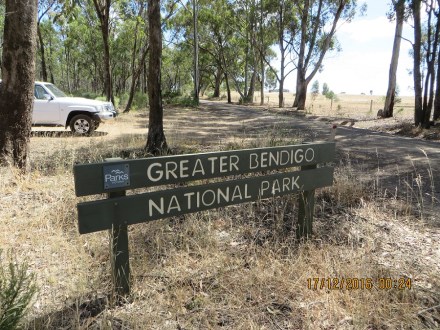
Greater Bendigo National Park, VKFF-0623, 17th December 2016

My motivation for a third visit to the Greater Bendigo National Park was to complete 44 contacts for the WWFF program. Here is a link to my last activation of this park: https://vk5bje.com/category/greater-bendigo-national-park/

After leaving Ballarat we travelled to Bendigo.

greaterbendigonpv1

Photo shows the corner of Hart Road (a track) and Wallenjoe Road

We planned to stay one night and then travel to Koondrook on the Murray, near the Gunbower National Park, for a cruise on the Murray River and a further activation of that Park. However, those plans did not eventuate and we stayed a second night in Bendigo. The additional night enabled us to catch up with another University friend from the 1960s. The three of us were all in a residential college at the University of Melbourne and our friendships have survived over 50 years. I attended the wedding in Mildura of the couple from Ballarat while I was in College. The fourth member and his wife live in Tasmania.

On the way to Bendigo we stopped at Daylesford for coffee. While seated at an outdoor table I noticed the man on the adjoining table. He had a back pack with him and was engaged in conversation with two other men.  Then the two left and he was on his own. Suddenly a voice emerged from the backpack and I could see he had radio antennas protruding from it. I engaged him in conversation and he told me he was an amateur radio operator and was also a volunteer with the local CFA brigade. His name is Stewart and his call is VK3FSTU. We conversed for quite a while until we had to leave. I said I would monitor the two metre Mount Alexander repeater and after we were well on our way up the Calder Highway heading to Bendigo he gave me call. This is just one of many such experiences I have enjoyed over the years meeting fellow amateurs on the road.

On the way to Bendigo I was feeling a little unwell. I noticed that my heart rate was varying. The condition is called Atrial Fibrillation and was diagnosed late last year. I have been prescribed medication and have been taking this regularly and more recently the condition has become better controlled so I was a little surprised. I did plan to activate the Park during the afternoon of my arrival but decided against that idea. I posted an update to my alert indicating I was having TCXO (temperature controlled crystal oscillator) trouble! A little rest during the afternoon and all was well again so a mere 12 or so hours later I was off to the Park.

On the morning of the 17th, before UTC rollover, I decided to go back to the Huntly block. I have activated this park from four locations, three different, but I recommend the Huntly block. Here are the coordinates for anyone who is interested:

S 36 38.828 and E 44 18.329.

Take the Midland Highway for about seven kilometres past the fountain, to Lean’s Road (a left hand turn as you leave Bendigo) them drive Lean’s Road to Wallenjoe Road and take (a right hand turn) to Wards Road. At this intersection Hart Road (a track) turns off at 45 degrees. My activating spot is about 500 metres along the track into the Park and is suitable for a normal tw0 wheel drive vehicle.

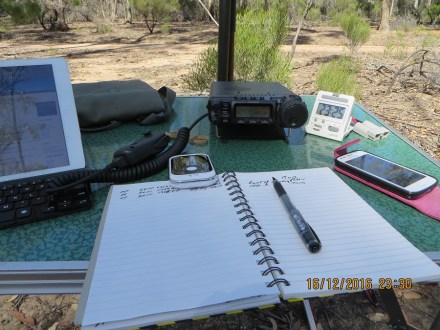
my-operating-position-gbnp

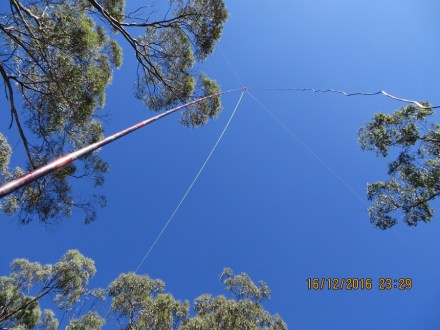
For this activation I used my Yaesu FT857D set for ten watts with a linked dipole capable of operating on 80 metres.

looking-up-the-antenna-set-for-80-metres

I was on the air before UTC rollover (16th December 2016) and commenced operations on the 80 metre band. Here is my log of contacts:

3.594 21:58 VK5KAA, Gordon in the Adelaide Hills, a neighbour, s55 r53. The half hour time difference between Victorian and South Australia meant I could join my regular morning net.

21:59 VK5ZK, Garry 59 54

22:00 VK5TW, Trevor 58 45

22:01 VK3LY, Bill de Nhill 59 58

What a great start to the activation speaking with four of my mates on 80 metres and the first time I have used an 80 metre dipole in the field for 15 years.

I then moved to 40 metres and found 7.110 free.

22:05 VK5BC, Brian, also a mate of mine 59 57 22:15

Then followed a succession of regular chasers, all well known:

22:24  VK5IS/2 Ian 56 57

22:26 VK5PAS 59 57 (it was great to hear Paul on 40 metres, but I was planning to go back to 80m later to catch some of the ‘closer’ in amateurs who might miss out if I stayed on 40m.

22:29 VK5MRT Tony 57 57

22:33 VK4HNS/4 Neil holidaying at Gundawindi

22:35 VK5FMAZ 59 59

22:38 VK5FMWW 59 58 Mike at Second Valley

22:39 VK5FVSV 59 58

22:41 VK5HS 59 55, Ivan at Renmark

22:42 VK2XXM 58 58 Robert Grafton

22:45 VK2VW 59 59 Brett

22:47 VK1DI 59 58 Ian Canberra

22:50 VK7NWT 59 57 Scott

22:54 VK5PAS 59 59 Paul

3.610 23:00 VK5PAS/M 56 35 Paul in his vehicle in the drive

23:02 VK3GGG 58 57 Mick

23:05 VK5PMG 58 57

22:07 VK3VBI 58 57 Ron

23:09 VK3ACJ 59 59 Peter near Lake Eppalock

23:17 VK5EE, 59 54 Tom

7.144 VK5GJ, Greg 59 57

23:31 VK4HNS/4 Neil 58 32

23:33 VK5GI 58 45 Norm

I quite enjoyed my visit to the Greater Bendigo National Park, made all the more fun by those who gave me a call. Contacts are always appreciated.

Mount Arapiles-Tooan State Park, VKFF-0765 & VK3/VW-022, 15th December 2016

On the 14th December 2016 we left home on our driving holiday to Sydney to see our son and his family for Christmas. This is the seventh such road trip and before that he lived in Perth. We made at least three visits to Western Australia to see him and they were all camping trips with added expeditions, always involving radio and often staying in and activating National Parks before the WWFF program was conceived. Many, but not all, contacts were pre-arranged.

Our first overnight was at Naracoorte and early the next day set out for Ballarat where we were visiting old friends from our University days in the 1960s. On the way we visited Mount Arapiles-Tooan State Park to activate the summit. I was not eligible for the one point on offer as I had activated Mount Arapiles in March. Here is a link to that activation, my second:https://vk5bje.com/2016/04/21/mount-arapiles-vk3vw-022-vkff-0765-11th-april-2016/

However, I was keen to secure sufficient contacts to qualify the Park for the WWFF program aiming for at least 44 contacts. I made 24 contacts with VK 1, 2, 3, 5 and 7 stations and, with those already in the bank, now have the 44 needed. Here is my log for the activation:

Date:15/Dec/2016 Summit:VK3/VW-022 (Mt Arapiles) Call Used:VK5BJE/3 Points: 0 Bonus: 0 Delete

Time   Call   Band   Mode   Notes
00:06z VK5FANA 7MHz SSB
00:10z VK2UH 7MHz SSB
00:13z VK3PF 7MHz SSB
00:14z VK2KYO 7MHz SSB
00:15z VK3RW 7MHz SSB Ray Benalla
00:17z VK2HHA 7MHz SSB
00:19z VK2IO 7MHz SSB
00:22z VK7LTD 7MHz SSB
00:23z VK1DI 7MHz SSB
00:26z VK7FAMP 7MHz SSB XYL VK7LTD
00:29z VK5GJ 7MHz SSB
00:37z VK5PL 7MHz SSB
00:39z VK5PAS 7MHz SSB
00:42z VK5ZK 7MHz SSB
00:44z VK2EXA/3 7MHz SSB
00:55z VK3KAI 7MHz SSB
01:01z VK3GP/M 7MHz SSB
01:12z VK5GP 7MHz SSB Glynn Murray Bridge
01:14z VK5NRG 7MHz SSB
01:18z VK5GI 7MHz SSB
01:18z VK5ZPG 7MHz SSB
01:18z VK3GV 7MHz SSB
01:18z VK5ZPG 7MHz SSB
01:19z VK3SQ 7MHz SSB
01:20z VK5FANA 7MHz SSB
01:25z VK2UH 7MHz SSB
01:26z VK1DA/2 7MHz SSB

I did set up my antenna for 80 metres, but the only way I could do this was with each leg at 90 degrees to the other. I could not get the VSWR down low enough to use it. One of the challenges of setting up a portable antenna (a dipole) for 80 metres is the space required and on Mount Arapiles this was a challenge. I have subsequently used the antenna in a more traditional layout and it works really well. See my forthcoming post from Greater Bendigo National Park.

I would like to thank all of those operators who, during the busy Christmas period, took time out to give me a call. I hope Santa brought you all a new radio!

The impact of trees on radio propagation, 8th December 2016

The Impact of Trees on Radio Propagation

John Dawes VK5BJE/VK5PF

This paper came about because Paul, VK5PAS, was told by a European amateur, who in responding to a photograph of Paul’s portable station, suggested his antenna was too close to trees and that this would impact negatively on propagation. Paul asked me to write something on this topic for Out and About.

I should declare at the outset that I do not have formal qualifications in physics and simply hold an AOCP (1977).

However, I said I would tackle the topic as an amateur radio operator.

Trees belong to a class of organic objects which include shrubs and ground cover plants, such as native grasses, which might all have a potential impact on radio propagation. The factor of interest is absorption, but could include other factors such as directivity. If trees and other foliage absorb radio frequency energy (RF), is this a serious matter and likely to adversely affect a portable amateur radio station? Many objects are able to absorb RF, for example, people, cars, rocks, hills as well as foliage.

In my experiments on 23 cm with Brian, VK5BC, Brian noted that an increase in signal strength at his home station occurred if he turned his beam towards the local silos at Gawler. I know from Amateur Radio Magazine, that Justin (VK7TW) reported that amateurs in Hobart use Mount Wellington as a passive reflector for 23 cm transmissions around the city and environs. Those of you with two metres and 70 centimetres transmission capability in your vehicles will know that antenna placement is critical in determining the radiation pattern. Roof top centre-mounted antennas are more likely to result in a donut-shaped radiation pattern and perform better. You are also likely to have experienced ‘flutter’ on mobile VHF and UHF, as well as with FM broadcast transmissions caused by objects, including plants, in the propagation path.

When it comes to absorption of radio waves by foliage this has been researched for several decades (see Goraishi, Takada & Imai, 2013, ch 6).

More recently telephone companies have driven this research on the impact of foliage on their UHF and microwave transmissions because they want to know how foliage might change the radiation patterns from their phone towers, especially when foliage is suggested as a factor in persuading the local neighbourhood to accept a tower, as was the case recently at Bridgewater in the Adelaide Hills.

An internet search revealed a plethora of articles, some scientific, of absorption at UHF and microwave frequencies and many articles by amateurs about foliage and HF. The latter were more subjective and observational as one would expect from amateurs who do not have the resources available to research institutions, government and military.

When I later conducted a search using Google Scholar I found well over 100 refereed journal articles. A meta-analysis of these is beyond my capacity and time. So returning to observational approaches to understanding absorption has been the field of amateurs.  Carefully recorded observations can be useful. I know from my own experiments on 70 cm using ATV (AM), SSB and FM foliage has an impact on signals. Flutter noise and fluctuating signals resulted, especially when the foliage was wet (see Meng et al, 2009) and the impact on ATV was more noticeable because of the 7MHz wide channel. With digital television signals, at home if I walk through the signal from channel 44 the picture pixilates.

At the empirical level many of the reported experiments targeting the interaction of radio waves with vegetation in a spatial sense used directional antennas (beams). This is the simplest approach (see Ghoraishi et al, 2013). Their conclusion ‘is that the airy spaces in the vegetated area can have a crucial influence in directing the signal toward specific directions, to be re-directed by foliage with the line of sight towards the receiver”. Or, in my words, such a situation can have unintended consequences in terms of the target area for your signal.

What about foliage at HF frequencies?

Should we give up using trees as antenna supports for our stations in the field or at home? My answer is a strong NO! Experiments at HF are much more difficult to construct. There are simply too many variables to control, for example, the sun (the K and A indices, the solar flux, the time of the year and the season), antennas, structure, type, direction, the skill of the radio operator (the art of communication) and equipment. What we can say is that trees are small, relatively in terms of wavelength. Australian trees, especially eucalypts, are generally less dense than trees that grow in colder climates, Europe and North America for example. And our portable experiences would be poorer if we couldn’t find a magnificent shade tree to keep the sun away in an extended activation while the tree also supports one end of the antenna. My view is that the losses in miss-matched antennas, batteries with reduced voltage and lack of operator skill are more likely to impact on the success of your day out.

Just beware that some Australian eucalypts can drop branches, especially on a hot day after wind. So be careful!

References

Giles-Clark, Justin, VK7-News, Radio and Electronics Association of Southern Tasmania (REAST), Amateur Radio Magazine, October 2016, pp 62-63

Ghoraishi, Mia, Jun-ichi, Takada and Imai, Tetsuro, (2013), Radio Wave Propagation Through Vegetation, Chapter 6. Accessed 6th October 2016. http://dx.doi.org/10.5772/52571

 Meng, Y. S., Lee, Y. H. and Ng, B. C., 2009, STUDY OF PROPAGATION LOSS PREDICTION IN FOREST ENVIRONMENT, Progress in Electomagnetics Research, B, Vol 17, 117 – 133

This article first appeared in Out and About, Issue 26 December 2016


Eqsl award: worked three hundred prefixes confirmed

eqslThis award is for three hundred confirmed contacts via the eqsl system. The contacts comprise a mix of ssb and digital (JT65HF).  You might wonder what happens to the ‘wall paper’. No, I don’t frame certificates and place them on the wall. I turn them into place mats by laminating them in plastic. I now have enough place mats to set up a restaurant!
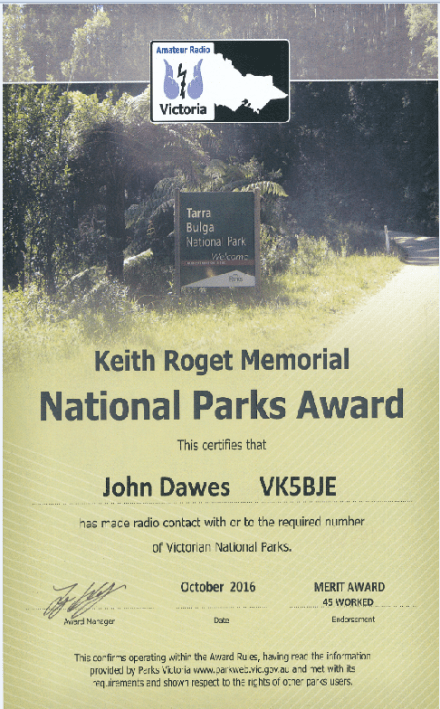
Keith Roget Memorial National Parks Award Merit, November 2016

krmnpa

I was pleased to receive the Keith Roget Memorial National Parks Award at Merit level. It took me over four years to secure the award chasing contacts in Victorian Parks when I had some free time, mainly at weekends. I also secured Parks while operating portable in National Parks in South Australia, Victoria and New South Wales. Many of the Victorian National Parks we have visited both as National Parks or as Crown Land, but what this award did was to encourage me to become familiar with the more recent parks, their history and geography and the reasons for their protection. I congratulate Amateur Radio Victoria and the Awards Manager, Tony Hambling, VK3VTH, VK3XV for sponsoring this award. I recall reading about Keith Roget early in my amateur radio career while living in Melbourne. I have recollections of hearing him in the field and marvelled at the heavy radio transceivers and batteries required for voice activations before minaturisation and solid state technology became common place. Finally, thanks to all of the portable operators who enjoy operating low power radios from Parks, and who all now radio friends!

Mount Remarkable National Park, 27th September 2016

I was keen to get back to Mount Remarkable National Park to complete 44 plus contacts for WWFF. I had been to this beautiful park many times, including camping at Mambray Creek and have operated my portable station from three locations within the Park. Here is a link to my previous activation:

https://vk5bje.com/category/mount-remarkable-national-park/

mount-remarkable-from-matthew-flinders-lookout-arid-gardens

Mount Remarkable from Matthew Flinders Lookout over Gulf

This time I wanted to operate from the Napperby Block. The Park is in two sections and my last three activations were in the Mount Remarkable section. I checked the DEWNR web page and found that the Department was conducting pest eradication in the Napperby Block  and the nearby Telowie Gorge Conservation Park. Now while some people might consider amateur radio operators ‘pests’, I did not want to be in their ‘sights’. The most common pests are goats, not Mountain Goats of the Summits On The Air type, but four legged ones! So I decided the the Mambray Creek camping and picnic area would be a good choice. Mount Remarkable National Park attracts fees for campers and vehicles. For day visitors the cost is $10 ($8 concession). I knew from my last visit to Mambray Creek that internet coverage is only available near the main entrance and soon disappears within the folds of the hills. I stopped and paid my fee using my Ipad and credit card and saved the receipt so I could show that I had paid the appropriate fee.

I was soon in the park and drove through to the day visitors area. There was only one other couple present although there were school buses parked suggesting that there were school children camping and or walking in the park.

I was soon set up and ready to go and after checking the frequency called CQ about 10 minutes before UTC rollover. But the new day dawned before I made my first contact! I was fortunate to obtain 21 contacts as band conditions on 40 and 20 metres were poor. Contacts were made with VK 1, 2, 3, 4 and 5 stations. I also tried 20 metres without success. I was hoping to be heard in VK6. Thanks to all who gave me a call and to those who patiently waited until the band opened and gained a contact quickly. Signals were not loud and QSB (fading) was rapid. I now have 44 plus contacts for this park.

mambray-creek-in-flood

This photo shows the Mambray Creek in flood.

The weather was great, warm, sunshine and no wind. It was in fact the calm before the storm! The Mambray Creek which runs through the Park was flowing rapidly and just within its banks. The Rangers had posted warnings about taking care near the creek and this Park and many others in the State were closed the next day as a result of the very severe weather system.

mambray-creek-warning-notice

This photo shows the warning notice about the creek.

The activation was leisurely  and I had many visitors both human and animal (grey kangaroos, grey butcher birds, kookaburras and many little brown birds (LBBs). A number of visitors were interested in what I was doing and, in turn, I heard stories of knowing amateurs and having a grandfather who was an amateur.

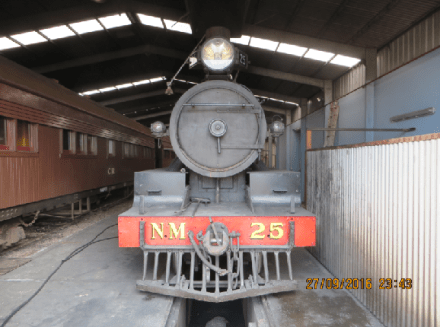
About mid-afternoon it was time to drive to our accommodation in Port Augusta and to a later dinner engagement. Tuesday evening we had dinner with Les, VK5KLV and Kaye and Peter, VK5KPR and Kate. We had a splendid evening talking about many things, not just amateur radio. Peter and Kate are long-time and active members of the Pichi Richi Railway Preservation Society Inc. and early Wednesday morning I accompanied Kate on a special visit to  to the Memorial Operations Centre to see the Afghan Express and steam locomotive NM 25.

This train, entirely comprised of ex-Commonweath Railways rolling stock is stabled at Port Augusta. The train will make a return journey to Quorn over the long weekend ahead. One preserved carriage was used by General Douglas MacArthur to travel from Alice Springs south and eventually to Melbourne and later Brisbane to oversee the allied war effort against the Japanese. It was at the Telowie station that MacArthur made his famous speech, ‘I shall return’. Anyone who visits this part of South Australia should, if at all possible, take a trip on the Pichi Richi Railway. Here is a link to a previous post featuring the Pichi Richi Railway:

https://vk5bje.com/category/pichi-richi-railway/

nm21-ex-commonwealth-railways-ghan-steam-engine

NM 25 ex-Commonwealth Railways locomotive

builders-plate-v1

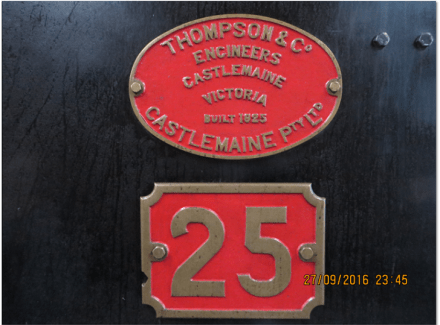
Builder’s plate NM 25: many steam locomotives were built at Thompson & Co

dedication-plaque

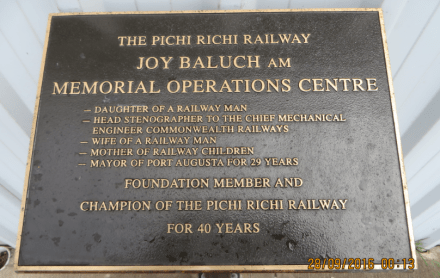
Memorial to Joy Baluch AM: Mayor of Port Augusta for 29 years

coat-of-arms

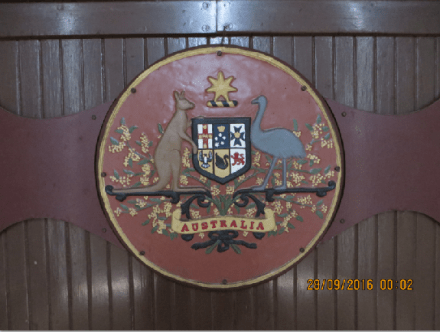
Australian Coat of Arms affixed to side of carriage

Unfortunately I could not continue with my proposed activations on Wednesday and Thursday as the wind was too strong and the heavy rains were just beginning. It was raining lightly when I arrived at the Memorial Operations Centre to see the train. I knew before I left home that rain was predicted but not the cyclonic conditions that impacted quite widely on the State. At about 4.00 pm the power supply to the state shut down. We spent the evening having dinner by candlelight. The motel staff were able to complete cooking by gas and when we returned to our room we listened to ABC local radio from Port Pirie and 891 Adelaide to keep up with the unfolding drama. We decided to remain in Port Augusta on Thursday to avoid being on the roads but travelled home early Friday morning to ensure we were not further delayed by road closures at Port Wakefield. CFS crews were placing sand bags around the Lower Light Hotel as we drove past and the highway was later closed at Port Wakefield as predicted. Water was lapping at the top of the culverts on the highway at Lower Light when we passed by.

Contacts

VK7FMPR Mark

VK2CIM P2P  Hattah Kulyne National Park

VK3NCC/P

VK3FQSO

VK3FLAK

VK4FW

VK2PDH

VK3GGG

VK3PMG

VK3OHM

VK4AAC/P3

VK2PKT

VK3SQ

VK3PF

VK5EE

VK4RF

VK4HA

VK2MTC

VK3SFG

VK1AT

VK3SQ