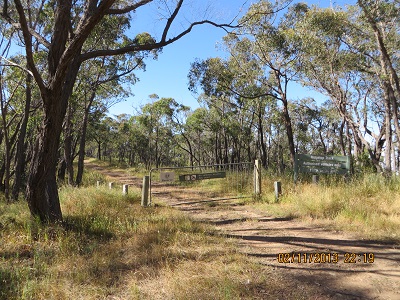
Mt Lofty, VK5-SE-005, a night time activation with VK5PAS/p, 6th November 2013

Paul suggested to me through the day that he was going to activate Mt Lofty at night. It was predicted to be a warm night and that is how it turned out. He invited me to come along. I could not resist. We shared his gear although I had three batteries in the car, two not used and antennas, squid pole and transceivers: all my gear from Port Gawler Conservation Park. I arrived at Mount Lofty at about 1900 hours local and Paul already had an impressive list of contacts in his log. He invited my to activate Mt Lofty, which is also in Cleland Conservation Park. I got to work and the following contacts were made on 7090 beginning at 08:52: VK3AMB, Bernard; VK5CZ, Ian; VK2JI, Ed; VK3YE/ pedestrian mobile, Peter; VK3OHM, Mark; VK3XL, Mike; VK2YK, Adam; VK3MRG/p, Marshall in his back yard; VK3FBCK, QRP, Nick; VK3ARR, Andrew; VK5MBD, Bill; VK3MRG, Marshall, QRO and VK2IWO, Romesh.  Later in the evening on the 7.130 net, I had contacts with VK5MJ, Mal; VK2HAA, Dennis; VK7DON, Don; VK4TH, Andy; ZL2ASH, Brian and VK7ROY, Roy. I did try to call FO5JV, William at Tahiti, but conditions had changed. Paul had a successful contact with William earlier in the evening: it was a highlight of a great evening. I enjoyed my 19 contacts and wish to thank all who gave me a call. I have now completed three SOTA activations.

Here is a link to Paul’s splendid video of the activation: http://youtu.be/nV6MNznDfYA

Port Gawler Conservation Park, 6th November 2013

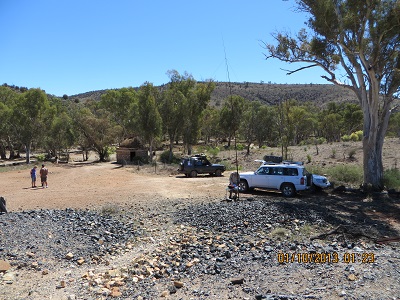
My radio day had a second beginning on Wednesday, (the first was at 08:00 local with the 7073 net) when I received a message on my phone from VK5PAS/p, Paul. The message arrived at 10:43 am local time and indicated that Paul was activating Black Hill Conservation Park. I raced into the shack and was able to work him on 7100. This inspired me into action! I was about to leave the house anyway because of the fire danger rating in the Adelaide Hills. I thought I should also activate a park. I chose Port Gawler Conservation Park because it is on the Adelaide Plains, about 32 kilometres North West of Adelaide, near the coast and away from the hills. In the rush I forgot my camera! So I took the coordinates of my operating position: S 04 39 155 and E 108 26 786. I chose this spot away from the end of Port Gawler road to avoid parking in the turning circle.  Port Gawler can be accessed from Highway One.

Port Gawler conserves coastal mangroves which in turn provide breeding habitat for local fish species so prized in South Australia. As I drove into the park down Port Gawler Road I kept seeing signs suggesting the park is patrolled frequently. As I was researching this park prior to my activation I came across a report of vandalism and use of the park for non-approved purposes http://www.plainsproducer.com.au/?p=513  Nevertheless all was quiet during my visit. A few cars were heard on Port Gawler Road but I was off on the northern side three or four hundred metres away.

I used a fence post to secure my squid pole and it was a pretty good spot: except for the flies. I had the following contacts beginning at 03:08: VK5PAS, Paul now back at his home; VK5YX, Hans; VK3BWZ/p, Bob at Merino; VK5AV, Tim; VK5KBJ, Barry; VK5MCB, Mike from Port Pirie who I had met at the SOTA lunch at Gawler; VK5FCLK, Chubba; VK5EE, Tom; VK5FMID, Brian; VK3BWZ/p, Bob for a second contact; VK5PAS, Paul; VK5DJ, John and VK5ATQ, Trevor. Thirteen contacts in what I thought were pretty reasonable conditions on 40m, given the propagation upheavals of recent days.

An alternative to a Buy and Sell

Today in South Australia our most significant ‘ham fest’ takes place which is organised by the Adelaide Hills Amateur Radio Society Inc. Many South Australian amateurs make their way to the Goodwood Community Centre. So do some from interstate: amateur suppliers and specialists with their cars and trailers loaded up with ‘goodies’. The motivations for the pilgrimages are varied: for some it is to purchase a new transceiver or a desirable bit of extra gear for the shack. For others it is to carefully search out someone’s no longer wanted items for something that will find a new home with a new owner. For others it is to share a special interest, for example, SOTA; DStar or the VK5 National and Conservation Park award and try and win others to these special interests.  And for still others it is a social event frequently followed by lunch at a local eating house!  I normally make this pilgrimage!

This time I could not go. I was required in Clare to play with the Payneham Community Band. We all had a great time on Saturday evening with the local community band. But Sunday was free. I decided I would indulge my amateur radio interest with some visits to parks and one Sota summit. I selected two parks near Clare.

Spring Gully Conservation Park, 3rd November 2013

Spring Gully Conservation Park

Spring Gully Conservation Park

Spring Gully Conservation Park is about 12 kilometres south of Clare. It conserves a beautiful section of local bush, 96 hectares, in an area otherwise used for grazing, cropping and known for riesling and shiraz, among many varieties, the famed Clare wine region. I enjoyed seven contacts: at 22:46 I called CQ and my call was answered by VK5EE, Tom from Mount Gambier; VK5YCP, Chris; VK2AWJ/ QRP, Gol Gol using a KX3; VK3AFW, Ron; VK5FMID, Brian; VK3MRG/p QRP, Marshall on VK3 VN-009 and VK5HS, Ivan, and completing seven contacts before UTC rollover. It was a magnificent morning, sunny and warm and I listened to the WIA broadcast and the local club news and tried to join the call back on 7.135 Mhz. Although local signals were 5 and 9 from Adelaide, none of the Adelaide stations could hear me. It is really a waste of time trying to get heard operating QRP, with such high noise levels for many city stations. After a little over an hour I decided I would dismantle my station and head for Martindale Hall Conservation Park.

Martindale Hall Conservation Park, 3rd November 2013

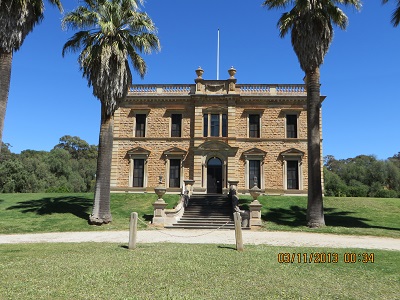
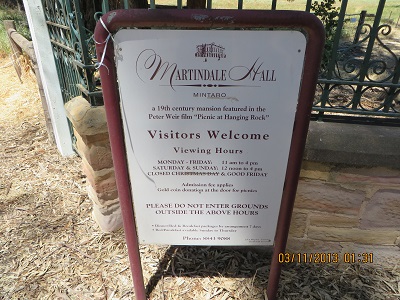
The mansion is not far from the heritage village of Mintaro in the beautiful Clare Valley. Martindale Hall became well known to film goers in 1975 when it was used in Peter Weir’s successful Australian film Picnic at Hanging Rock. There is plenty of material about Martindale Hall on the web and the mansion now functions as a boutique hotel. Opening hours on a Sunday are from 12.00 noon to 1600 hours. I arrived soon after 1100 hours, the weekday opening time. I took a few pictures and set up my station near some trees within the parking area about 150 metres from the mansion. One visitor asked my what I was fishing for: I said radio waves! However, there were not too many about on 40 metres at that time.

Propagation had changed for the worst and signals were attenuated but I still managed three contacts: at 00:54, VK2HF/3, Geoff near Swan Hill; VK5WG, Nev and VK5EE, Tom. I then packed my gear and drove to Auburn for some lunch and then down the Main North Road to Gawler before taking secondary roads to Mount Gawler.

Martindale Hall

Martindale Hall

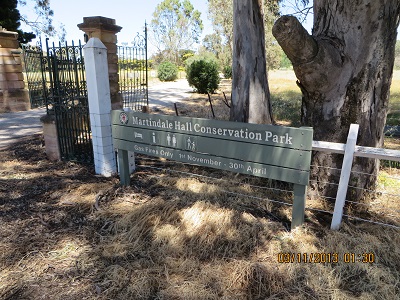
Martindale Hall - entrance and start of the Long Drive

Martindale Hall – entrance and start of the Long Drive

Martindale Hall opening hours

Martindale Hall opening hours

My second Sota Summit, 3rd November 2013

Mt Gawler, VK5 SE-013

I used my vehicle based GPS to navigate from the Clare Valley through the town of Gawler and on to Mount Gawler. I visited parts on SA, especially around Gawler, that I have never seen before!  I then used the Country Fire Service maps to confirm that I had indeed found Mt Gawler. These maps are 1:50 000 and show Mount Gawler being about half way between Airstrip and Richardson Roads on Mount Gawler Road. The map even shows a symbol for the trig point (located on private property just a few metres from the road). Here are the coordinates and altitude measures: 34.78054 138.81216;  DMS 34º 46′ 49.95″ S 138º 48′ 43.79″ E;  Altitude 543.48m. I did quite a bit of looking around on foot and parked my 4 x 4 in a safe place and carried my gear to the activation point.

While I had to move around the 40 metre band a little to secure contacts, I finished with 10 in the log, a reasonable effort given the buy and sell. At 05:05 my first contact was with VK5NWE, Roger; VK5FACE, Andrew; VK5FMID, Brian and then VK5TW, Trevor, making four contacts. Up until this point the going was very slow and propagation poor. I then had contacts in fairly rapid succession with VK5EE, Tom; VK5NFB, Don; VK5CZ/m, Ian driving home from the buy and sell; VK5PAS, Paul; VK3EO, Tom at Swan Hill and VK3GFS/ QRP, Frank at Mount Evelyn.

An Anniversary: six months of SANPCPA, 20th October 2013

Yesterday, while doing some other things around home and keeping a late afternoon appointment, I was able to be a chaser to help celebrate six months of the VK5 National and Conservation Park award program.

Today, I was able to activate three metropolitan conservation parks. I made a concession to the objective of responsible fuel use and, with the aim of successful navigation, I turned on the female voice in my GPS. She really sounds awful! But, I did find the Parks with a minimum of fuss.

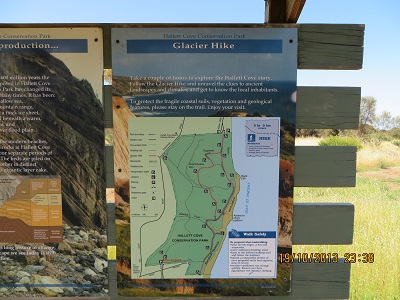
I began early with the Hallett Cove Conservation Park. This is a small park is just 51 hectares. It conserves outstanding geological features including glacial pavements and folded rocks. It was proclaimed a conservation park in 1976. Aboriginal artefacts were discovered in the area in 1934 and more that 1700 pieces were collected. I set up my station just inside the main entrance near the information kiosk. I was able to sit near and under some melaleuca trees which provided great shade.

I had contacts with the following stations beginning before UTC rollover at 2240: VK3SAW, Ash, portable in the Grampians National Park with a scout group from Horsham. Ash called me. Then followed VK3YE, Peter as usual pedestrian mobile; VK5LY, Larry, QRP portable in Spring Gully Conservation Park. VK3GRW, Greg in North East Victoria, VK5AV, Tim; VK3BJM, Barry; VK5FAKV, Shawn from Renmark; VK3PF, Peter; VK3MMX, Darren at Harcourt; VK5KGP, Graham; VK5PAS/p, Paul at Minlacowie Conservation Park, my second Park to Park for the activation; VK5TN, Robin; VK5LY/p, Larry; VK3SAT, Lachlan in Central Victoria; VK5ATQ, Trevor and VK5AV, Tim. Sixteen contacts in just under an hour I thought was pretty good. The 40 Metre band seemed to be working well, although the noise floor was higher than I usually experience when in a rural park. All signals were either S8 or S9 with the exception of VK3YE, Peter who I received 5 and 1. I packed up and headed just a few kilometres closer to Adelaide to activate the Marino Conservation Park.
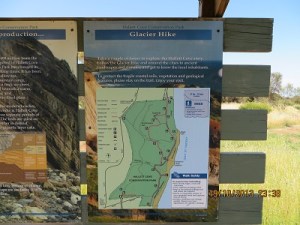
Hallett Cove Conservation Park Information Kiosk

Hallett Cove Conservation Park Information Kiosk

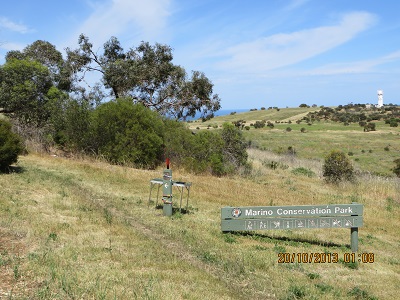
Marino Conservation Park

Marino Conservation Park was once a traditional resting and fishing place of the Kaurna Aboriginal people. However, in the early 20th century much of the area had been cleared and grazed. It also conserves coastal heath and provides a green buffer between two suburbs. I found operating from this park much more challenging than at Hallett Cove Conservation Park because of the higher noise floor. There were high tension power lines just across the road from where I set up my station.

I had contacts with the following stations beginning at 0031: VK5HCF/p, Col at Gower Conservation Park; VK5PAS/p, Paul at Barker Rocks Conservation Park; VK5AV, Tim; VK5WG, Nev, a very loud 5 and 9, best signal all day; VK5DJ, John and VK5WF, Wolfe, making  six contacts.
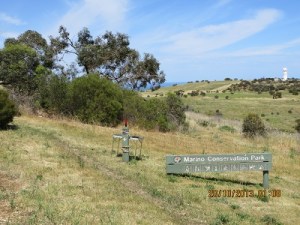
Marino Conservation Park
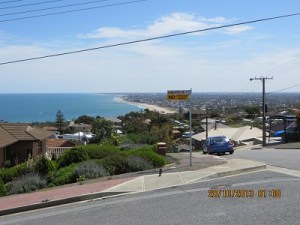
Marino Conservation Park

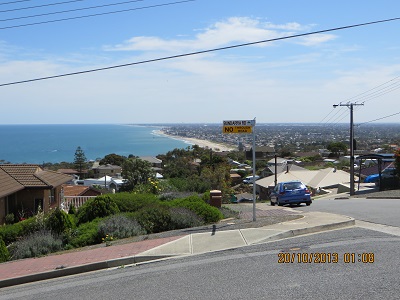
View looking North, Adelaide Coast and power lines

View looking North, Adelaide Coast and power lines, from the corner of the Park where I was set up.

Fort Glanville Conservation Park

I had the following contacts from Fort Glanville Conservation Park: VK5PAS/p, Paul at Ramsey Way Conservation Park on York Peninsular; VK3UBY, Col at Mildura and VK5ATQ, Trevor. These were all difficult contacts because of the very high noise floor.

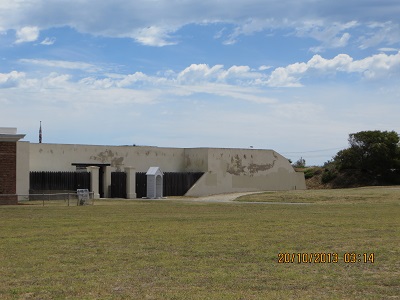
Nevertheless, I am very pleased to have activated this park. This park conserves Fort Glanville which was constructed in 1880. It is an most complete example of a coastal artillery station built in Australia and dates from South Australia’s colonial past. The park is surrounded by a high mesh fence complete with trespassers prosecuted signs clearly displayed. I activated the Park from within the car park. The park is open on the third Sunday of the month, 20th October, and features a re-enactment of military drills, the sound of bugles, complete with the firing of the canon. I will suggest to the Adelaide Hills Amateur Radio Society (I am a member) that we should activate the park during history week during May 2014. Actually setting up a station on the lawns or further away from the main roads and the power lines might make for a more successful activation. Using a radio with better noise reduction capability compared with the FT817 would assist. I knew I should have used the Ten-Tec Argonaut VI!

At the end on the day I had activated three parks and enjoyed 25 contacts. I was pretty happy with that.
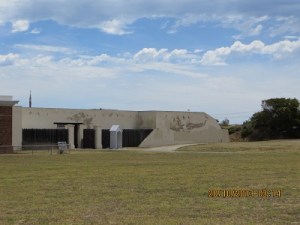
The artillery battery at Fort Glanville

The artillery battery at Fort Glanville
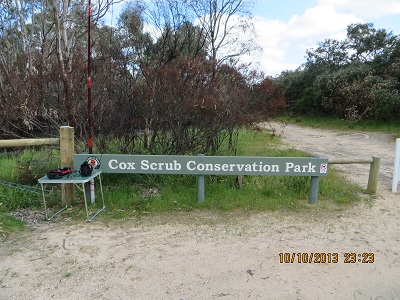
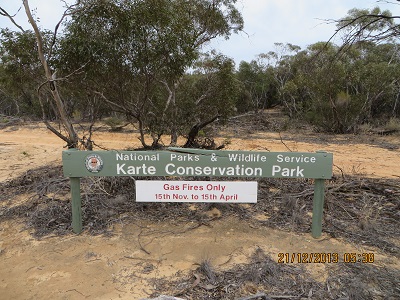
Cox Scrub Conservation Park 11th October 2013

Cox Scrub Conservation Park

Cox Scrub Conservation Park

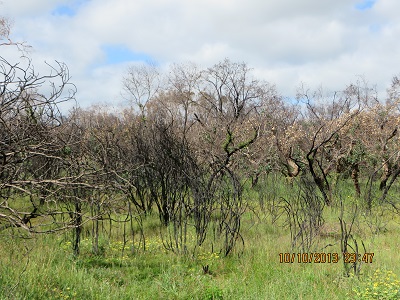
Cox Scrub CP showing burn off

Cox Scrub CP showing burn off

Cox Scrub CP 'green' shoots appearing

Cox Scrub CP ‘green’ shoots appearing

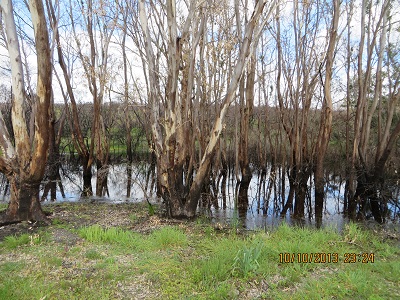
On Friday morning while driving to Middleton I decided I would activate Cox Scrub Conservation Park which I drive past on my journey. Last time I came back from the south coast, about three months ago after lunching with South coast amateurs, and with VK5KC, David and VKATW, Trevor on board, and on passing the park I was disappointed to see how badly burnt it was as a result of a ‘controlled’ burn that quickly got out of control! The Friends of Cox Scrub Conservation Park web page indicates that the park is 544 hectares in area and all but five hectares in the South Western corner were burnt out. The park protects the Yellow-tailed Black Cockatoo. I thought while the park was on my to do list I would not be in a hurry to visit. Any way Friday, a warm and sunny day, was the day I chose! I pulled into a parking bay within the park and set up my gear. Before UTC roll over I checked 7.100, found it was clear,  and called CQ. At 2310 in answer to my CQ call, VK5LY, Larry replied. He said my signal was 5 and 9 in Renmark and so was his at my end. I had contacts with VK5MBD, Bill; VK5HS, Ivan and VK5LI/m, Craig. All received signals were 5, 9 and my worst report was 5 and 5 from Craig. Then the band went quiet. I called CQ a few more times and checked up and down the band: nothing heard. I took three photos and packed up my gear and continued to Middleton. My photos do not adequately show the destruction.

Mount Remarkable National Park 3rd October 2013, VKFF – 360

Mount Remarkable National Park is rugged, hilly and a magnificent place. This time we approached the Park from Wilmington, that is, from the East and drove the sealed road to the Alligator Gorge car park. We have also camped at Mambray Creek where the camp ground is very popular. Mambray Creek is approached from the West and is a short drive from Highway One.

Allligator Gorge

I was starting to think that the trip during the last two days was all in vain, because of poor propagation, and this was reinforced again this afternoon. I managed to send a text to VK5PAS, Paul, advising him I was on 7.100. I heard him : 5 and 0. Obviously Paul could not hear me.  May be starting to activate the park at 06:37 was a bit late! VK2ARK, Tom at Kandos could not hear me and nor could VK1CJ. There was no propagation to Adelaide. I could barely hear VK5BW, Barry in the noise – static crashes!

My day was made when I caught up with VK3AXH, Ian, in Ballarat, with whom I have had many weak signal contacts on 144.1 + from home. Ian was 5 and 9++ and I received a 5 and 5/6. Not a satisfactory outcome from Mount Remarkable National Park, but Ian was left in no doubt about how pleased I was with the contact.

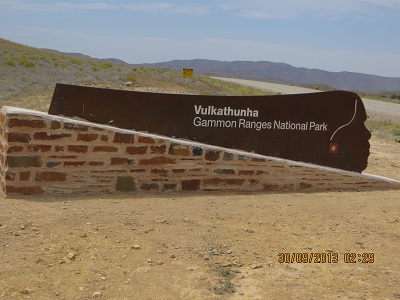
Vulkathunha-Gammon Ranges National Park, VKFF – 189

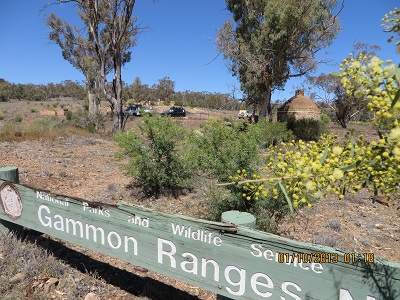
Entry to Vulkathuna-Gammon Ranges National Park

Entry to Vulkathunha-Gammon Ranges National Park

We have visited the Vulkathunha-Gammon Ranges National Park on previous occasions and have camped in the park using our camper trailer. But this time we made our base the Arkaroola Private Wilderness Sanctuary, which is next door to the National Park. If you have not visited Arkaroola you should. It is a great place and you can see the results of careful conservation work over a number of decades, especially in the care of the local flora. It is a large property. There are plenty of 4 x 4 tracks and lots of interesting places to see. We saw two Yellow-footed Rock Wallabies at the Arkaroola waterhole. There are also two astronomical observatories each beautifully equipped with 14 inch telescopes: see their web site for further details http://www.arkaroola.com.au/. And the Ridge Top Tour leaves people with enduring memories!

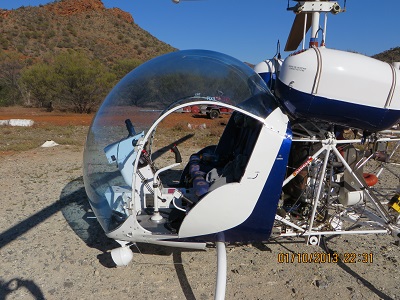
It was also great to catch up with VK5HS, Ivan, who with his wife, were taking advantage of their one hour gift flight on the Bell helicopter.

Bell Helicopter ready for VK5HS, Ivan & XYL

Bell Helicopter ready for VK5HS, Ivan & XYL

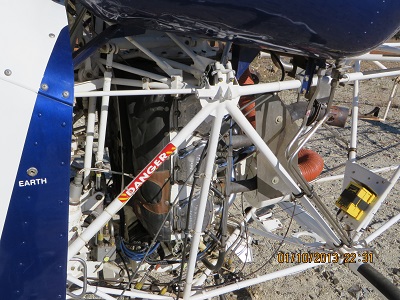
Six cylinder boxer engine: one side visible

Six cylinder boxer engine: one side visible

Weetootla Gorge 30th September 2013

My first activation in the very extensive park was at Weetootla Gorge Camping Ground. It was blowing a gale and dusty and I thought I had found a relatively protected spot. I managed seven contacts before everything blew down or away: log sheets going in all directions! I had contacts with: VK5LY, Larry; VK5HS/m, Ivan; VK1NAM/p QRP, Andrew, on VK3 VN005; VK5PAS, Paul; VK2FALL, John; VK5NQP and VK5WG, Nev.

V-GR NP Weetootla Gorge camping ground

V-GR NP Weetootla Gorge camping ground

Bolla Bollana 1st October 2013

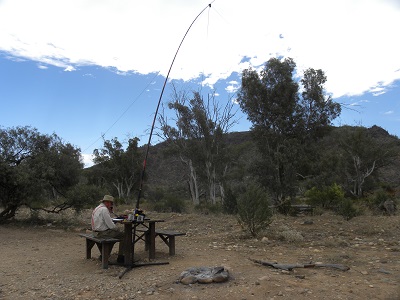
Tuesday was a great contrast with Monday: a warm and sunny day arrived and we drove the 4 x 4 track from Arkaroola to the park at Bolla Bollana, where the old copper smelter remains are just inside the park boundary. I enjoyed contacts with VK5PAS, Paul; VK5ATW, Trevor; VK5HS/m, Ivan on his way to Arkaroola for a helicopter ride; VK5KGP, Graham; VK5MBD, Bill and VK5HCF, Col: six contacts in all before the other vehicles arrived with their sightseeing passengers and the ignitions and refrigerators making a racket.

I did promise three activations, the third planned for Wednesday and here is the reason why I didn’t keep my promise. A bus load of passengers arrived at Arkaroola including a 24 hour gastro bug. I succumbed! I was not happy.  Twenty four hours may be a reasonable time for a younger person to overcome a 24 hour bug, but it took me more like 30!

Crossing Creek bed from Arkaroola into Vulkathunha

Crossing Creek bed from Arkaroola into Vulkathunha

Bolla Bollana Smelter and portable operation

Bolla Bollana Smelter and portable operation

Mount Brown Conservation Park 29th September 2013

Mount Brown Conservation Park and summit is about 13 kilometres from Quorn. I would have liked to tackle the 13k walk to the summit and back, but common sense prevailed. I was a bit sore after the Dutchmans Stern activation the day before.

I activated this park by calling on the VK5 call back after the WIA broadcast. I was hoping to stir some interest on 7.100 MHz, as it turned out not very successfully. I had contacts with VK5PX, Peter, VK5ATQ, Trevor; VK5WG, Nev; VK5KGP, Graham; VK5LY, Larry; VK5IS, Ian; VK5PAS, Paul; VK5CZ, Ian, VK5PAS, Paul a second time after a posting advice of my activity; VK3PF/p QRP, Peter 5, 0 to him and 4, 3, from Mount Tassie, VK3 T046 and finally with VK5NWE, Roger and a tough contact with VK5FMJC, John who had a high noise level: 12 contacts in all.

The approach to Mount Brown Conservation Park

The approach to Mount Brown Conservation Park

I did have other contacts: I joined the 7073 KHz net and received excellent reports from the mobile (FT857D) and I also had a QRP contact (FT817) on 20 metres QRP with VK4QC, Peter. I was in Arkaroola and the contact was at 0515.

My first SOTA activation: Dutchmans Stern, VK5/NE-028

Today I climbed to the summit of the Dutchmans Stern (no apostrophe, woeful English grammar in my opinion) and activated VK5-NE-028 (six points). I am delighted to report I had 23 contacts. Thanks to all who took time out on AFL Grand Final Day to give me a contact and thanks to those who alerted others. This summit is located within the Dutchmans Stern Conservation Park and also counts for the SANPCPA award (1 point). It took a little over two hours to climb the 4.2K route to the summit and about one hour forty minutes to descend. I was feeling pretty tired by then. I used my new seven metre squid pole and a couple of trees to support my dipole and a 4.3 amp hour sealed lead acid battery for power.  My gear is too heavy! I will be working hard to reduce the weight. I am considering Li Po batteries and I have a SOTA linked dipole (which I haven’t tried yet) and continue to use my home made dipole which is so rugged.

The following contacts were made on 40 metres: VK5CZ, Ian, who was unwell and could not join me in the activation; VK5IS QRP, Ian; VK5HS, Ivan; VK5WG, Nev; VK5NQP, David, who with some encouragement and slow use of phonetics was able to made a successful contact; VK5LA, Andy; VK2YW, John; VK3FPSR, Peter; VK2UH, Andrew; VK3CAT, Tony; VK3ANL, Nick; VK3DET, Ernie; VK5LY, Larry; VK5PAS, Paul; VK5AV; Tim; VK3MCD, Brian; VK3HRA, Allen; VK5PAS, Paul, with the AFL scores; VK5AKH, Andrew; VK5FMID, Brian; VK5HCF QRP, Col; VK5AR/p, Allan portable at Eagle on the Hill and undertaking antenna experiments and VK3YY, Glenn. The Dutchmans Stern Conservation Park is a great place for a hike. It is also very beautiful on the slopes and towards the summit. Unfortunately acres of Salvation Jane, a favourite with the bees, was not good for my lungs. You walk through this to get to the trail. We also noticed plenty of goats, four legged ones. However, the kangaroos were pretty quiet and did not rush away, but stopped and watched us make our way down the path. We saw lots, including plenty of juveniles. I commend to you the Walking Trails Support Group brochure if you are planning a trip. We spoke to a young woman training for her attempt at Mt Killimanjaro who left the car park at the same time as us and took the longer loop track to the top. We caught up with her again on her descent 100 metres from the summit. We also spoke with a couple, about our age, from NSW and a man, a bit younger than me, a Vietnam Vet, keeping fit. Otherwise the Park was ours! We left a note in the visitors’ book kept in a sealed container at the summit. It will tell future readers of the VK5 and SOTA awards.

On the Dutchmans Stern

On the Dutchmans Stern

The 'Shack' on board

The ‘Shack’ on board – the 7 m squid pole is in my right hand. Notice one of the locals on the path

Flinders Ranges National Park, 24th September 2013, VKFF – 176

You might be interested to know that the picture at the introduction to my blog is taken from the summit of Mount Ohlssen Bagge. The plaque on the right hand side of the picture (not clear to readers) states the name of the mountain and gives the height as 923 metres. My wife and I climbed Mt Ohlssen Bagge in September 2011 and had  a great day out. I should say that Mount Ohlssen Bagge does not meet the SOTA criteria, but it is still a great climb and we love this part of the world!

My first activation was on 24th September 2013. I picked a creek bed almost at Sacred Canyon. At 06:10 I called on 7.100 and VK5LY/p answered my call. Larry was activating Cooltong Conservation Park. Then came VK5WG, Nev; VK5PET, Peter; VK5KGP, Graham; VK5PAS, Paul; VK3ANL, Nick; VK5HS/m, Ivan near Adelaide Airport; VK2BNN/p5, Brett at Rawnsley Park; VK5HCF, Col; VK3AMB, Bernard and VK5FCTC, John. As it turned out Brett was staying at Rawnsley Park and later that evening I arranged to meet Brett with the help of 146.500Mhz. Brett told me he was planning to activate Saint Mary Peak as his very first SOTA activation. I am waiting to hear whether he was successful or not?

Second Activation: 25th September 2013 Wood Duck Dam

I enjoyed contacts with: VK5KC, David; VK5LY, Larry; VK5PAS, Paul; VK3GT/p5, George camping in Parachilna Gorge; VK5HS, Ivan; VK5APC, Errol at the Port Adelaide Radio Club; VK5FEKH, Errol, 10 watts on his dipole; VK2IY, Angus and VK1MA/p2, Matt at VK2 ST 005.

Third Activation: 26th September 2013 Wilpena (near overflow car park).

I had contacts with VK5LY, Larry; VK3UBY, Col; VK5PAS, Paul; VK3LSC, Sandra at Mildura; VK3HRA, Allen; VK5HCF, Col; VK3ABM/2, Peter and VK3BJM/m2, Barry. Imagine my surprise when two workers stopped the utility near the park table I was using and one said, I recognise that voice! Richard, VK5UK, I knew was working at the Wilpena resort and it was great to catch up with him. I was a bit sorry he had to get back to work!

My fourth activation of the Flinders Ranges National Park occurred from the Trezona Camp Ground. I had contacts with VK5PAS, Paul; VK5LY, Larry; VK5HS, Ivan; VK5CZ, Ian and VK5HCF, Col, making a total of 33 contacts over the four activations.

On Friday 27th at the Wilpena Visitors’ Centre I saw Brett, VK2BNN, for a second time. I congratulated him on activating St Mary Peak and wished him well as he set out with his family for further adventures.

Brachina Gorge, Flinders Ranges National Park

Brachina Gorge, Flinders Ranges National Park

The Flinders Ranges area is known for its geological features which shed further light on the history of our planet. While at Trezona campground we set out to find the Golden Spike. This monument celebrates the Ediacaran period in geological time and a small plaque is embedded in rock in the creek bed to signify the importance of this area.

Standing near the Golden Spike

Standing near the Golden Spike

The Ediacaran Period

The Ediacaran Period

Edicaran plaque 'Golden Spike'

Ediacaran plaque ‘Golden Spike’

.