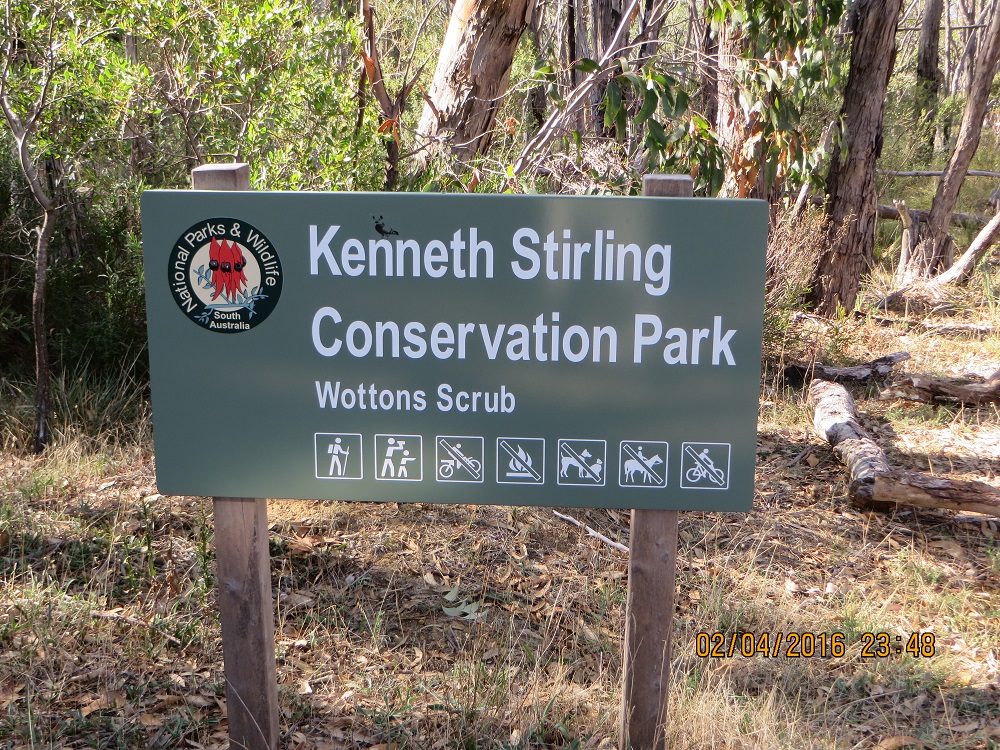
On Monday evening I checked the weather forecast and the Bureau of Meteorology suggested a fine and sunny day for Adelaide.I decided that I would activate Kenneth Stirling Conservation Park at the Wottons Scrub Block. This park has four sections and a fuller description can be found at my earlier post on this park dating from April 2016.
I set up my station in the same location. But just about everything had changed – previously I used a second hand Yaesu 897D and a Sota beams linked dipole antenna. I no longer own the 897D – it was a good radio but a bit too big and I mainly used 10, sometimes 20 watts, so I purchased a Yaesu 857D, the same radio apparently in a smaller package. I had it with me yesterday but did not use it. My set up is now an IC705 and the matching AH5 tuner, a 12 amp hour LiFePO4 battery and two home made antennas. One is a linked dipole for 40 and 20 metres and the other is a linked dipole for 15, 17 and 10 metres.
I set up for 15 metres and did not get a contact. I did not try 17 but moved to 40 metres after changing the antenna. Propagation was strange. Signals came and went in seconds I could get a word, for example, a callsign and not hear the rest of the transmission. This happened with VK2IO on 20 metres. There was also echo on some signals. I was told by others who were activating parks on the east coast that they had similar experiences. At least it wasn’t a total black-out. I was told what we experienced was the end of solar storms and ejections and that conditions will probably stabilise in a day or two! A check of some of the sun weather internet sites confirmed what I was told and what I had suspected, that the earth was in a direct path from a storm on the sun; a second wave, on Monday.
I enjoyed the following contacts on 40 metres before transferring to 20 metres.
01:44 Z VK3BEZ/P in VKFF-0753 Brian
VK2RK Robert
VK2ACR Robert
VK5IS, 59 56 There was an interesting echo on Ian’s voice.
VK5GY Gordon
VK5LA Andy
VK3PF Peter
VK3MTT Therese
VK2IO Gerard
VK4JT John
VK5KAA Gordon
VK3BWS/P in VKFF-0747 Barry
20 metres 02:37 Z
ZL1BQD 51 52 Roly
VK3BWS/P in VKFF-0747 Barry
VK5HAA John
VK4EMP Mark Brisbane
VK4TJ John
ZL1TM 52 57Andrei
Thank you to the successful callers and to those who tried to make a two way contact.
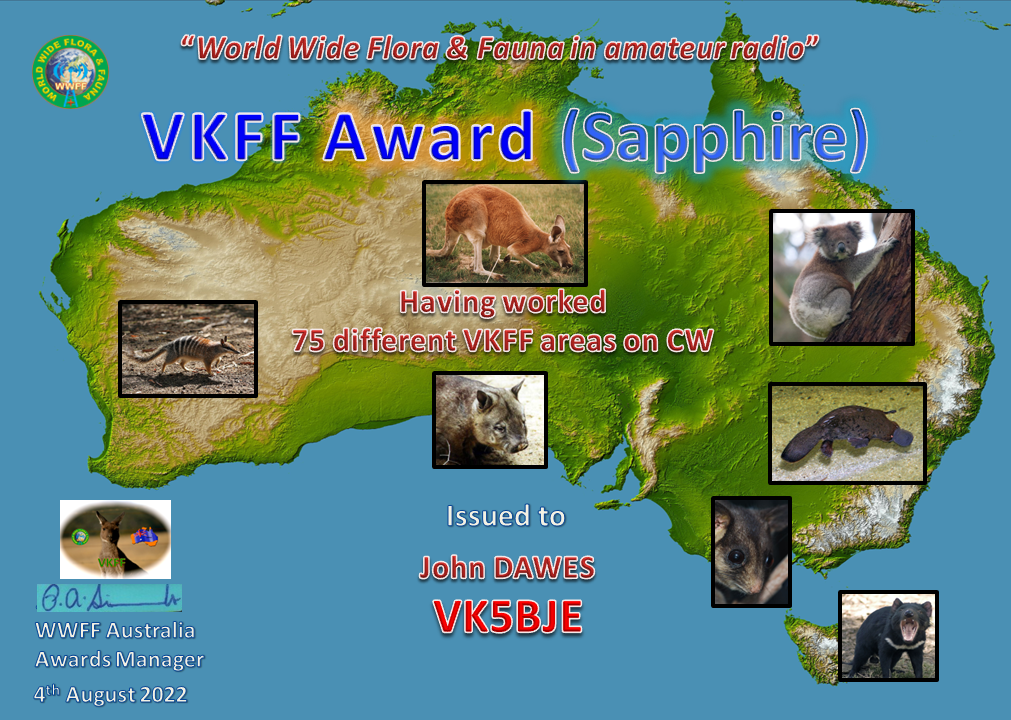
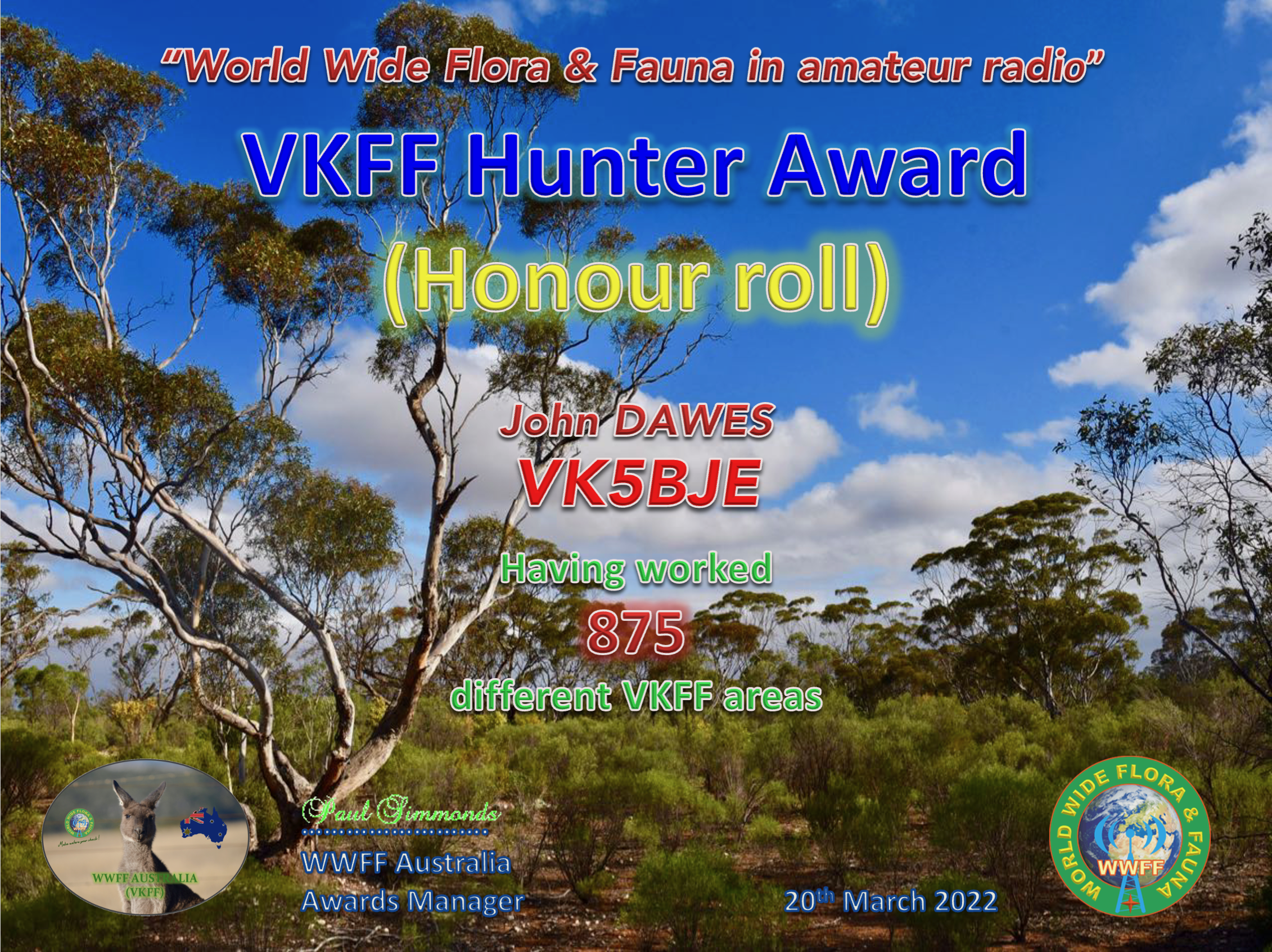
VKFF Hunter Award 900 My latest VKFF award for working 900 different parks. I am pleased to have reached this milestone, albeit a bit slowly! Thanks to Paul and all the VKFF team.
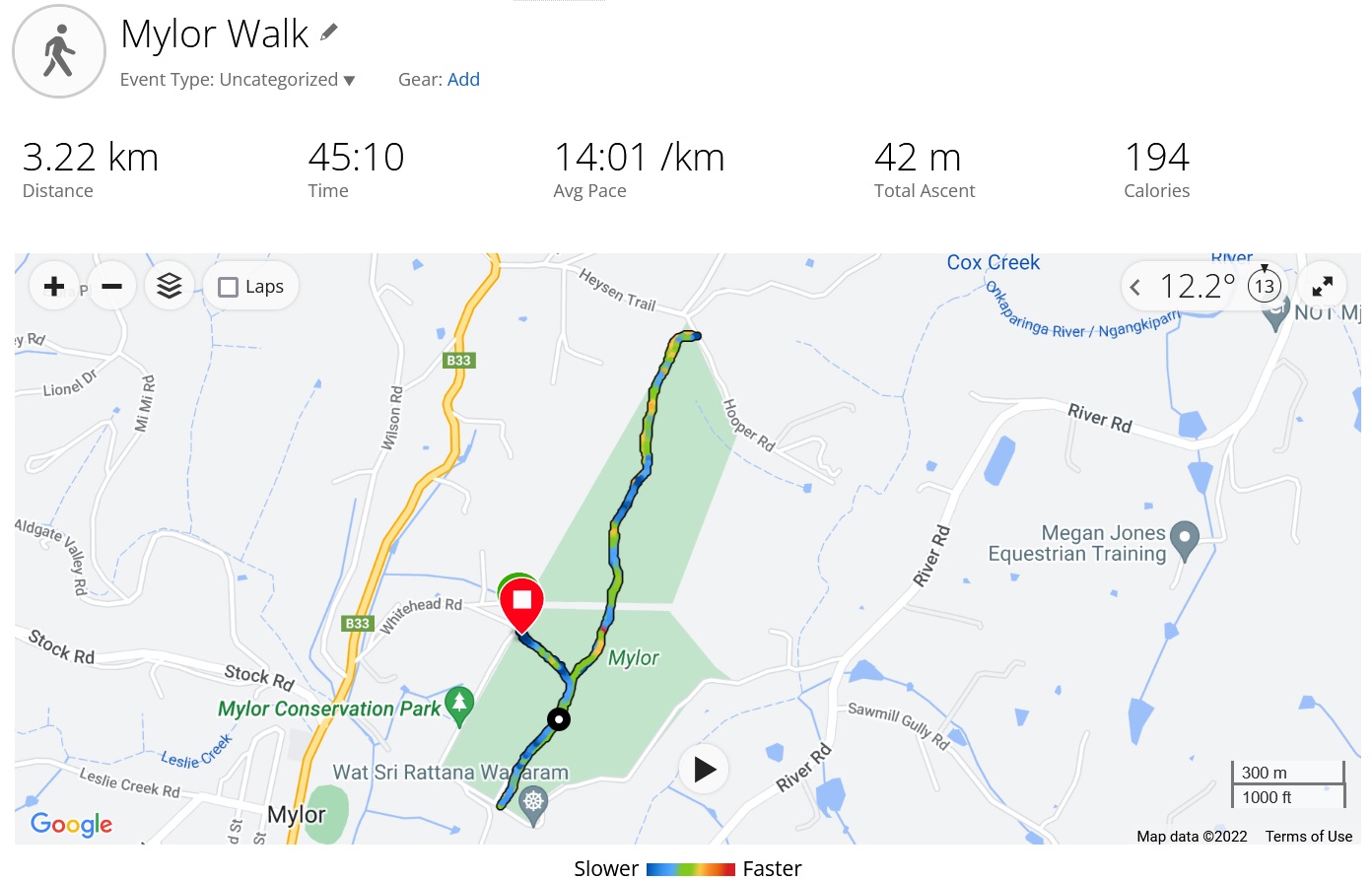
One of my regular activities is walking and on Sunday last, I walked my usual trail in Mylor Conservation Park. I listen to the Wireless Institute of Australia (WIA) broadcast on the VK5RDF, two metre C4FM repeater. The signal is good for the whole walk, although it weakens towards the northerly end of the park because of a rise on the westerly side. I always call in on the callback and announce that I am pedestrian mobile. Now I know that this is not HF, no WWFF, but it is still fun. I have taken this walk for a number of years and never mentioned that this is how I usually listen to the broadcast. Of course the regular listeners know! I use a Yaesu FT-70D set for 0.5 watts, that is, half a watt. I have no trouble accessing the two metre and 70 centimetre repeaters (VK5RDF) with such such low power.
You can see from the walk profile that the total ascent is just 42 metres and most of that is from the entry to the park to the north-south track – the hard part of the walk (about 500 metres) is over at the beginning!
And the listening is great, the WIA national news, VK5 club news and then the call back. We have a group from Detroit, Michigan, which is expanding in numbers and who call in, a Californian and one or two from the East plus some interstate amateurs. VK5RDF is linked to all of the C4FM repeaters in the state and the 10G backbone as well as being accessible through Wires x.
Thursday was a magic Winter’s Day. While the temperature was in the low teens the sun shone in a cloudless sky and there was no wind. I thought I would make it a radio day and try out my new Icom 705 in the field. My last activation was on the 18th April and I sustained an injury which kept me at home following hospital treatment.
I went to my usual activation spot about 100 metres into the Park on Whitehead Track. I tried out the radio as a QRP rig, running five watts, using the supplied battery and later supported by a Lithium Iron battery (LiFePO4) I ran 10 watts. I used a home made dipole and the Icom AH5 coupler. What I am attempting to do is make my footprint and load smaller, without going overboard! I have even tried out my Palm Iambic paddle matched to the keyer in the radio. It works well. I have had it for some years but did not use it, preferring a hand key. But I have made this move to reduce weight as I want to walk to more activation spots.
Secondly, I am chasing the first level WWFF Boomerang Award, that is, five activations on separate days with at least 10 contacts at each activation. I will check this out over the next few weeks.
Here is a link to my last activation at Mylor Conservation Park.
All the contracts listed above were completed using the internal battery on the IC 705, that is, five watts. I then changed to an external battery and worked the following stations:
VK5KAA Gordon
VK5NFT Tom
VK3ZFC Graham
0226 VK3BEL/P Ross Park to Park VKFF-2021
Thanks to all who gave me a call and to Paul, VK5PAS, who spotted me on ParksnPeaks. Unfortunately, my Night Hawk modem has died!
Today the weather was not as good and I was going to add a few more contacts using a vertical antenna – but I changed my mind and walked the Park instead.
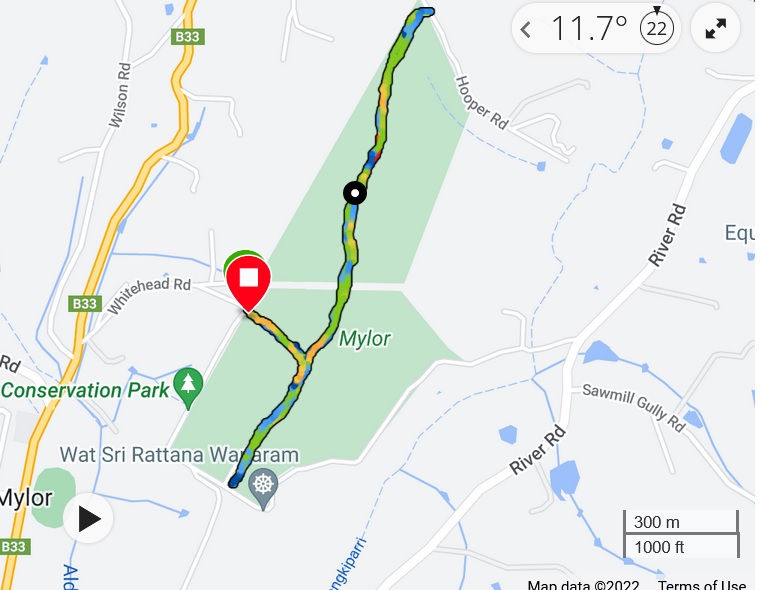
Map of Mylor Conservation Park
I entered the Park at the Whitehead Road entrance and walked up the hill on Whitehead track to the junction and turned left and walked to the end of the park at Hooper Road. I then re-traced my steps to the southern end of the Park near the entrance to the Thai Forest Monastery. The walk is about three and a half kilometres and took me about 47 minutes, including time out to speak with another walker.
I have described this park in previous posts and I have enjoyed my many visits. However, I will now shift most of my walking to Mark Oliphant and Scott Creek Conservation Parks where the walks are more challenging. Mylor Conservation Park is one of a number of parks make up the Greater Mount Lofty Parks.
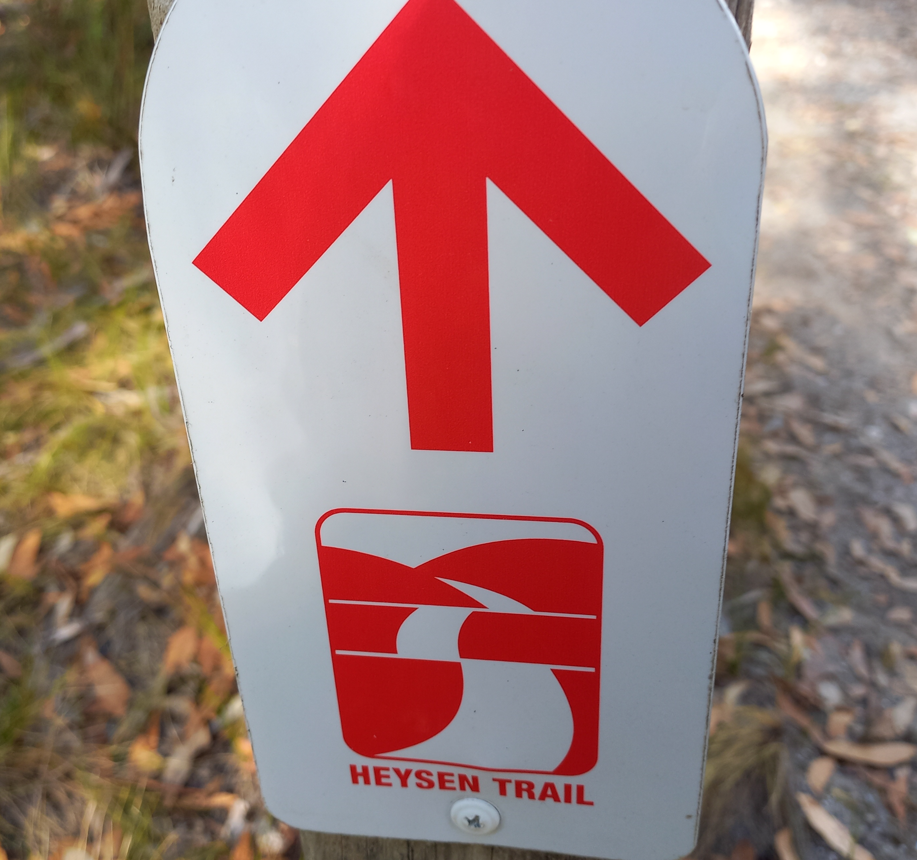
I am interested in the Park tracks, which includes a section of the iconic Heysen Trail. Are these tracks built on earlier walking paths established by the local First Nations People? I cannot answer this definitely. It is unlikely as the Park contains re-growth forest and there is a sign near the main gate which suggests the Park was once a farm.
Here is some photographic evidence I have collected on my camera as I have gone about my walks.
Heysen Trail marker
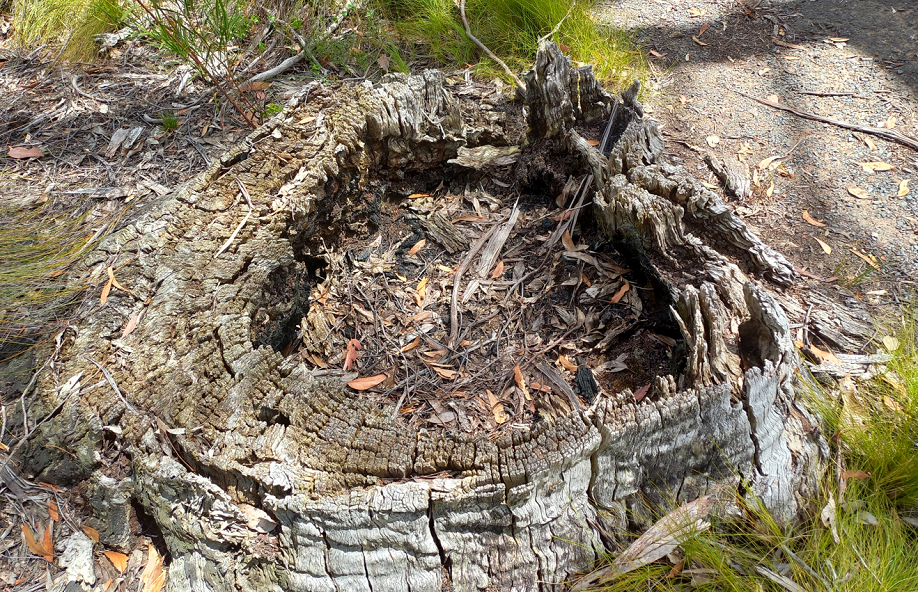
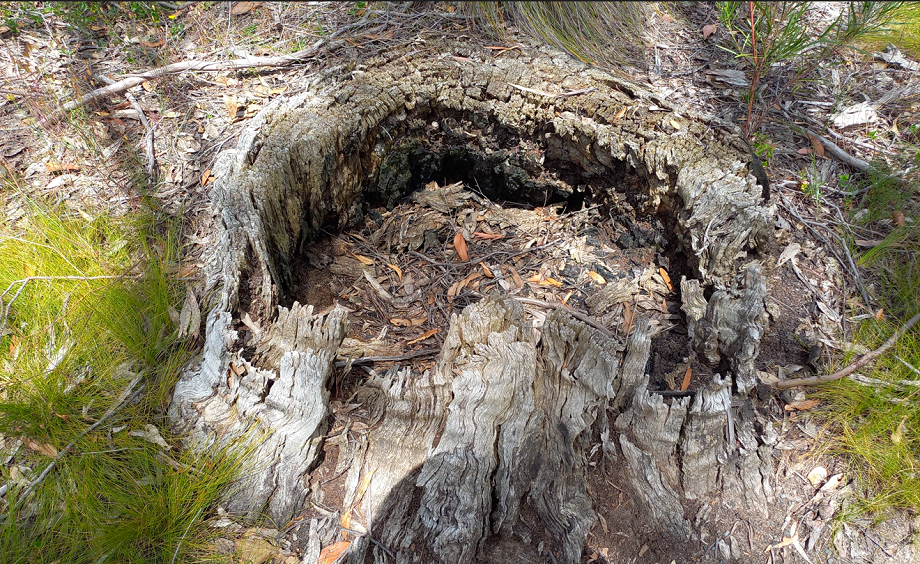
Stringy Bark – stump shows saw marks.Stringy Bark stump – over one metre in diameter and showing saw cuts.
I have found about five of these stumps and they are all located on the Eastern side of the Whitehead track and all are on the shoulder of the road. These were big trees and my guess is that they were removed when the road was made. Much of the forest re-growth is made up of trees with smaller diameters.
Once again I thank all of the radio amateurs who gave me a call and got me over the Boomerang Award threshold.
Congratulations to Gary on achieving the Centurian Award. This award is obtained by making contacts using morse code (CW) with one hundred Straight Key Century Club members. My contribution to Gary’s award was just 100th of the effort he needed to gain the award. On the 23rd of February 2022, I (VK5PF) had a contact with VK2GAZ on the 30 metre band on 10.118 Mhz. I used 100 watts and my report was 5 7 and 9 and I gave Gary the same report. I was really pleased to assist. My SKCC number is 18570. My call-sign is visible on the South Australian (VK5) group. Thanks Gary for the chance to assist.
Re-opening of Scott Creek Conservation Park, April 2022, 23rd April 2022, VKFF-0788
World Amateur Radio Day
I can do no better than to start this post with a direct quotation from the IARU. Each year for World Amateur Radio Day a different theme is chosen and this year the flavour is one of history and gaining access to radio frequency spectrum.
‘Every April 18, radio amateurs worldwide take to the airwaves in celebration of World Amateur Radio Day. It was on this day in 1925 that the International Amateur Radio Union was formed in Paris.
Amateur Radio experimenters were the first to discover that the short wave spectrum — far from being a wasteland — could support worldwide propagation. In the rush to use these shorter wavelengths, Amateur Radio was “in grave danger of being pushed aside,” the IARU’s history has noted. Amateur Radio pioneers met in Paris in 1925 and created the IARU to support Amateur Radio worldwide.
Just two years later, at the International Radiotelegraph Conference, Amateur Radio gained the allocations still recognized today — 160, 80, 40, 20, and 10 meters. Since its founding, the IARU has worked tirelessly to defend and expand the frequency allocations for Amateur Radio. Thanks to the support of enlightened administrations in every part of the globe, radio amateurs are now able to experiment and communicate in frequency bands strategically located throughout the radio spectrum. From the 25 countries that formed the IARU in 1925, the IARU has grown to include 160 member-societies in three regions. IARU Region 1 includes Europe, Africa, the Middle East, and Northern Asia. Region 2 covers the Americas, and Region 3 is comprised of Australia, New Zealand, the Pacific island nations, and most of Asia. The International Telecommunication Union (ITU) has recognized the IARU as representing the interests of Amateur Radio.
Today, Amateur Radio is more popular than ever, with more than 3,000,000 licensed operators!’
Scott Creek Conservation Park fire January 2021
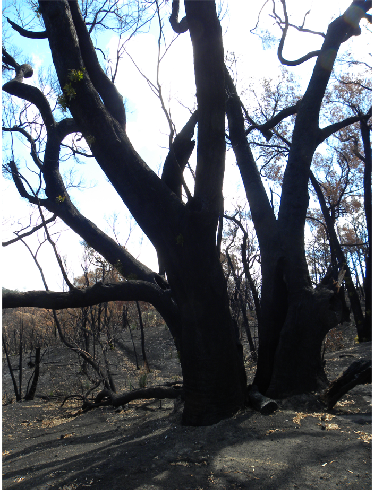
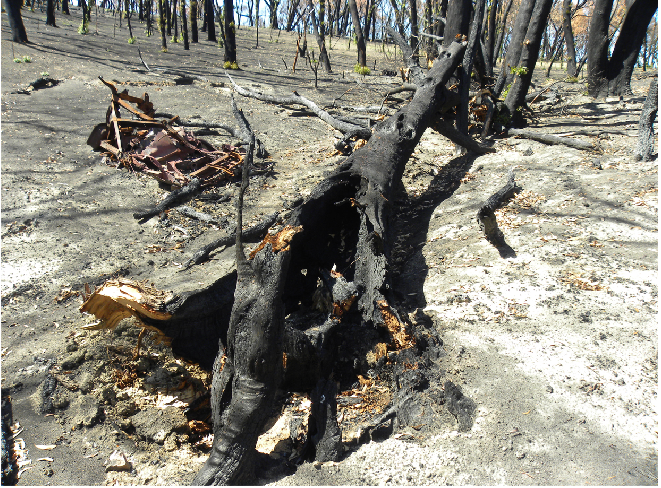
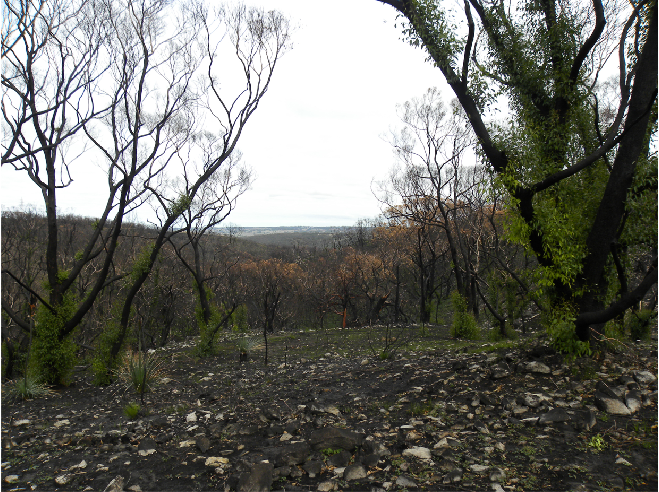
Scott Creek Conservation Park was badly damaged by a fire on January 24th 2021. The Park was immediately closed to the general public and has only just re-opened after a break of 14 months. During the time the park was closed work began to make the park safe again. There are a number of matters that needed attention: tracks repaired; fences replaced; fallen trees cleared; trees with obvious damage needed attention, pruning or removal and holes and hazards on the ground repaired. As well a thorough inspection of the park was undertaken. I used to walk in the park almost every day and had my favourite tracks, high and with views. I was often pedestrian mobile in the park with a hand held vhf/uhf amateur transceiver. I did drive around the perimeter on public roads but then put the park out of my mind for the time being. I began walking more regularly in Mark Oliphant Conservation Park. However, that had to cease when the Government decided to increase the amount of parking at the main gate. I called by the park yesterday 22nd April 2022 and had a look at the completed work. It is excellent and my wife and I spent some time speaking with a couple of contractors and they were pleased we had noticed their work. It is good to see the plaque honouring Sir Mark Oliphant clearly visible again. I have done most of my walking in Mylor Conservation Park over the last eight months or so and enjoy that park.
So my contribution to world amateur radio day was to set up my station just inside Gate 9 and hope that the weather would remain fine. I worked (had contacts or qsos) with 16 stations in the VK call areas of 2, 3 and 5, that is, 2 in NSW, 3 in Victoria and 5 in South Australia. Conditions on the air were really good and signals were strong. I used to activate from Gate 8 (see earlier posts for the park) but the new fence is on a different alignment and there is just parking for one car at Gate 8. The Senior Ranger is keen to get the fence shifted to increase parking places.
Here is a link to my last Scott Creek Conservation Park radio activation.
I was on the air at 04:45 UTC and worked the following stations:
VK3FKL/P
04:49 VK5BJF
04:53 VK5PX
04:58 VK5KKT
05:04 VK5PL
05:08 VK5FANA
05:14 VK5BBB
05:15 VK2CCP/3
05:17 VK5ZPF
05:20 VK2YK/5
05:23 VK3PF
05:26 VK5WWW
0530 VK5KLV
05:33 VK5HAA
05:34 VK2VW
05:36 VK2HFI
Sixteen stations in just over 45 minutes is not difficult to achieve and during that time I was visited by the Senior Ranger and we talked about radio and other things for a few minutes. He knew who I was and I know about him – probably because my wife is very active with the Friends of Scott Creek Conservation Park!
I swapped to the 20m antenna and the band was alive. I listened to SP4LVG, from Poland, whose signal was over strength nine. I was competing with some Australian amateurs running a lot more power and I could not break through. As the rain was now making its presence felt I packed up my gear, but tripped!
I managed drive home and then the Emergency Department at a city hospital became my QTH (home) until Friday evening. I will be a home station for Anzac Day.
Typically destroyed section: JCD photo
Earth has been burnt bare: JCD photo
More destruction: JCD photo
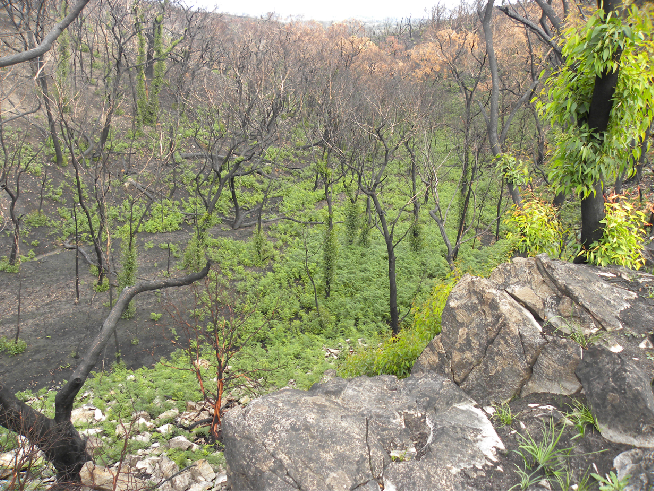
Growth at Last: JCD photo
Operating Conditions
I used my Yaesu 857D transceiver set for 10 watts, powered by a seven amp hour LiFePO4 battery, a linked dipole, a log book and clock set for UTC time. A squid pole completed the set up and I went to Gate 9 for the activation. I do not recommend Gate 9 as an activation spot: there is not enough space without going off track. Gate 8 is now unsatisfactory as the new park fence is is on a different alignment and there is space for only one vehicle. The Senior Ranger for the park is going to get the fence re-established on its earlier alignment. I enjoyed the activation and thanks to all of the operators who gave me a call. I was pleased to work Adam VK2YK/5 who was in Porter Scrub, VKFF-0787, making one park to park contact on the day.
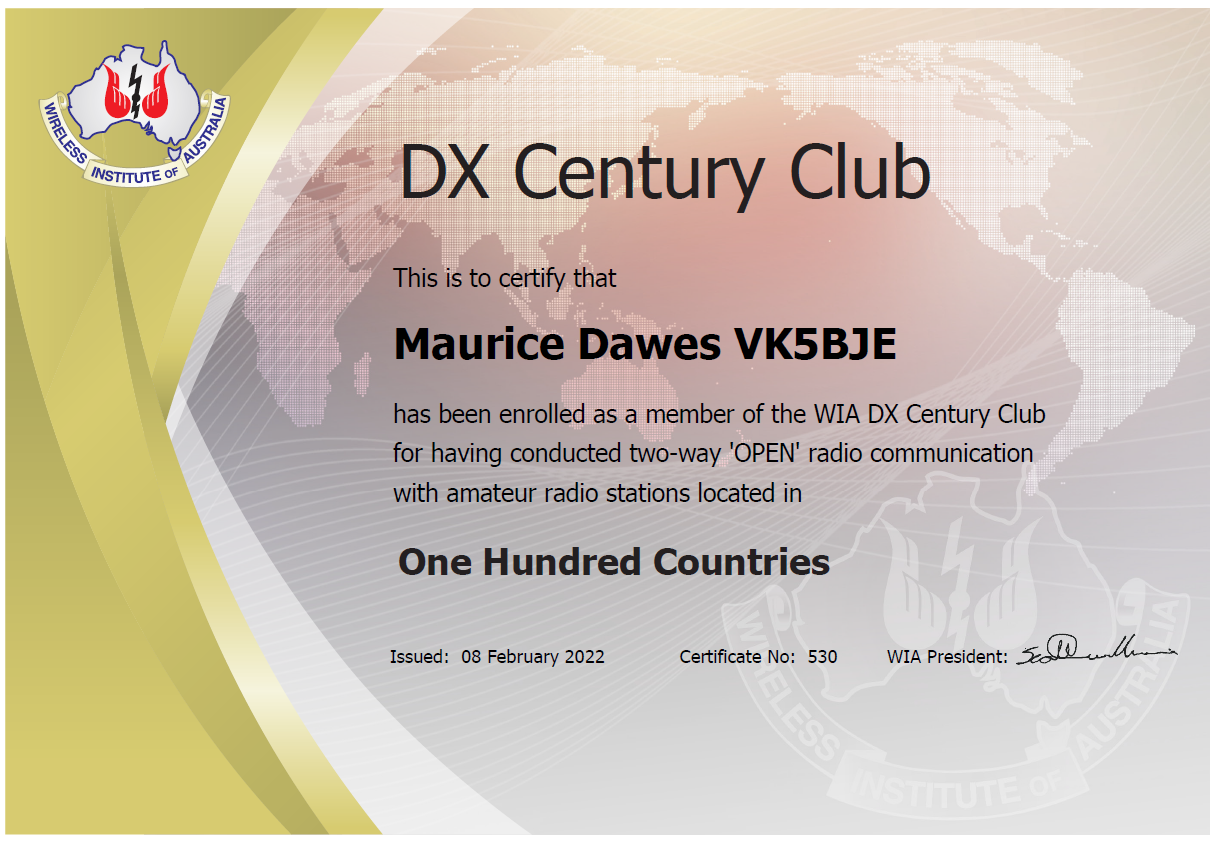
At long last: The Wireless Institute of Australia DX Century Club award for making contacts with amateurs in 100 countries! I have been an amateur since December 1976 but never had the time to become serious about DX. Radio filled the gaps left over after family, work, music and keeping fit took most of my time. Covid 19 has helped a bit by creating time as we have kept ourselves quarantined. I should also acknowledge Paul, VK5PAS, an avid DXer, who has encouraged me to keep going. The highlights include those made in my comments relating to the ARRL award, but as well I should say that chasing the DXpeditions has been fun.
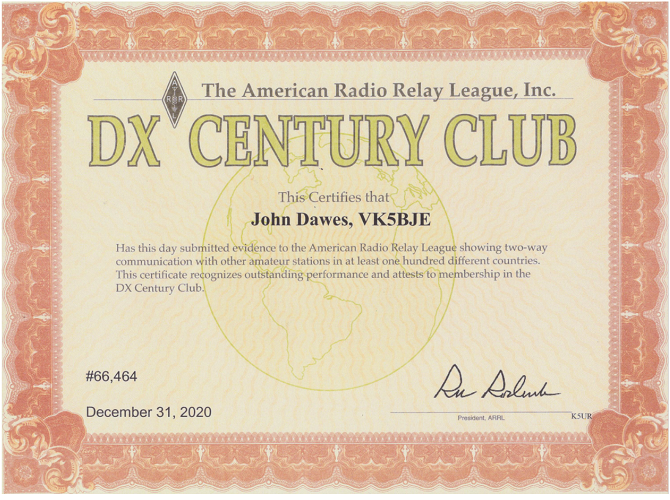
ARRl DX Century Club with my preferred name
This award was obtained relying on Logbook of the World confirmations only.
I woke to a hot, humid but dry day and very still. A mass of unstable, moist air, laden with storms and electrical activity stretched like a giant finger across the continent from the Kimberley in Western Australia towards Victoria. This tropical weather system impacted a swathe of country including bits of Queensland, New South Wales and the Australian Capital Territory, Victoria, South Australia and extending to Tasmania. It is called a La Ninia system. La Ninia in Australia is associated with increased rainfall and for a Hills dweller like me, reduces the fire risk in the Mount Lofty Ranges.
We have been in exile! Perhaps I mean in isolation? I really mean in self-imposed quarantine. My wife and I have taken responsibility for our own care during the pandemic. We are both triple vaccinated and we keep a low profile. I do walk everyday in one of our local conservation parks, dog and bike free, in theory. When I hear or see runners or bikes on the tracks and out of control dogs, I quickly step aside and give way. I wish the rangers were more prominent and issued more on-the-spot fines more often!
We decided to stay home for Australia Day. The word Australia derives from the Latin Terra Australis. Terra Australis was the name given to a possible great south land hypothesised by scientists and navigators. Matthew Flinders began using Australia in his writings from 1804 and popularised it. In 1824 the British Admiralty agreed to adopt the term Australia for the continent.
Australia as a nation was initially comprised of six self-governing colonies and Federation took place on 1st January 1901. Federation Day would make a less contentious day for Australia day than January 26th 1788, when New South Wales was established as a prison colony.
So for Australia Day I had the choice of entering into a new trial contest or getting on the bands and working a few stations. I chose getting on the bands and seeing how many stations I could work in just a few hours not as a block of time but in episodes that were convenient. No doubt the contesters have had a lot more contacts than me, but I am now in my ninth decade and am taking my life in a more leisurely way: playing radio, reading and writing and enjoying some music. I am vulnerable to Covid 19 because of my age and comorbidities. I prefer my real ham shack to the virtual ham shack in the sky!
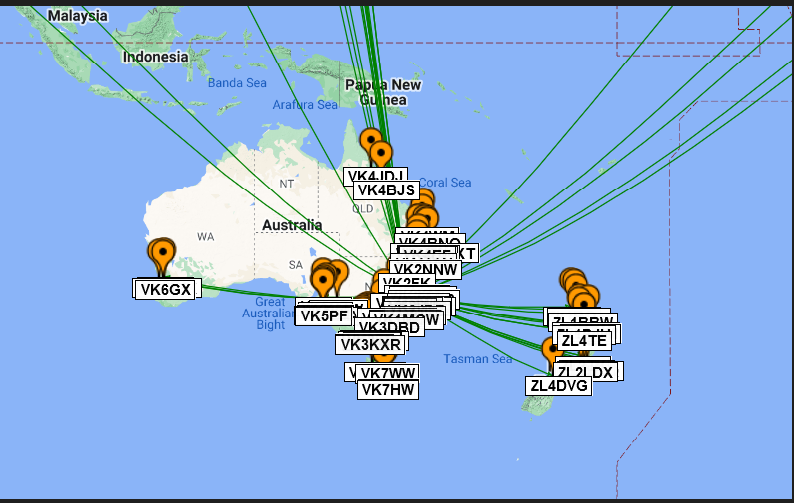
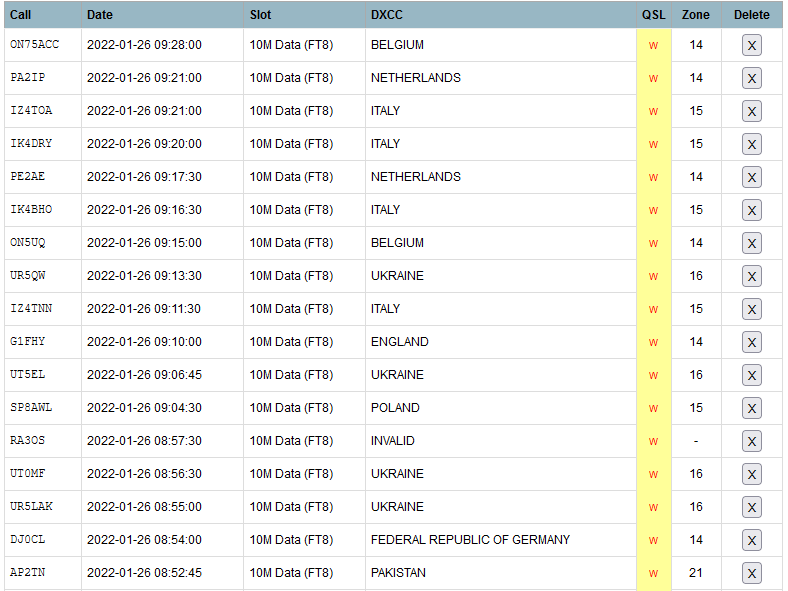
So I decided I would work on the 20, 15 and 10 metre bands over a number of time slots but the most active period was late afternoon and early evening when the 10 metre band opened to Europe. I enjoyed 102 contacts (qsos) with 17 countries. The late afternoon and early evening 10 metre band opening into Europe enabled my to increase my country count on this band. All contacts were made using the data mode of FT8.
Image from Club Log: the sprint on 10 metres (click to expand)
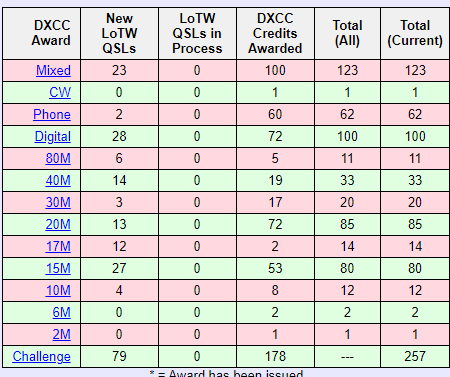
This image from Logbook of the World shows my current totals for all bands I operate. Club Log, which includes all my call signs, shows I now have 142 DX entities/countries confirmed.
I had a fun radio day and thank all the operators from overseas who now have AX5BJE in their logs.
The Australian prefix for amateur radio stations is VK. The Australian Media and Communications Authority (ACMA) sometimes allows the VI prefix to be used for special event stations. We are permitted to use AX on Australia Day and Anzac Day (25th April) and I chose to use the AX prefix for my station. I suspect it made a difference with more stations chasing me. The AX prefix is also permitted on World Telecommunications Day in May each year.


 vk5bje