Coopracambra National Park, 25th April 2014, VKFF-113

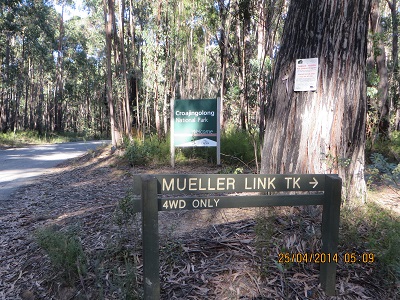
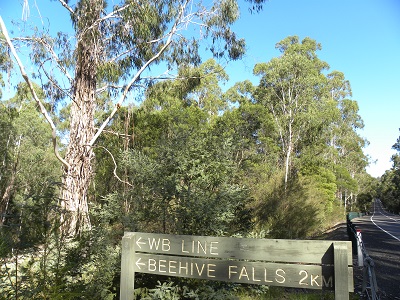
Today we returned to Victoria from Narooma in NSW. We took the Pacific Highway and not too far out of Bega turned right onto the Snowy Mountains Highway before turning South on the Monaro Highway and crossing into Victoria with the Park on the left hand side of the road. Not too far into Victoria we saw a sign giving access into the Park and indicating Beehive Falls about two kilometres further on. I found a good spot complete with picnic tables and no other homo sapiens. VK3PF, Peter, who has activated the Park twice recommended this spot. We had it to ourselves.

I set up and 23 contacts later packed up. I was really pleased with the activation. I used a new to me, but pre-loved Yaesu 897D, running about ten watts. I purchased this radio from a deceased estate in Sydney after seeing an advertisement in Amateur Radio Magazine for December/January. My son collected it about three weeks ago and this was the first time I had a chance to put it on the air. It will be used in the longer term at slightly higher power, say 30 to 40 watts, to give me a better chance of working DX from parks and giving chasers a better chance of hearing me from remote locations. I need to investigate a battery capable of supplying a higher current draw for a longer period if time, but still remaining ‘portable’. I will study the blogs of other amateurs to see what they use when using their FT897Ds on higher power in the field.

Beehive Falls turn-off at Coopracambra National Park

Beehive Falls turn-off at Coopracambra National Park

Here are my contacts: beginning at 02:16, VK3YY/P3, Glenn on VK3 VT 026; VK3MTB, Tim; VK3JNI/P, Tim at the Lakes National Park; VK3RAN, Tony; VK3PF/P3, Peter on VK3 VE 056; VK2IB/P3, Bernard also on VK3 VE 056; VK3FQSO, Amanda; VK3ZPF, Peter; VK2CCJ, Cliff; VK3ZPF, Peter; VK3BHR, Phil; VK3JD, John; AX2UH, Andrew; VK3MRG/P3, Marshall on VK3 VN 017; VK5PAS, Paul; AX2UH, Andrew; VK3FB/P3, Len; VK3TKK, Peter; VK3HRA, Allan; VK3ANL/P3, Nick on VK3 VE 039, The Hump, at Mount Buffalo National Park; VK3MRO, Tibor; VK2LAX, Rod and at 03:10, AX2CL/P2, operator Raffy at Club Station on Bear Island.

Eurobodalla National Park, 22nd April 2014, VKFF – 0164

I had a great time at Eurobodalla National Park just seven kilometres south of Narooma. I drove down a well-maintained track towards an inlet and while I was setting up a Sea Eagle flew circuits above me – I would like to think she/he was checking me out!  I was on the air at 00:56 and after checking the frequency called on 7.095 and was answered by VK2AFA/P2, Sam, on VK2/ CT – 002; then VK6MB/P2, Mike, as I have never heard him before barely a hop-step and jump away; VK5LY, Larry; VK5PAS, Paul; VK3PI, Mark; VK3UBY, Col; VK2LAX, Rod; VK2FW/P2, Ray; VK2CCJ, Cliff; VK3XL/P3, Mike, on SOTA summit VK3/ VC – 007 Mt Macedon; VK1MBE/P1, Andrew on VK1/ AC – 040 Mt Ainslee; VK1RX/P2, Al on VK2/ ST – 015; VK3AFW, Ron and VK3PF/3, Peter at 02:14 on VK3 /VG – 003. Fourteen contacts, some for a few minutes, has enabled me to qualify my first VK2 National Park for the VKFF award.

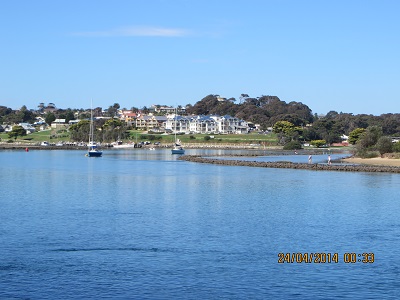
A view of Narooma near board-walk

A view of Narooma from board-walk

At Eurobodalla NP JCD photo

At Eurobodalla NP JCD photo

Eurobodalla National Park, of 3,069 hectares, on the far South Coast of New South Wales, has beaches, wetlands, spotted gum forests and a great home for water birds. It also contains significant Aboriginal and European cultural sites. While we have visited a number of National Parks in New South Wales this was the first time I really paid attention to the spotted gum.  These are magnificent trees.  I checked the NSW Government web pages for Parks and it indicates that there are close to 900 Parks and Reserves in that State. What a challenge for a Park activator!

Burrowa-Pine Mountain National Park, 19th April 2014, VKff-069

We accessed the Burrowa-Pine Mountain National Park by a road less travelled. Taking the first left-hand turn from the Murray Valley Highway onto Jeffcott-Jewells Road we made our way to the Park boundary and then followed the Black Mountain Track just past the Bush Rat Track and just short of the Ross Lookout. The track is a comfortable two wheel drive track and I selected a point where I could easily turn our 4 x 4.

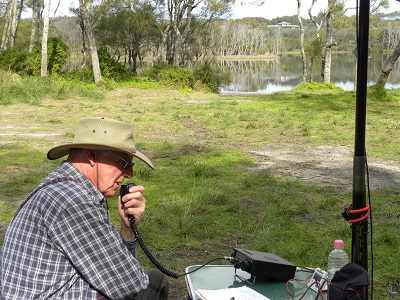
I used my tripod and nine metre squid pole and home-made linked dipole. I was hoping for a successful activation and my hopes were not dashed.

I began my day by calling VK2TWR/P2, Rod at 03:56, on SOTA summit VK2 SM 072 and then up five, VK3PF/P3, Peter on VK3 VE 072; VK2MT, Rob, on VK2 CT 001; VK3MTB, Tim; VK1MA, Matt; VK3VTH/P2, Tony in Ben Boyd National Park, VKFF026; VK3AMB, Bernard; VK3UBY, Colin; VK3XD, John; VK5PAS, Paul; VK2IB/P3, Bernard on SOTA summit, VK3 VE 082; VK3FIAN, Ian; VK3AFW, Ron; VK3ETC, Ethan; VK5KC, David; VK5CZ/M5, Ian; VK5FMID, Brian; VK2FLEX, Tim; VK3MNZ, Don; VK3XL, Mike; VK2IAX/P2, Richard; VK5LY, Larry; VK5NIG/P5, QRP, Nigel; VK2TWR/P2, Rod on VK2 SM 065; VK5GY/P5, Gordon at Bullock Hill CP and VK2IB/P3, at 05:43, Bernard on VK3 VE 061, making 26 contacts in all.

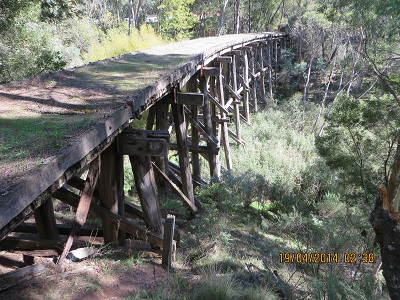
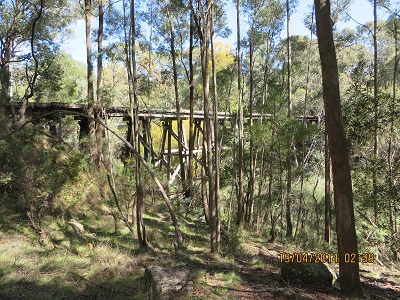
The Burrowa-Pine National Park was accessed fairly easily from the Murray Valley Highway, which traverses magnificent sub-alpine scenery. We were travelling from Shepparton to Corryong and the Park is just out of Corryong. We purchased our lunch in Wodonga and stopped to lunch at the Historic Trestle Bridge. I could not resist the temptation to take a photo of this trestle bridge on the Cudgewa Line. The line was closed on the 22nd January 1995. I have travelled to Cudgewa on a steam-hauled special train many years ago and it was an interesting experience to walk some of the road bed and experience the grades. The rail track bed is now called the High Country Rail Trail and we noticed many people using it: riding bikes, walking and walking dogs.

Historic trestle bridge on Cudgewa line

Historic trestle bridge on Cudgewa line

Another view of trestle bridge

.

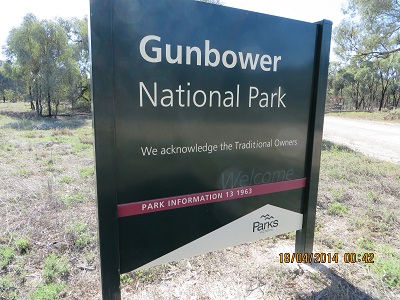
Gunbower National Park, 18th April 2014

Gunbower National Park

Gunbower National Park

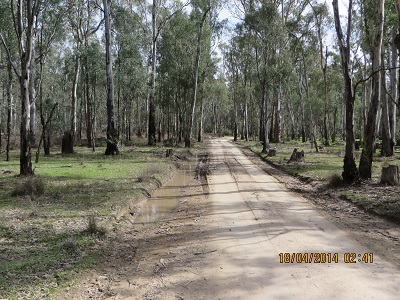
We approached this park from Cohuna. We called at the Information Centre to obtain a map of the park. We were also told that there had been about 60 millimetres of rain and that the track had been damaged. We found the track generally dry but soft on the shoulders with large patches of water remaining (see photo below).  We eventually came to a point where the track became a bog. We chose not to try and get through. After crossing the bridge at Gunbower Creek we followed the main road for just a few kilometres before taking the Nursery Track into the Park, then through the Gunbower State Forrest before emerging into the Park again near the Murray River. Nursery track is not clearly marked and we went just beyond the turnoff before noticing our error. The 4 x 4 just in front of us also made the same navigational error and on our way out of the Park we saw another car do the same thing. The Park sign is just too far off the road.

I chose spot away from campers on a ‘lawn’. The grass was green and the track dry. After setting up the squid pole on a stump and the linked dipole antenna in place I thought I would use the Ten Tec Argonaut V1. After checking 7.100 a few times I called CQ at 01:17 and was answered by VK3SRB/M2, Steve, near Parkes. Signals were good and after a short contact I worked VK5AR/M5, Allan; VK5FO/P5, Bob; VK5ZAR/P5, Arno in Clinton Conservation Park; VK5FMID, Brian; VK5PAS, Paul; VK5LY, Larry; VK5NJ, John; VK3AFW, Ron; VK3MQ, Rob; VK5MBD, Bill; VK3FQSO, Amanda, giving her a new Park; VK3BHR, Phil; VK3HRA, Allen; VK3UCD, David; VK2AWJ, John; VK3VZZ, Charlie; VK3AMB, Bernard; VK5NJ, John for a second time; VK2UH, Andrew; VK1MA, Matt; VK3TB,  and at 02:17 VK3GRW, Greg.  Twenty-three contacts in an hour I thought was great fun. Generally the band was quiet: there appeared to be few other signals on 40m, so thanks to all those who took time out to give me a call.

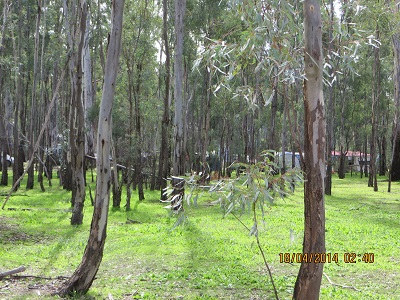
Easter campers among the trees

Easter campers among the trees

Nursery Track Gunbower National Park

Nursery Track Gunbower National Park

Hattah-Kulkyne National Park, 17th April 2014, VKFF – 231

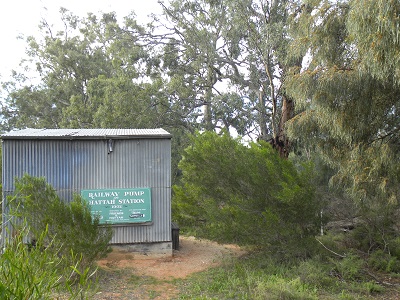
Hattah-Kulkyne National Park: old pump-house

Hattah-Kulkyne National Park: old pump-house

I activated the Hattah-Kulkyne National Park on the 17th April, en route to Narooma in New South Wales, via Ouyen, Shepparton and Corryong. The Park is large: about 50,000 hectares. We took the Hattah Nature Drive which begins at the Lake Hattah Visitor Centre and stopped at the old pump-house which has been restored by volunteers. It provided a great spot for my activation. I used the low-level fence around the car-park to support my squid pole.

The following contacts were made beginning at 06:20 UTC, VK3AMB, Bernard; VK5FAKV, Shawn; VK3FI, Noel; VK5LY, Larry; VK5KGP, Graham; VK5WK, Graham; VK5FEKH, Errol and VK4GJP, Geoff at 06:58. Eight contacts in 40 minutes and then the band went dead! However, there were plenty of nets in action although these don’t work well with QRP stations and I resisted the temptation to join various queues. Well it is a successful activation as far as the Keith Roget Memorial National Parks Award is concerned, but I needed another two contacts to creep over the line and count for the VKFF.

First year anniversary SANPCPA, 5th & 6th April 2014, Scott Creek Conservation Park

The 4th, 5th and 6th of April were set aside to celebrate the first anniversary of the SANPCPA award. It was a week end of exceptional activity especially on the 40 metre band. There were lots of activators, including some for the first time, and many chasers. My first contact was with VK5PAS/P5, Paul, who activated the Cox Scrub Conservation Park. I worked Paul from home. My last contact, from my home station, was on Sunday afternoon at 05:21 with VK5ARG/P5 (Amateur Radio Experimenters Group Inc.) Andrew at Belair National Park, 59 contacts later. These contacts included a number of new parks for me.

On Sunday morning local time, UTC 22:48 5th April 2014, I went back to Scott Creek Conservation Park, which I last activated on the 19th May 2013. I returned to Gate 8 on Mount Bold Road (See map on Friends of Scott Creek web page – link below). My equipment this time was a home made linked dipole for 20 and 40 metres and the Ten Tec Argonaut V1 (model 539).  Power was drawn from a 8.4 amp hour LIfePO4 battery, which was more than adequate for this activation. About one hundred metres inside the park there is a plateau which makes a fine activation spot. I enjoyed 52 contacts, including a number of new Parks and also with VK3PF/P3, Peter, on VK3 VC 001, Mount Matlock.

Here are my contacts: VK5NQP/P5, David at Cromer CP; VK5KET/P5, Andrew at Telford Scrub CP; VK5KC, David; VK5WG, Nev; VK3FQSO, Amanda; VK5GJ, Greg; VK5FMID, Brian; VK5LY/P5, Larry at Lowan CP; VK5PAS/P5, at Deep Creek CP; VK5AV, Tim; VK2AWJ, John; VK5IS, Ian; VK3AMB, Bernard; VK3UBY, Col; VK3CAT, Tony; VK3VIN, Ian; VK4FR/P5, Chris; VK5JP, Peter; VK5KRF/P5, Peter at Winninowie CP; VK5KGP, Graham; VK5KLV/P5, Winninowie CP; VK5DT, Darren;  and VK5FTRG/P5, Tom at Furner CP.  Then after UTC rollover, VK3VTH/P5, Tony at Carpenters Rocks CP; VK5FTRG/P5, Tom at Furner CP; VK5PAS/P5, Paul at Deep Creek CP; VK5ARG/P5, Andy at Horsenell Gully CP; VK5KLV/P5, Les at Winninowie CP; VK3CAT, Tony; VK5VCO/P5. Paul at Clinton CP; VK5KX/P5, Peter; VK5AV, Tom; VK5DJ, John; VK5LY/P5, Larry at Ridley CP; VK5TRM, Rob; VK2UH, Andy; VK5FMID, Brian; VK5NRG, Roy; VK5KET/P5, Andrew at Nene Valley CP; VK5LY/p5, Larry at Ridley CP; VK5NQP/P5, David at Charleston CP; VK5MJP, Patrick; VK5NE, Paul; VK5ZGY/P5, Greg at Naracoorte Caves NP; VK5ZAR/P5, Arno at Black Hill CP; VK3LY/M3, Bill at Yannack; VK3PF/P3, Peter at VK3 VC001, Mt Matlock; VK5MR/P5 Andrew at Tandappa CP; VK5HCF/P5, Col at Hacks Lagoon CP; VK5FTRG/P5, Tom at Reedy Creek CP; VK5PAS/P5, Paul at Eric Bonython CP and VK5STU/P5, Stu at Port Gawler CP.

Thanks to all those amateurs who gave me a call. It is greatly appreciated and I didn’t think Scott Creek Conservation Park would be so popular as the park has been activated three times: twice by me and once by VK5PAS, Paul.

Scott Creek History

Scott Creek History

Marie Steiner’s excellent book, published in 2000,  contains a wealth of research about the various sections of land which were incorporated into  Scott Creek Conservation Park, gazetted in 1985. ‘The Land Acquisition Act, passed in 1969′ (Steiner, 2000, p. 7), provided the basis for the State Government to pursue the long-term water needs of the community by purchasing the private land in the area now included in the Park. Not all of the land was in private hands but clearly the majority. Steiner’s (2000) book traces the challenges and hardships of trying to make a living on rocky, steep and, in places, infertile land.

The land was acquired to extend the catchment for the Mount Bold Reservoir, including the size of the dam. The plan was later modified because of unstable geological features which could lead to failure of a larger water holding.

The Crooked Chimney, Scott Creek CP

The Twisted Chimney, Scott Creek CP

The Twisted Chimney, for example, was on a holding of 17 and a quarter acres, Section 1190.  Steiner (2000, p. 53) sketches the history of the occupation of this section and others.  Such a long history, of 150 years of human occupation and endeavour, is reflected in the challenges of living in the area and the gaps in knowledge. She asks how could such a large parcel of land with this history, come to be created a conservation park (Steiner, 2000, p. 55)? Her answer is that ‘Scott Creek Conservation Park contains some of the most diverse and interesting areas of indigenous vegetation left within the Mount Lofty Ranges’ and that much of it ‘survived the impact of settlement’.

Remains of a tractor

Remains of a tractor

The picture shows the remains of a tractor, ‘discovered’ following a spraying of blackberries by the Friends of Scott Creek Conservation Park. http://www.users.on.net/~dld/Friends%20of%20scott%20creek/Website/

SA Water land (left) and Scott Creek CP (right)

SA Water land (left) and Scott Creek CP (right)

This picture shows the two fire breaks, one each side of the fence, separating the Park from SA Water land.

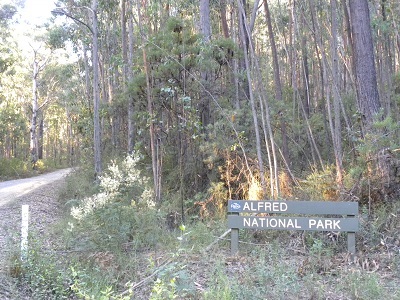
Mark Oliphant Conservation Park, 10th March 2014

I went back to Mark Oliphant Conservation Park today, 10th March 2014. It was my second activation. My first was on 21 May 2013 (see blog for August 14th 2013). VK5PAS, Paul, encouraged me to become active today, and we did manage a Park to Park contact. Paul was in the Onkaparinga River National Park. I chose a position not far from my first activation spot. I only managed eight contacts. I thought the band was in reasonable condition and I called CQ frequently. My first contact was with VK5PAS/P, Paul at Onkaparinga National Park; VK5EMI, John; VK5KGP, Graham; VK5WG, Nev; VK3BHR, Phil; VK5NWE, Roger; VK5MBD, Bill and VK5EMI, John for a second time.

May be I was a bit tired. Yesterday I attended the first VK5 SOTA & Parks Symposium. This was organised by VK5PAS and the Adelaide Hills Amateur Radio Society Inc. It was a great day. It was my privilege to present two papers: the first was on using Lithium chemistry batteries and the second, on preparing to purchase an ‘Adventure Radio’.  So today I operated using my 8.4 amp hour LIFePO4 battery. I used the battery last night for an hour or so running a five watt FM radio in DStar Hot Spot service and also for today’s activation and the voltage still reads 13.01 volts. I am really happy with this and with a smaller battery, 4.8 amp battery as a back-up and a similar size LiPO and should be able to save my back! I am looking forward to some cooler days and some hiking!

Tasmania, February 2014

We arrived home on Friday 28th February. We had a great time and I wish to thank all of the amateurs with whom I had contacts. Working with five watts is always a challenge and it was magnified, particularly from the southern end of the state and when conditions were poor on the bands. Nevertheless I was able to tally 134 contacts. I activated 11 parks, two of them twice, from different locations, and visited a number of places I had not been before and enjoyed some tourist experiences.

Tasmanian National Parks, minus Macquarie Island, Tasmanian National Parks Service

Tasmanian National Parks, minus Macquarie Island, Tasmanian National Parks Service

Here is my list:

Narawntapu National Park 6th and 7th February, 11 contacts

Rocky Cape National Park, 9th and 10th February, 8 contacts

Cradle Mountain Lake St Clair National Park, 13th February, 10 contacts

Franklin – Gordon Wild Rivers National Park, 13th February, 10 contacts

South West National Park, 14th February 5 contacts

Franklin – Gordon Wild Rivers National Park, second activation, 14th February, 8 contacts

South Bruny National Park, 16th February, 24 contacts

South Bruny National Park, 17th February, second activation, 4 contacts

Tasman National Park, 19th February, 3 contacts

Maria Island National Park, 21st February, 12 contacts

Freycinet National Park, 21st February, 8 contacts

Douglas – Apsley National Park, 22nd February, 13 contacts

Mount William National Park, 12 contacts

All contacts have been transposed into Ham Radio Deluxe and up-loaded to Log Book of the 
World. 

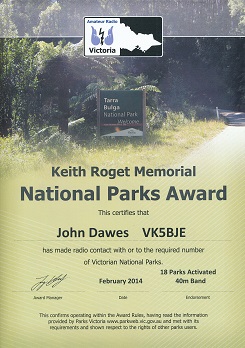
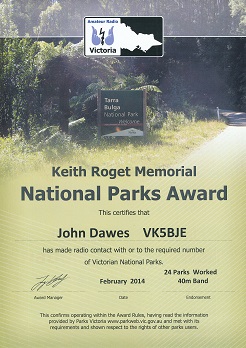
I received a pleasant surprise when I arrived home: I now have the Keith Roget Memorial National Park Award from Amateur Radio Victoria. Eighteen parks activated and 24 parks worked: I still have a long way to go!

Keith Roget Memorial National Parks Award - activator

Keith Roget Memorial National Parks Award – Activator

Keith Roget Memorial National Parks Award - Activator

Keith Roget Memorial National Parks Award – Hunter

Mount William National Park, 23rd February 2104, VKFF – 366

All good things must come to an end! Today was the end of my VK7 National Parks activations. Our holiday is over. We set off from St Helens this morning over gravel roads, in good condition generally, for Mount William National Park. This park is in the north east of the State and includes Eddystone Lighthouse. The Parks brochure suggested that the Park has a great diversity of wildlife, including Tasmania’s only kangaroo species, the Forrester, although the other iconic species, the Tasmanian Devil is now not common due to the facial tumour disease which has been devastating. The Parks authorities suggest ‘that the large population of marsupials has combined with previous farming practices to maintain large areas of open lawn‘. We did not find any of those areas probably because they are away from roads.

We travelled to the day area and boat ramp, but too many people were present and I thought taking over a picnic table, together with my voice, might be too intrusive, so we back-tracked down the road for about four kilometres to a disused gravel pit.

Reflections at a water hole: a river crossing in the Park

Reflections at a water hole: a river crossing in the Park

This became my base. I set up my full QRP station with tripod and squid pole. I was fortunate to make over ten contacts on 40 metres: 23:15, VK5LY/P3, Larry in Chiltern-Mt Pilot National Park; VK2TWR/P2, Rod on VK2 SW 001; VK3FQSO, Amanda; VK3AFW, Ron; VK3PF, Peter; VK5ZLT/P3, Alan; VK2FALL, John; VK3HRA, Allan on VK3 VS 014; VK5PAS, Paul; VK5HCF, Col and VK3ZPF/P3, Peter in the Point Nepean National Park.

Mount William National Park: note the blue signs

Mount William National Park: note the blue signs

Douglas Apsley National Park, 22nd February 2014, VKFF – 145

I was a bit sceptical about the likely success of an activation extending over the mid-day period with propagation as it is! But I managed 12 contacts and therefore gained sufficient points for the VKFF requirements. My first contact on 7.100 was with VK1RX/P1, Al, on SOTA summit VK1 AC 001; then VK2QR/P2, Rod on SOTA summit VK2 SM 006; VK3PF/P3, Peter on VK3 VT 017 also in the Alpine National Park; VK7FGGT, Greg; VK2IB/P3, Bernard, on SOTA summit VK3 VE 041; VK3ZFP, Peter in the Brisbane Ranges National Park; VK3FLAK, Bob; VK3FQSO, Amanda; VK3APC/P3, on VK3 VC 025; VK3ZPF, Peter; VK3AMB, Bernard and, finally, a great contact with VK2TPM, Peter running 20 watts on 14.210, with a FT897D and a balcony antenna. Taking out the duplicates I finished with 12 contacts and a successful activation for the VKFF award. The VKFF number is VKFF145.

Douglas-Apsley National Park is mid-way up the East Coast of Tasmania. I cannot find a description of how it obtained its name in any of the official literature on the park. But a good explanation is that the hyphenated name is created from the names of the two rivers which flow through the Park: the Douglas and the Apsley. The Park is described as a dry eucalypt forest. I activated from a corner of the car park at the Apsley water hole. When I finished my activation I enjoyed the walk to the water hole: perhaps about 15 minutes. It was occupied by a ‘loud’ family which ensured that any wild-life in the area would probably go somewhere else. The family had a radio, not wireless, with blaring pop music at a high level! I reflected on an experience at Maria Island where my activities attracted the attention of officialdom. A vehicle arrived at my operating position when I was trying a difficult contact. Up went the background noise! One of the staff members asked what I was doing. After providing an explanation of my activities and showing him my log book, and my information sheet, he relaxed a little. However, he suggested that I should have sought out the rangers and gained permission before undertaking my activities. In the mean-time half an hour had elapsed. I wonder if the family at Douglas-Apsley gained permission from the rangers to enable them to ‘take over the water-hole’? In fairness to the Tasmanian Parks staff at Maria Island, seeing me in action was a first! They knew nothing about amateur radio and the Parks programs in Victoria and South Australia. The field is wide open for the Tasmanian amateurs to consider developing a program.