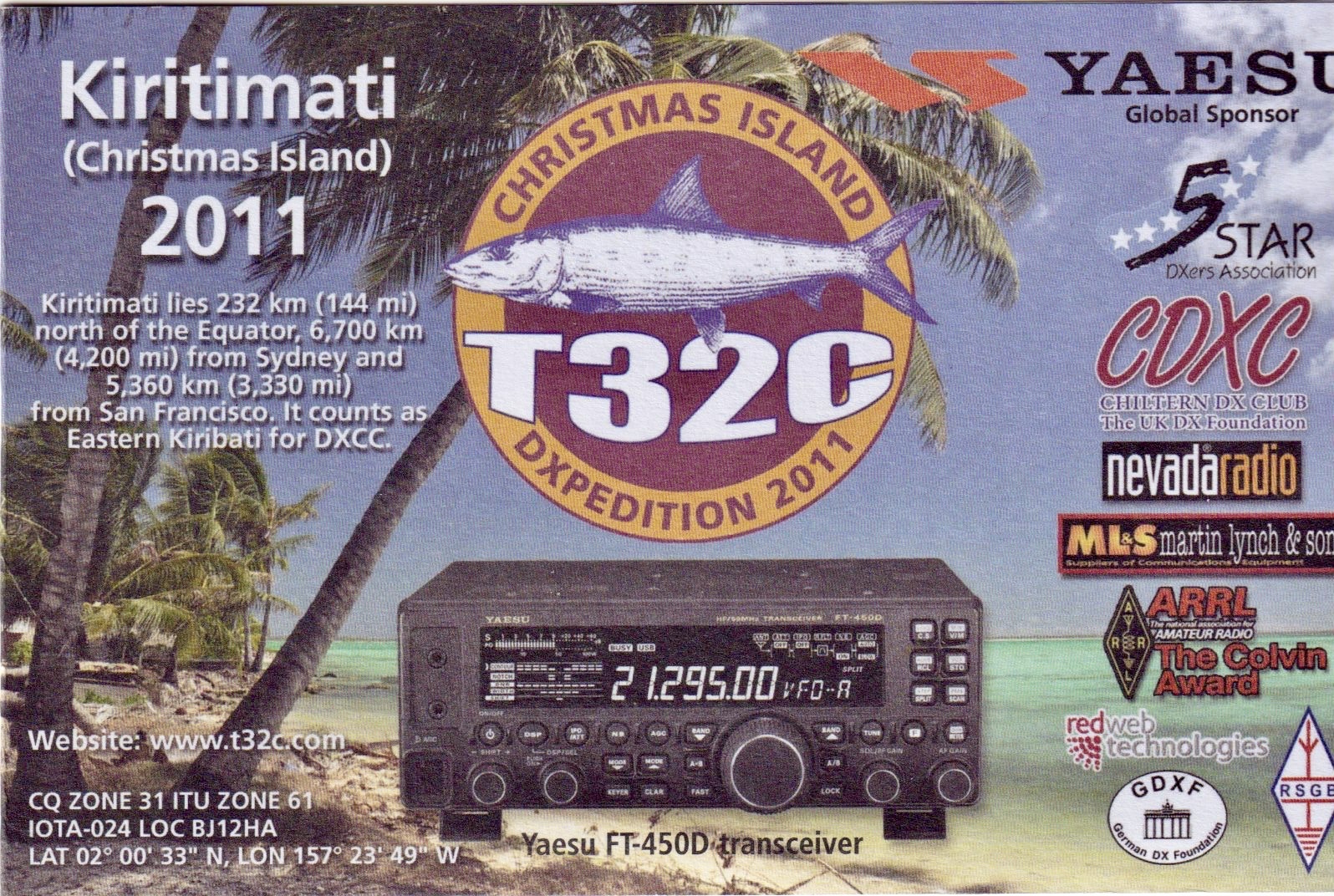
T32C QSL card, better late than not at all, 31st December 2025

T32C, is the call-sign of a DXpedition station to Kiritimati (Christmas Island) and counts as Eastern Kiribati for the DXCC. Kiribati or more correctly, the Republic of Kiribati, is in the Pacific Ocean and should not be confused with Christmas Island in the Indian Ocean, an overseas territory of Australia. This was a 24 day event held late in 2011, that is, 15 years ago. I was delighted to receive the card on the last day of the year, and its arrival was totally unexpected. The QSL card is four-sided and contains quite a bit of information about the DXpedition.

The LOTW entry matches the card and records four contacts: two on 28 MHz (10 metre band) and one each on 21 MHz (15 metres) and 14 Mhz (20 metre band).

Side two shows that the DXpedition made 213,116 contacts over 24 days and details of the station and antennas together with radio operators are also shown. It is an impressive and detailed QSL card, Sides three and four show further information about the DXpedition and lists the major sponsors and supporters. It would have been an expensive exercise and amateurs around the world took up the challenge of a contact (or more) to get the call T32C in their logs. Thanks to all concerned.

.

 Call signWorkedDate/TimeBandModeFreqQSL
DetailsVK5BJET32C2011-10-08 03:02:0010MSSB 
DetailsVK5BJET32C2011-10-08 05:12:0020MSSB 
DetailsVK5BJET32C2011-10-10 02:38:0010MSSB 
DetailsVK5BJET32C2011-10-11 03:02:0015MSSBEASTERN KIRIBATI

Here is (above) an extract from my Log Book of the World (LOTW) of my four contacts as listed in the QSL card. I was given credit for Eastern Kiribati for my ARRL DXCC.
T32C, pick of the bunch in a QSL card mailout, 31st December, 2025.

I received a small parcel of QSL cards from the VK5 inwards bureau. I enjoy receiving QSL cards and I usually have a quick scan to see what riches have arrived. T32C ‘takes the cake’ this time and I have written a separate post on this card.

Here I want to acknowledge the work of the inwards bureau. This service for VK5 (South Australia) is provided by one of the SA radio clubs: AREG or the Amateur Radio Experimenters Group Inc. The person behind all the work is VK5GR, Grant. I know from past practice that Grant has a small team to assist him in this task. Grant told the members a few days ago that he had mailed about 30 kilograms of cards through Australia Post to other SA Clubs and their members as well as AREG members. Thank you Grant. And I am pleased to be a member of AREG.

This card took 14 years to arrive at my QTH. I earned my credit for KIRITIMATI when the contact was confirmed as shown in the extract from my LOTW below! So the card is a bonus: four sides (the front shown below) sides two and three show information about the station and my four contacts and the last page has a number of photos of the Dxpedition members.

New Query

4 Records Shown (1-4)
Sorted by QSO Date (0.008312 seconds elapsed)

 Call signWorkedDate/TimeBandModeFreqQSL
DetailsVK5BJET32C2011-10-08 03:02:0010MSSB 
DetailsVK5BJET32C2011-10-08 05:12:0020MSSB 
DetailsVK5BJET32C2011-10-10 02:38:0010MSSB 
DetailsVK5BJET32C2011-10-11 03:02:0015MSSBEASTERN KIRIBATI

Most recent QSO record received 2024-04-20 01:54:02Z

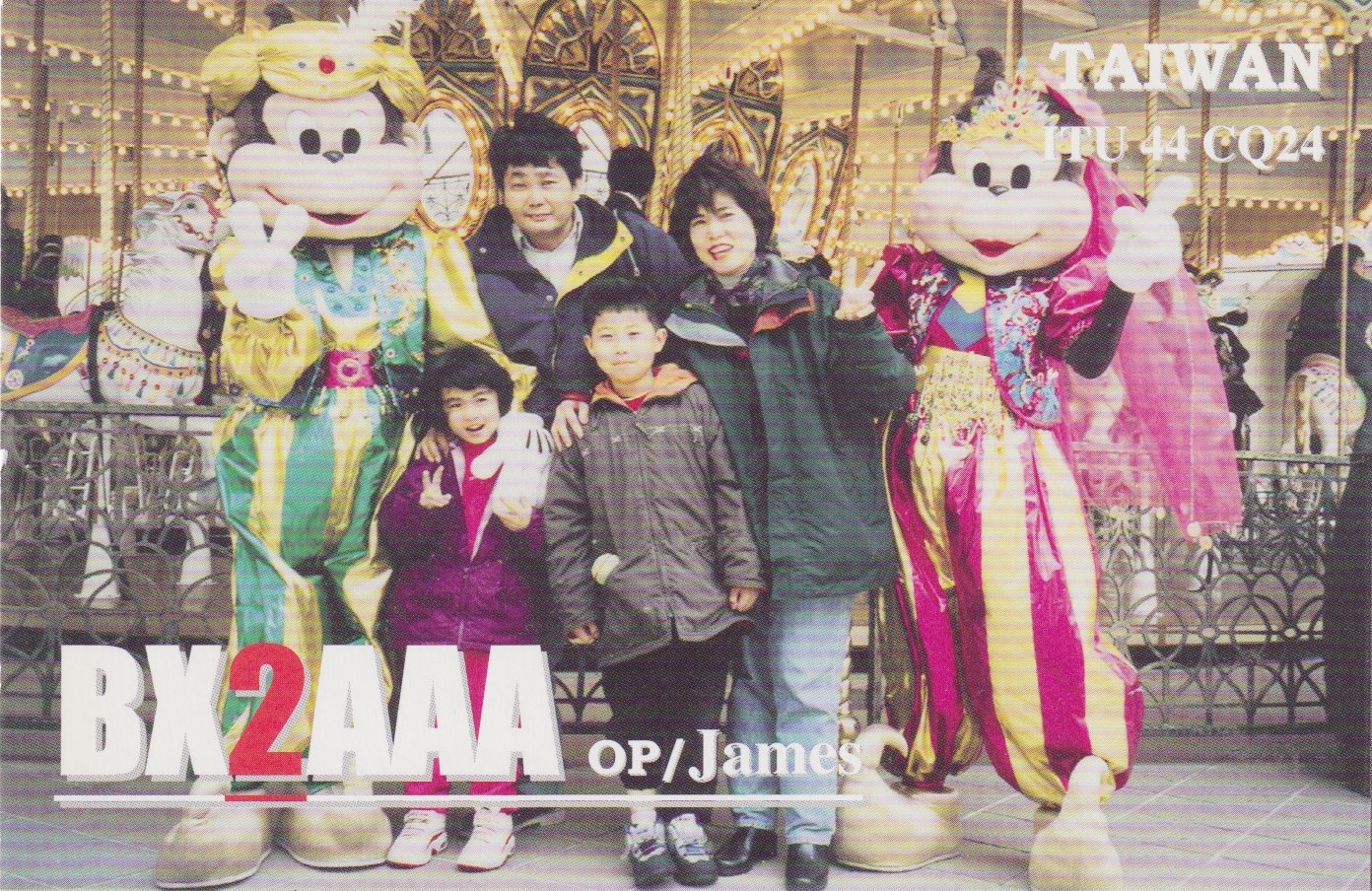
BX2AAA, rtty contact 26th February 2017.

The QSL card featured confirms a radio-teletype contact I had with a Taiwanese station on 26th February 2017. This is my one and only teletype contact. I use the Ham Radio Deluxe software package for log-keeping. The package also includes various communications programs for computer sending and receiving of morse-code, rtty and use of amateur satellites.

I typed in a CQ call, repeated three times, wound back the power of my transmitter (rtty is a key down methodology and I treated my radio as if I was transmitting FT8 or even AM), Imagine my surprise when my first call was answered by James, BX2AAA – the 15 metrre band was quiet, or so I thought! Signals were 599 both ways.

My reservation about rtty and FT4 is that they both require the operator to have reasonable typing skills, including accuracy. I don’t qualify. I have been around the sun 84 times and I have a health condition that is not working in my best interests. I will stick with radio telephony and radio telegraphy, that is, voice and morse code (cw) using a paddle.

Thanks Grant (VK5GR) for the encouragement.

New Query from LOTW

2 Records Shown (1-2)
Sorted by QSO Date (0.011680 seconds elapsed)

 Call signWorkedDate/TimeBandModeFreqQSL
DetailsVK5BJEBX2AAA2017-02-26 01:23:0015MRTTY21.09400 
DetailsVK5BJEBX2AAA2022-01-11 10:37:3040MFT87.07616 

Here is an extract from my log in the ARRL Logbook of the World. It shows I have had two contacts with this station, the second more recently, in 2022, using FT8. All good fun!

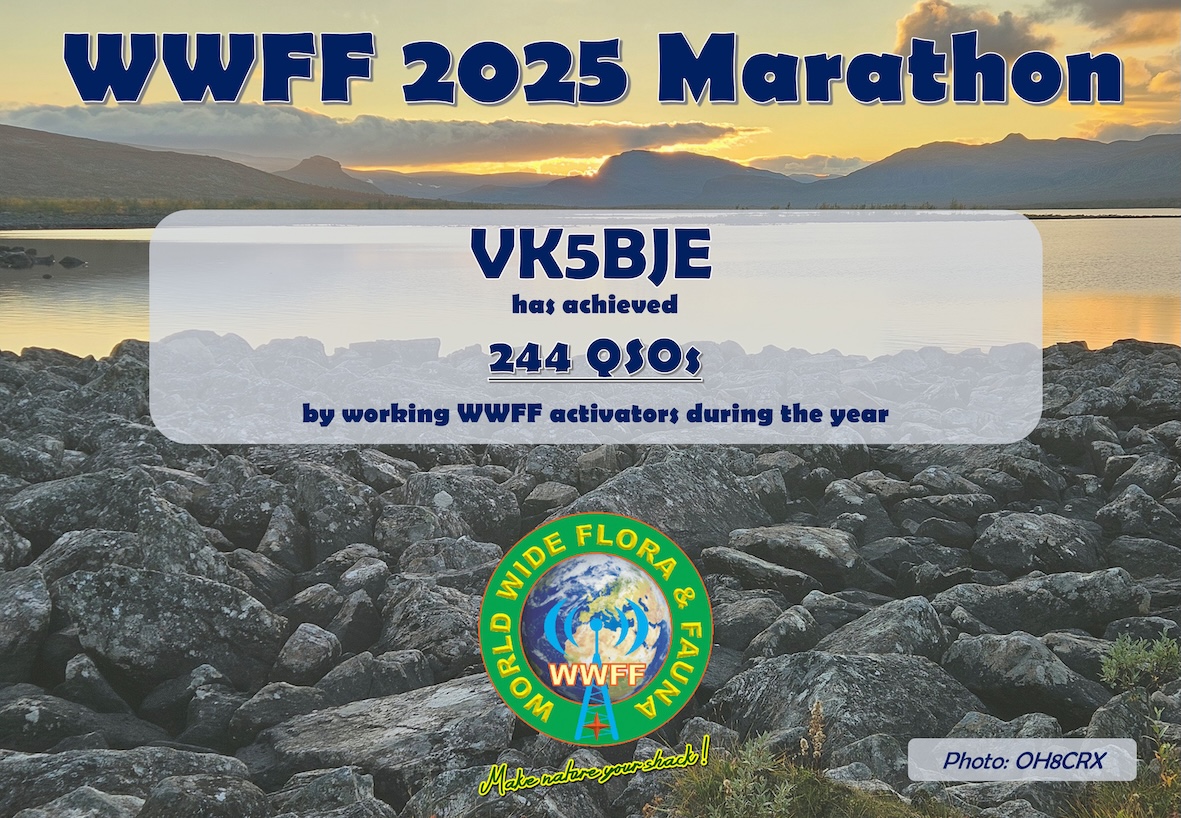
WWFF my annual contribution for the year, 16th February 2026

My annual contribution to the wwff program in 2025 was wholly on the chaser side of the ledger. I was unable to get into the field for an activation. I still hold a desire to get out into the bush, set up my station and call CQ. My wife Jenny and I have made some excursions to some local parks: to check out suitable locations. I need level ground and smooth surfaces – not always available in parks. The very hot summer has been a bit off-putting!

I also disposed of my Mazda 2. My Grand-daughter in Sydney is the new owner. Getting in and out of the vehicle was just too hard. Mr P remains a constant and unwelcome companion

Challenges in HF Radio: Navigating Changing Band Conditions, 10th February 2026

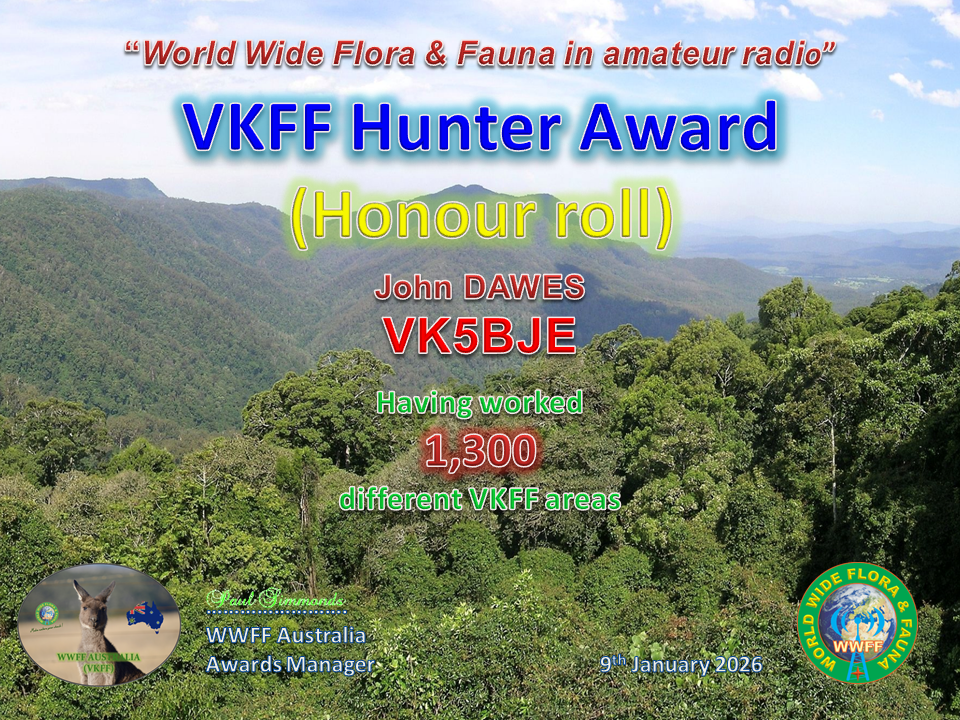
I was pleased t receive this award soon after the one before. The bands were alive in 2025, but it is a different story now. I am finding it very difficult if not impossible to work stations in New South Wales and Victoria in daylight. There seems to have been plenty of action on the sun, flares and storms, often generating auroras and beautifal skies but challenging conditions for HF radio operators.

Hunter Award 1300 contacts

Chasing activators has become more challenging in 2026 as a result of changing band conditions. The sun has become active. This activity, including flares and storms, affects users of the high frequency radio spectrum and can lead to radio blackouts where signals are not heard or heard only intermittently with increased noise.

Noise generated by human activity (QRM) increases the noise floor, that is, the background noise heard before a wanted signal is found. The background noise makes ‘copying’ the wanted signal harder to hear whilst competing with the noise. The QRP and weak signals heard and copied during daylight hours was common place, now it is very difficult or impossible and I spend more time on the higher bands where I have more success.